S&P 500 — US Large Cap Index
 FTSE 100 — UK Blue Chips
 Euro Stoxx 50 — Eurozone Leaders
 DAX 40 — German Equities
 CAC 40 — French Market Index
 Nikkei 225 — Japan Benchmark
 Hang Seng — Hong Kong Index
 Shanghai Composite — China Mainland
 ASX 200 — Australian Market
 TSX Composite — Canada Index
 Nifty 50 — India Large Cap
 STI Index — Singapore Market
 KOSPI — South Korea Index
 Bovespa — Brazil Equities
 JSE Top 40 — South Africa Index
 IPC Index — Mexico Market
Cocoa Price Forecast: Cocoa Recovers From 8-Week Lows as Dry Weather and West African Crop Risks Support Prices

Today Markets Analysis
Cocoa prices recovered from eight-week lows on Monday as short-covering emerged amid concerns that forecast dry weather in the Ivory Coast could place additional stress on cocoa trees and reduce yields during the 2026/27 crop season. December ICE NY cocoa settled 24 points higher at 5,354, while December ICE London cocoa #7 gained 27 points to 3,948.
The recovery comes after cocoa prices came under significant pressure during the previous three weeks as evidence of stronger production from the Ivory Coast and rising exchange inventories encouraged bearish sentiment. However, the market is now balancing those supply improvements against growing concerns about the next West African crop, particularly as weather conditions, disease and poor pod development become increasingly important to the outlook.
The fundamental picture remains mixed. Current-season production in the Ivory Coast and Ghana has been strong, while ICE inventories have reached their highest level in two years. At the same time, early assessments of the 2026/27 Ivory Coast and Ghana crops point toward potentially lower production, while the prospect of El Niño-related heat and dryness adds a medium-term supply risk.
Cocoa Market Snapshot
| Market Factor | Latest Development | Price Impact |
|---|---|---|
| December NY Cocoa | +24 points, +0.45% | Bullish |
| December London Cocoa | +27 points, +0.69% | Bullish |
| Ivory Coast 2025/26 harvest | 2.06 MMT, +30% y/y | Bearish |
| Ivory Coast port shipments | 2.14 MMT, +18% y/y | Bearish |
| ICE Cocoa Inventories | 3.43 million bags | Bearish |
| Ghana 2026/27 estimate | 650,000 MT, -13% y/y | Bullish |
| Ivory Coast early 2026/27 estimate | ~1.8 MMT, -18% y/y | Bullish |
| Global 2026/27 surplus – StoneX | 25,000 MT | Mixed/Bullish |
| Global 2026/27 surplus – Transgraph | 80,000 MT | Mixed |
| Q2 European grindings | -4.6% y/y | Bearish |
| Q2 North American grindings | +7.7% y/y | Bullish |
| Q2 Asian grindings | +25% y/y | Bullish |
Cocoa Prices Today: Short-Covering Follows Eight-Week Low
December NY cocoa and December London cocoa both moved higher on Monday as traders responded to forecasts for drier conditions in the Ivory Coast.
The move represents a recovery from the recent eight-week lows and suggests that traders are beginning to reassess the downside after the market’s three-week decline.
The immediate catalyst is weather. Dry conditions at this stage of the crop cycle can reduce soil moisture, increase stress on cocoa trees and potentially damage yield prospects. This has encouraged short-covering as traders consider whether the recent decline has already priced in much of the current-season production improvement.
However, the recovery does not remove the bearish supply evidence currently weighing on the market.
Ivory Coast Production Creates Bearish Pressure
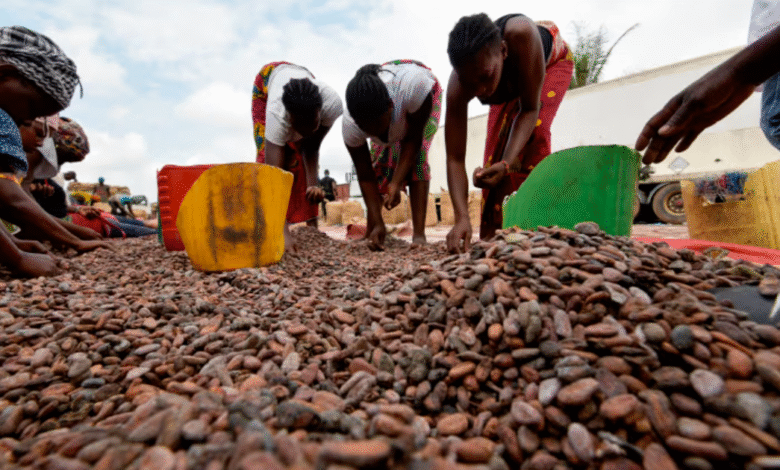
The Ivory Coast remains the most important factor for global cocoa supply, and production data for the current season has been particularly strong.
The Ivory Coast cocoa regulator, Le Conseil du Café Cacao, reported on September 2 that the country harvested 2.06 million metric tons of cocoa between June 2025 and June 2026. That represented an increase of approximately 30% from the 1.58 million MT harvested a year earlier.
Strong production has contributed to expectations that global cocoa availability is considerably better than during the severe supply shortages that pushed prices to record levels during the previous El Niño-related crisis.
Bloomberg also reported that Ivory Coast farmers had shipped approximately 2.14 million MT of cocoa to ports during the international cocoa marketing year through September 13, an increase of 18% from the corresponding period a year earlier.
There is, however, an important calendar distinction.
The Ivory Coast changed its domestic marketing year this year to begin on September 1, while the international cocoa marketing year traditionally begins on October 1. Reuters reported that under the Ivory Coast’s new marketing-year calendar, deliveries during September 1-13 were approximately 26,000 MT, down 45.8% from the comparable period of the previous season.
This creates some uncertainty when comparing shipment statistics across the two reporting systems.
Cocoa Inventories Reach Two-Year High
Exchange inventories remain another major bearish factor.
ICE cocoa inventories climbed to approximately 3,436,742 bags on September 4, the highest level in two years. Stocks were still close to that level at approximately 3,431,944 bags on Monday.
Higher certified inventories indicate that immediately available cocoa supplies are substantially more comfortable than during the extreme shortage conditions seen previously.
For the futures market, continued inventory accumulation could limit the upside unless physical demand strengthens or expectations for the 2026/27 crop deteriorate materially.
The inventory trend will therefore remain one of the key indicators for traders assessing whether the recent recovery represents the beginning of a broader reversal or simply a temporary correction.
West African Weather Creates New Supply Risk
The medium-term outlook is becoming more complicated.
Cocoa prices had previously reached an 11.75-month high on August 31 in New York and an 11.75-month high in London on September 1, partly because of concerns about the quality of the upcoming West African crop.
Cloudy weather and limited sunshine across the Ivory Coast and Ghana have created conditions favourable for black pod disease, which can damage cocoa pods and reduce bean quality.
The combination of disease and weather stress is particularly important because the market is now transitioning from assessing the strong 2025/26 crop toward determining the potential size and quality of the 2026/27 main crop.
Ivory Coast 2026/27 Crop Outlook
Early surveys of the Ivory Coast crop have provided a more supportive signal.
Initial assessments reportedly show below-average cherelle formation on cocoa trees. Cherelles are young developing cocoa pods, and poor formation can signal weaker production later in the season.
Early estimates have placed Ivory Coast’s 2026/27 production around 1.8 million MT, approximately 18% below the estimated 2.2 million MT produced during 2025/26.
If this reduction is confirmed, the market could move from a period of abundant current-season supply toward tighter conditions during the next marketing year.
That transition is one of the most important bullish arguments currently supporting cocoa.
Ghana Production Risks Increase
Ghana provides another potentially significant source of supply pressure.
Ghana’s Cocoa Board said on August 20 that its field survey indicated a 2026/27 crop of approximately 650,000 MT, down 13% from 750,000 MT in 2025/26.
COCOBOD subsequently projected on July 30 that 2026/27 production could potentially fall to between 450,000 and 550,000 MT, compared with approximately 750,000 MT projected for 2025/26.
The lower projections have been attributed to a combination of swollen shoot disease, aging cocoa farms and potentially adverse El Niño weather conditions.
However, Ghana’s current-season production remains strong. COCOBOD reported on August 26 that approximately 750,000 MT had already been harvested during the 2025/26 season, up 25.6% from 597,000 MT in 2024/25.
This creates an important distinction for traders: current supply is strong, but forward supply expectations are deteriorating.
Global Cocoa Balance Becoming Tighter
Global balance estimates also provide some support to the medium-term cocoa outlook.
StoneX reduced its forecast for the 2026/27 global cocoa surplus to only 25,000 MT, down sharply from its previous estimate of 149,000 MT. The revision reflected increased risks to West African production and expectations for El Niño-related weather.
Transgraph Consulting also expects the global surplus to narrow substantially, forecasting an 80,000 MT surplus in 2026/27, compared with 415,000 MT in 2025/26.
Its forecast assumes global cocoa production will decline to approximately 4.87 million MT, compared with 5.11 million MT in 2025/26.
The important point is that neither forecast currently signals a major global deficit. Instead, the market appears to be moving toward a much smaller surplus, leaving cocoa prices increasingly sensitive to any additional production disruption.
El Niño Remains a Medium-Term Bullish Risk
Weather is likely to become increasingly important as the 2026/27 season progresses.
The US Climate Prediction Center said on July 8 that the El Niño pattern emerging across the equatorial Pacific could become one of the strongest in more than 75 years.
Historically, El Niño can contribute to warmer and drier conditions in West Africa. For cocoa producers, this can reduce soil moisture, increase tree stress and negatively affect yields.
The effect will ultimately depend on the intensity, duration and geographic distribution of the weather pattern. Nevertheless, the possibility of a significant El Niño provides cocoa with an important medium-term supply risk.
Cocoa Demand Sends Mixed Signals
Demand remains less straightforward.
European cocoa grindings fell 4.6% year-over-year to 316,366 MT in Q2, according to the European Cocoa Association. The decline was larger than the expected 1.5% reduction and represented the weakest second-quarter grinding volume in six years.
That is a significant bearish demand signal because Europe remains one of the world’s major cocoa processing regions.
However, North American and Asian processing data provide a contrasting picture.
The National Confectioners Association reported that North American Q2 cocoa grindings increased 7.7% year-over-year to 109,659 MT, substantially outperforming expectations for a 1% decline.
Asian cocoa grindings were even stronger, increasing 25% year-over-year to 224,646 MT, according to the Cocoa Association of Asia.
Consequently, the demand picture is not uniformly weak. European consumption and processing remain under pressure, but stronger North American and Asian grinding figures suggest that global demand has not collapsed.
Bullish Sentiment
1. Dry Ivory Coast Weather
Forecast dry conditions in the Ivory Coast are encouraging short-covering and raising concerns about crop stress during the early stages of the 2026/27 season.
2. Lower West African Crop Expectations
Early assessments point toward weaker production in both the Ivory Coast and Ghana, creating a potentially tighter supply environment ahead.
3. Ghana Production Risks
Swollen shoot disease, aging farms and possible El Niño weather effects could significantly reduce Ghana’s 2026/27 production.
4. El Niño Weather Risk
A potentially strong El Niño creates a longer-term threat to soil moisture and cocoa yields across West Africa.
5. Smaller Global Surplus
StoneX and Transgraph both expect the global cocoa surplus to shrink substantially during 2026/27.
6. Strong Asian and North American Demand
Q2 grinding data from Asia and North America showed substantial year-over-year growth, offsetting some of the weakness seen in Europe.
Bearish Sentiment
1. Strong Ivory Coast Current-Season Production
Ivory Coast harvested 2.06 MMT, up approximately 30% year-over-year, demonstrating the strength of current supply.
2. Higher Ivory Coast Shipments
Shipments during the international marketing year were reported at approximately 2.14 MMT, up 18% year-over-year.
3. Two-Year-High ICE Inventories
ICE cocoa inventories remain near 3.43 million bags, providing evidence of significantly improved available supply.
4. Strong Ghana 2025/26 Crop
Ghana has harvested approximately 750,000 MT during the current season, representing a 25.6% increase from the previous year.
5. Weak European Grindings
European Q2 grindings fell 4.6%, reaching their lowest Q2 level in six years and highlighting ongoing demand pressure.
6. Short-Term Correction Risk
Cocoa’s recent recovery follows a sharp decline and could attract additional selling if inventories continue rising or production data remain strong.
Cocoa Price Forecast: What Traders Are Watching
The cocoa market is currently caught between strong current-season supply and increasingly uncertain forward production.
The bearish case centres on high Ivory Coast production, strong Ghanaian output, elevated ICE inventories and weaker European processing demand. These factors provide evidence that physical availability has improved considerably from the extreme shortage conditions of previous years.
The bullish case is increasingly focused on the next crop. Poor cherelle formation, disease risks, lower Ghana production estimates and potential El Niño-related dryness could reduce 2026/27 output.
As a result, cocoa prices may remain highly sensitive to incoming weather and crop-development reports.
A sustained recovery would require evidence that the next crop is deteriorating sufficiently to offset the current inventory surplus. Conversely, continued strong arrivals and stable weather could keep the market under pressure.
Cocoa Supply Outlook
The supply outlook is likely to become increasingly dependent on the transition between the 2025/26 and 2026/27 seasons.
Current production remains strong, particularly in the Ivory Coast and Ghana. However, early indications for the next season are less encouraging.
The market therefore faces a potential timing mismatch: abundant nearby supply versus potentially tighter forward supply.
This can create significant volatility because futures traders must continually adjust expectations as weather, disease and crop-development data become available.
Cocoa Demand Outlook
Global demand remains mixed rather than uniformly weak.
Europe is showing clear signs of pressure, with Q2 grinding volumes falling sharply. However, North American grindings increased 7.7%, while Asian grindings surged 25%.
This divergence means cocoa demand needs to be monitored region by region rather than judged solely through European processing figures.
If Asian and North American demand remains strong while West African production declines, the smaller projected global surplus could disappear more quickly than currently expected.
Cocoa Market Outlook for the Coming Sessions
Near-term cocoa trading is likely to remain driven by the interaction between weather forecasts, West African arrivals, ICE inventories and technical short-covering.
The immediate recovery from eight-week lows indicates that traders are responding to the prospect of crop stress in the Ivory Coast. However, inventories near a two-year high provide a substantial counterweight.
The market could therefore remain volatile as traders weigh two competing narratives: strong current supply versus potentially weaker 2026/27 production.
For the coming sessions, fresh weather developments in the Ivory Coast and Ghana will be particularly important. Any evidence of worsening dryness or disease could strengthen the bullish narrative, while continued strong arrivals and rising inventories would reinforce the bearish case.
Currency Hedger View
For businesses exposed to cocoa prices, the current market highlights the importance of managing both commodity-price risk and currency exposure.
Cocoa is globally traded in US dollars, meaning that changes in the dollar can materially affect the effective cost of cocoa purchases for businesses operating in euro, sterling or other currencies.
Currency Hedger provides managed FX services for business and personal clients, helping clients manage international currency requirements alongside their wider financial planning.
For companies purchasing cocoa, food ingredients or other commodities internationally, managing the underlying currency exposure can help provide greater visibility over future costs when commodity prices are already volatile.
Today Markets View
Cocoa has moved into a particularly sensitive phase of the 2026/27 outlook.
The current fundamental picture still contains significant bearish elements, particularly strong Ivory Coast production, elevated ICE inventories and weak European grindings. However, the forward supply outlook is becoming more supportive as early crop assessments point toward weaker production in the Ivory Coast and Ghana.
The central question for cocoa traders is whether the expected decline in the 2026/27 crop will be large enough to absorb the substantial inventories accumulated during the stronger 2025/26 production cycle.
Bullish sentiment is being driven by dry-weather risks, disease, poor pod development, lower Ghanaian production forecasts and El Niño concerns. Bearish sentiment remains centred on high inventories and strong current-season West African production.
This leaves cocoa positioned between improving near-term availability and increasing medium-term production uncertainty, with weather and crop-development data likely to determine the next major directional move.
Louis Roche, Analyst, Today Markets
Disclaimer: Today Markets is a division of Octalas Group Ltd. The information provided is for general market commentary and educational purposes only and does not constitute investment, financial, trading or other professional advice. Market prices can move rapidly and past performance is not indicative of future results. Currency Hedger is a division of Octalas Group Ltd and provides information relating to foreign exchange and currency management services. Readers should conduct their own research and seek independent professional advice where appropriate.