S&P 500 — US Large Cap Index
 FTSE 100 — UK Blue Chips
 Euro Stoxx 50 — Eurozone Leaders
 DAX 40 — German Equities
 CAC 40 — French Market Index
 Nikkei 225 — Japan Benchmark
 Hang Seng — Hong Kong Index
 Shanghai Composite — China Mainland
 ASX 200 — Australian Market
 TSX Composite — Canada Index
 Nifty 50 — India Large Cap
 STI Index — Singapore Market
 KOSPI — South Korea Index
 Bovespa — Brazil Equities
 JSE Top 40 — South Africa Index
 IPC Index — Mexico Market
JPY sticks to disappointing domestic data-inspired losses against a recovering USD

- The Japanese Yen attracts sellers for the second straight day in reaction to disappointing domestic data.
- The optimism over the resumption of US-China trade talks further undermines demand for the safe-haven JPY.
- The divergent BoJ-Fed expectations should limit JPY losses and cap USD/JPY ahead of the US NFP report.
The Japanese Yen (JPY) sticks to modest intraday losses led by the disappointing release of Japan’s Household Spending data released earlier this Friday. Adding to this, the optimism over the resumption of US-China trade talks and a positive risk tone turn out to be other factors undermining demand for the safe-haven JPY. This, along with a modest US Dollar (USD) uptick, lifts the USD/JPY pair back closer to the 144.00 mark during the Asian session.
Any meaningful JPY depreciation, however, still seems elusive in the wake of the growing acceptance that the Bank of Japan (BoJ) will continue raising interest rates. This marks a big divergence in comparison to bets that the Federal Reserve (Fed) will lower borrowing costs further this year, which should cap the USD and support the lower-yielding JPY. This warrants caution for the USD/JPY bulls ahead of the US Nonfarm Payrolls (NFP) report.
Japanese Yen bulls remain on the sidelines in the wake of weaker data, trade optimism
- Government data released earlier this Friday showed that Japan’s Household Spending unexpectedly fell by 0.1% from a year earlier in April as compared to the 2.1% increase recorded in the previous month. On a monthly basis, spending declined more than anticipated, by 1.8% during the reported month.
- The monthly wage data released on Thursday showed that real wages in Japan fell for a fourth consecutive month in April as rising prices continued to outpace pay hikes. This could further undermine private consumption, which contributes to over 50% of Japan’s GDP, and trigger an economic recession.
- The US Treasury Department, in its exchange-rate report to Congress, said on Thursday that the Bank of Japan should continue to proceed with monetary tightening. The report argued that doing so would support a healthier exchange rate and facilitate needed structural adjustments in trade flows.
- Japan reportedly is softening its stance on the 25% US auto tariff and instead is proposing a flexible framework to reduce the rate based on how much countries contribute to the US auto industry. Japan’s chief tariff negotiator, Ryosei Akazawa, is in Washington for the fifth round of talks with US officials.
- Meanwhile, US President Donald Trump and Chinese President Xi Jinping spoke on Thursday and agreed that officials from both sides will meet soon for more talks to resolve the ongoing trade war. Trump said that the call was focused almost entirely on trade and resulted in a very positive conclusion.
- The US Dollar remains close to its lowest level since April 22 touched the previous day amid increasing odds of an interest rate cut by the Federal Reserve in September. Traders, however, seem reluctant to place aggressive bets around the USD/JPY pair ahead of the US Nonfarm Payrolls (NFP) report later today.
USD/JPY needs to surpass the 100-SMA on H4 to back the case for further appreciation
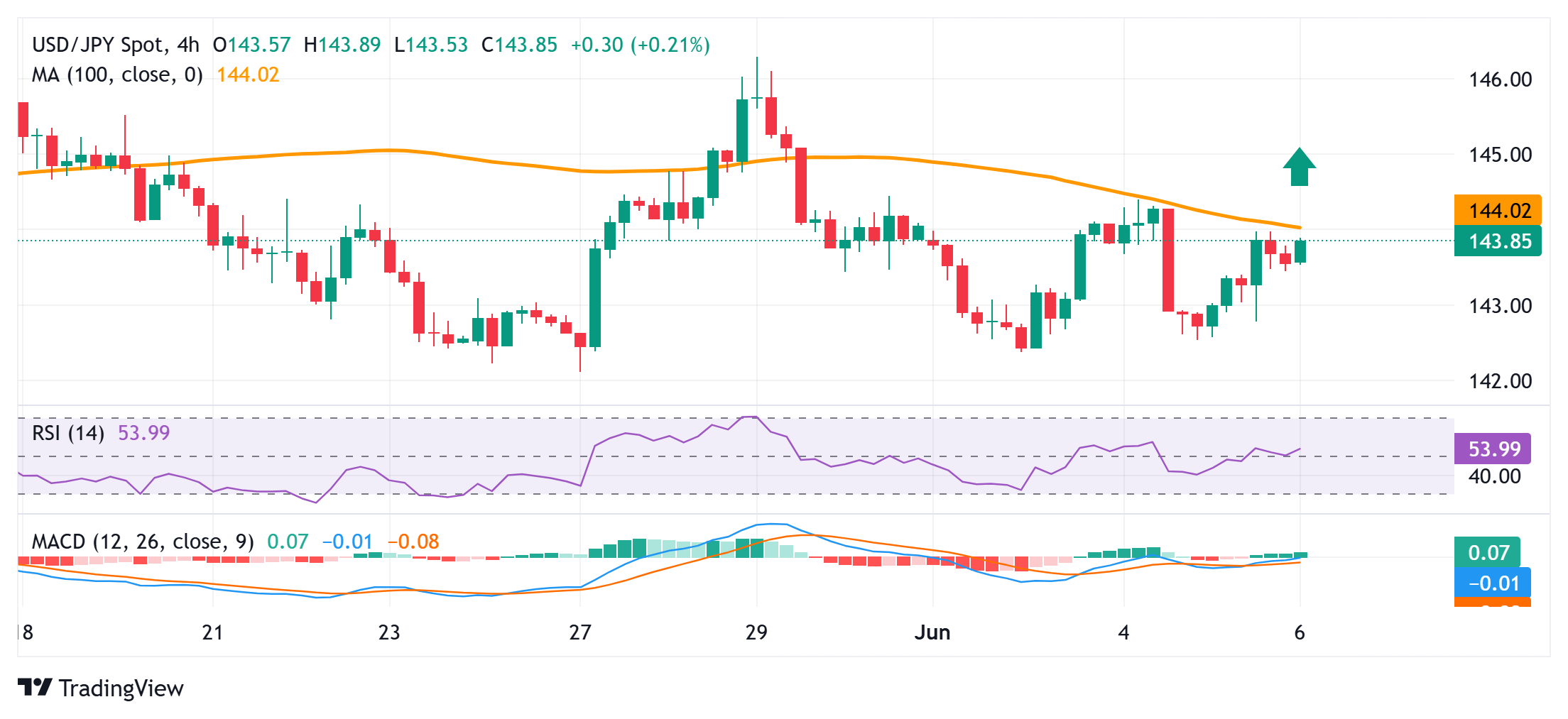
From a technical perspective, the USD/JPY pair has been oscillating in a familiar range since the beginning of this week, forming a rectangle on the daily chart. Against the backdrop of the downfall from the May monthly swing low, this might still be categorized as a bearish consolidation phase. Moreover, slightly negative oscillators on the daily chart suggest that the path of least resistance for spot prices is to the downside. Hence, any further move up is more likely to attract fresh sellers near the 144.00 round figure.
This is followed by the weekly high, around the 144.40 region. The latter coincides with the 100-period Simple Moving Average (SMA) on the 4-hour chart, which if cleared might shift the bias in favor of bullish traders and allow the USD/JPY pair to reclaim the 145.00 psychological mark.
On the flip side, weakness below the 143.50-143.45 area could be seen as a buying opportunity near the 143.00 round figure. Some follow-through selling, leading to a subsequent slide below the 142.75-142.70 region, could make the USD/JPY pair vulnerable to accelerate the downfall to the 142.10 region, or last week’s swing low. A convincing break below the latter could make spot prices vulnerable to the recent downward trajectory and slide further to the next relevant support near the 141.60 area en route to sub-141.00 levels.