S&P 500 — US Large Cap Index
 FTSE 100 — UK Blue Chips
 Euro Stoxx 50 — Eurozone Leaders
 DAX 40 — German Equities
 CAC 40 — French Market Index
 Nikkei 225 — Japan Benchmark
 Hang Seng — Hong Kong Index
 Shanghai Composite — China Mainland
 ASX 200 — Australian Market
 TSX Composite — Canada Index
 Nifty 50 — India Large Cap
 STI Index — Singapore Market
 KOSPI — South Korea Index
 Bovespa — Brazil Equities
 JSE Top 40 — South Africa Index
 IPC Index — Mexico Market
Samsung Enters the Era of “Physical AI” and Robotics; Shares Rise 3%


Samsung Electronics (SMSN.UK) has officially announced the establishment of a new strategic unit— Robotics eXperience (RX) . This move is a clear signal that the South Korean giant is no longer treating robotics merely as a side research project and is moving into a phase of aggressive commercialization. Investors reacted to the news with great enthusiasm—the company’s shares on the Seoul Stock Exchange jumped by nearly 6.8%, and its global depositary receipts (GDRs) traded in London are up 3% today. Here are the key takeaways from today’s announcement and the reasons why this decision is so important for the company’s future:
Direct supervision by the CEO and strategic transfers
The RX Division will not be just another isolated branch within the corporate structure. The new unit reports directly to the CEO (TM Roh), which underscores its status as an absolute priority. Equally important, Samsung has made a major addition to its leadership team. The Robotics Strategy Team is now headed by Lee Dong-kun — a manager who was previously responsible for robotics strategy at Hyundai Motor Group, including setting the direction for the development of Boston Dynamics, which they acquired. This shows that Samsung is focusing on people with proven experience in commercializing advanced systems.
Physical Artificial Intelligence as a New Engine of Growth
The company is focused on developing humanoid robots that combine AI software with advanced mechanics (known as “Physical AI”). Samsung’s strategy involves a very pragmatic, two-step approach:
- Industrial phase: Initially, robots are designed to increase productivity and the level of automation in factories.
- Consumer phase: Ultimately, the technology is intended for use in retail and in our homes, where machines will serve as assistants to support our daily lives.
Substantial Capital and the Construction of the “Data Factory”
Robot control algorithms require vast amounts of real-world data. To achieve this, Samsung has announced plans to establish a so-called “Data Factory” at its facilities in Gumi. It will serve as a center for collecting and analyzing data from real-world industrial environments. This project is part of a massive investment package. Samsung plans to invest as much as 60 trillion won (approx. $40.7 billion) in South Korea’s Yeongnam region. Of this amount, 19 trillion won will be allocated to infrastructure for physical AI and the construction of facilities to manufacture humanoid robots, with support from Samsung SDS. However, the company is not limiting itself to its home market. It has announced plans to open dedicated research centers in the U.S., China, and Japan to tap into local talent and advanced innovation ecosystems.
Summary for Investors
Today’s stock gains in London and Seoul reflect a shift from the announcement phase to the implementation phase. Following last year’s increase in its stake in Rainbow Robotics, today’s launch of the RX division is a logical—and very costly—step toward revenue diversification. Samsung recognizes that the smartphone and consumer electronics markets are becoming saturated, while the semiconductor market continues to show some signs of cyclicality, albeit disrupted by the AI “super trend.” AI-powered automation offers companies the opportunity to tap into a completely new and powerful revenue stream for decades to come.
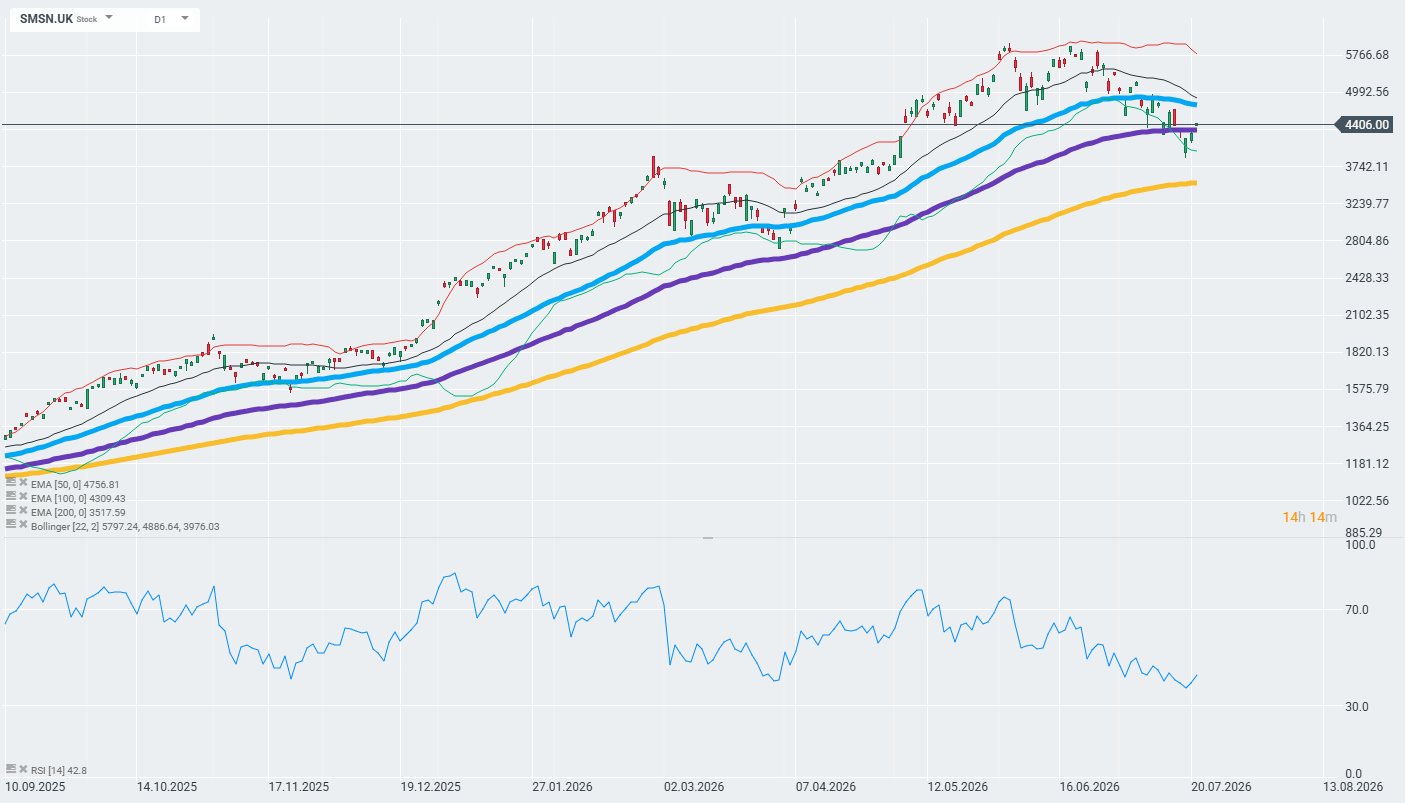
When analyzing the company’s stock price chart, a long-term uptrend can be observed, which, following a recent correction, found strong support at the 4,406 level and at the 100-period EMA (purple line). The price recently tested the lower Bollinger Band at the 22-day moving average with a ±2 standard deviation, which signaled a short-term oversold condition in the market and resulted in a dynamic rebound visible on the most recent green candle. The RSI indicator confirms this return of buying strength, rebounding from a zone close to oversold (around 30 points) and currently trending upward at 42.8. Source: xStation