S&P 500 — US Large Cap Index
 FTSE 100 — UK Blue Chips
 Euro Stoxx 50 — Eurozone Leaders
 DAX 40 — German Equities
 CAC 40 — French Market Index
 Nikkei 225 — Japan Benchmark
 Hang Seng — Hong Kong Index
 Shanghai Composite — China Mainland
 ASX 200 — Australian Market
 TSX Composite — Canada Index
 Nifty 50 — India Large Cap
 STI Index — Singapore Market
 KOSPI — South Korea Index
 Bovespa — Brazil Equities
 JSE Top 40 — South Africa Index
 IPC Index — Mexico Market
SpaceX shares continue to soar! The stock is up nearly 30% since its record-breaking IPO


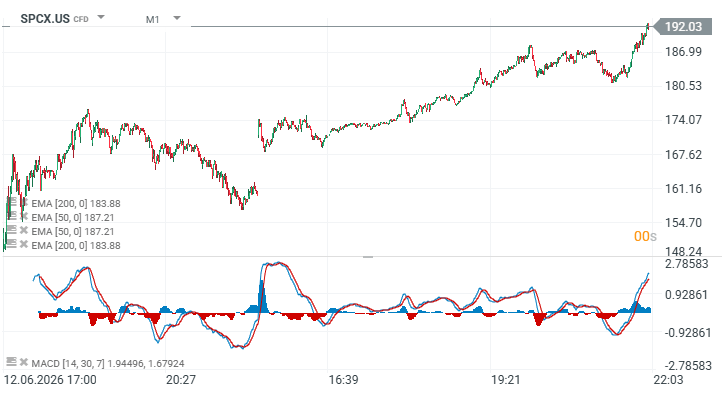
SpaceX shares have already gained nearly 30% since their debut last Friday, and the magnitude of the rally has been remarkable. The stock is trading another 3% higher in premarket today, approaching the $200 mark and implying a market capitalization of roughly $2.6 trillion. Meanwhile, critics arguing that the valuation has become detached from reality continue to make their case, but ultimately they are not the ones buying the stock. There is no such thing as a maximum share price, and supporters of the “space revolution” appear willing to pay almost any price for a stake in Elon Musk’s flagship company.
SpaceX: The Fundamental Analysis is Hard
The bull case rests on several powerful arguments: SpaceX’s dominance in orbital launch services, the enormous barriers to entry facing potential competitors, the company’s technological leadership, and the strategic importance of the Starlink network. The conflict in Ukraine alone demonstrated the practical value of Starlink’s capabilities. All of this, combined with Elon Musk’s charisma, ambitious vision, and a corporate mission that appeals to many investors beyond purely financial considerations, has resulted in an extraordinary valuation premium that appears difficult to justify through traditional fundamental analysis.
That does not necessarily mean the stock cannot continue to rise, nor does it predetermine an eventual market failure. It is entirely possible that SpaceX will continue to defy conventional valuation frameworks for an extended period. However, if broader market sentiment deteriorates, economic reality could eventually catch up with the company. Corporate insiders remain subject to lock-up restrictions and will be unable to sell shares for several more months.
If SpaceX stock were to double from current levels and reach $400 per share, the company would, all else being equal, surpass Nvidia in market capitalization. Yet SpaceX reported a net loss of $4.94 billion in 2025, following net income of less than $800 million in 2024, while Nvidia generated more than $120 billion in net profit in 2025 alone, representing annual growth of 64%. It is difficult to say how high SpaceX shares can climb and whether a $3 trillion valuation is within reach in the near future. One thing is clear, however: from today’s already extreme levels, every additional move higher pushes the story further into territory that many investors would consider increasingly detached from traditional valuation metrics.
Reporting on Its Own Terms?
Following its public market debut, SpaceX appears eager to establish its own rules for investor relations. The company plans to publish financial results exclusively on its corporate website and on X, bypassing traditional newswire services. This represents a departure from the standard communication model used by most public companies, which typically distribute earnings releases through major wire services and specialized financial information providers. For investors, the move means greater reliance on communication channels controlled directly by the company.
For SpaceX, the strategy may provide greater control over messaging, publication timing, and the presentation of financial information. The downside is that some market participants, particularly those relying on traditional financial information systems, could face reduced accessibility to corporate disclosures. The decision is consistent with Elon Musk’s broader communication style, which has long favored direct engagement with investors and the public through X rather than conventional media channels.
SpaceX shares (SPCX.US), M1 timeframe
Source: xStation5