Recent threats by President Trump toward Canada, involving the potential imposition of 100 percent tariffs on all Canadian goods, demonstrate that trade is no longer serving purely economic purposes and has become a tool of foreign policy. The Ottawa–Beijing agreement, which reduces tariffs on canola and electric vehicles, has become a pretext for escalating rhetoric that could have far-reaching consequences for the stability of North American markets.
The key destabilizing factor is not the sheer scale of potential tariffs, but the unpredictability of actions and the lack of clear rules. This situation generates heightened volatility in currency, commodity, and trade markets. In particular, the USD/CAD pair may experience significant pressure. The risk of tariffs threatens Canadian exports and economic growth, weakening the Canadian dollar against the US dollar. At the same time, Canada is a major exporter of oil and metals, so trade disruptions impact commodity prices, further affecting the exchange rate.
Rising uncertainty leads to short-term spikes in USD/CAD volatility, especially when new information emerges regarding potential tariffs or statements from the White House. The risk of retaliatory measures by Canada and the renegotiation of the USMCA, the North American free trade agreement between the US, Canada, and Mexico, adds to instability, creating pressure both for the strengthening of the US dollar and for fluctuations in the Canadian dollar in response to changes in exports and trade flows.
At this stage, Canada is responding calmly, emphasizing that the agreement with China covers only selected sectors and remains compliant with the principles of the USMCA. Prime Minister Carney described the United States’ actions as part of a broader negotiation context, focusing on border protection, price accessibility, and diversification of trade beyond the US. Canada’s approach shows that consistent adherence to rules and stable economic policy can help ease tensions, even in the face of direct threats from a trading partner.
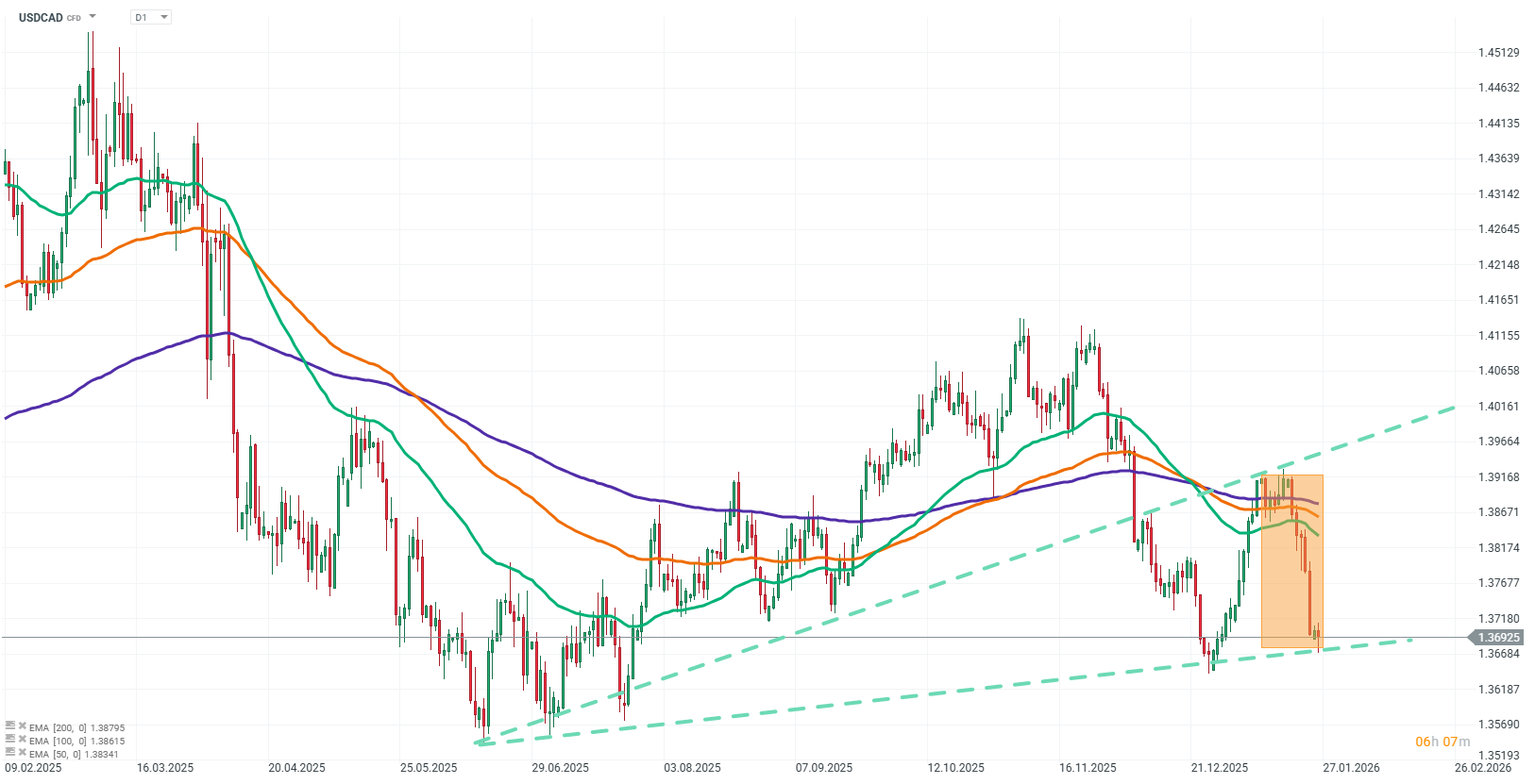
Source: xStation5
The material on this page does not constitute financial advice and does not take into account your level of understanding, investment objectives, financial situation or any other specific needs. All information provided, including opinions, market research, mathematical results and technical analyzes published on the Website or transmitted To you by other means, it is provided for information purposes only and should in no way be construed as an offer or solicitation for a transaction in any financial instrument, nor should the information provided be construed as advice of a legal or financial nature on which any investment decisions you make should be based exclusively To your level of understanding, investment objectives, financial situation, or other specific needs, any decision to act on the information published on the Website or sent to you by other means is entirely at your own risk if you In doubt or unsure about your understanding of a particular product, instrument, service or transaction, you should seek professional or legal advice before trading. Investing in CFDs carries a high level of risk, as they are leveraged products and have small movements Often the market can result in much larger movements in the value of your investment, and this can work against you or in your favor. Please ensure you fully understand the risks involved, taking into account investments objectives and level of experience, before trading and, if necessary, seek independent advice.