
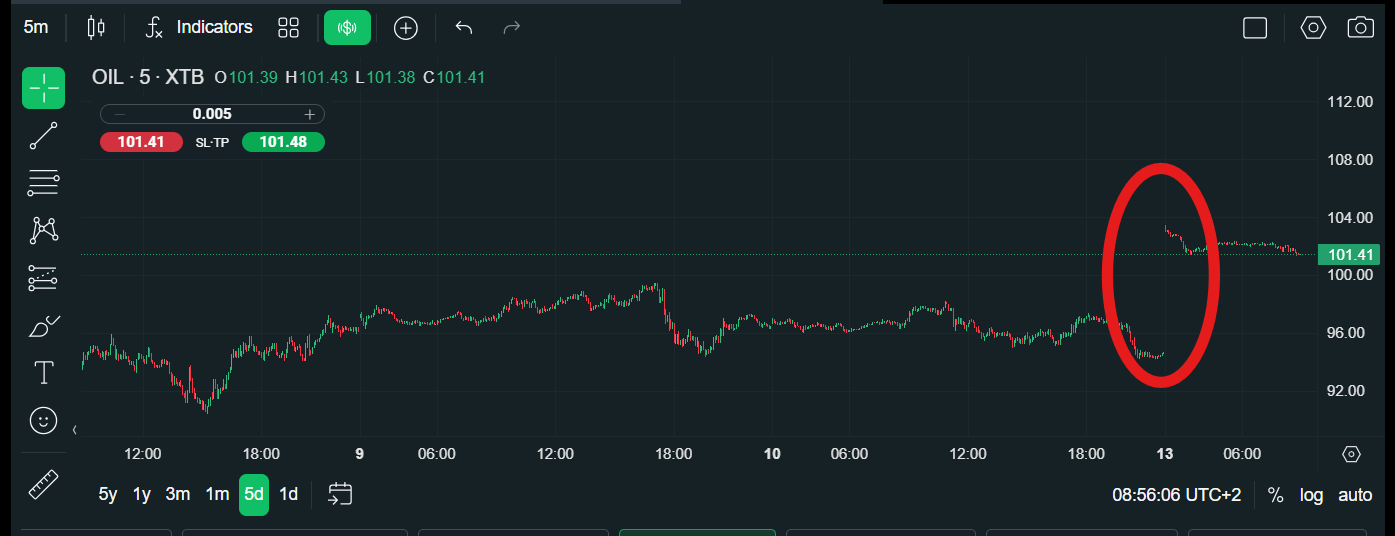
The failure of peace talks between Iran and the US and news that the US will blockade the Strait of Hormuz later today has pushed the oil price back above $100 per barrel. Brent is currently higher by more than 7% and is trading just below $102 per barrel, WTI is slightly higher at $104. There are declines across equity markets in Asia, and European futures are also pointing to a lower open this morning. However, the losses have been mild so far. The Nikkei and South Korean Kospi are down 1%, and Eurostoxx futures are pointing to a 1.2% loss.
Although oil prices have jumped back above the $100 level, the fact that they have not returned to pre-ceasefire highs above $111 per barrel for Brent, has tempered the sell off in risky assets at the start of this week. The peace talks between Iran and the US at the weekend was not a single event, but should be viewed as a process, and there are hopes that more talks will continue. Figures from the Iranian regime have hinted that this is the case. Even though President Trump is planning to blockade the Strait of Hormuz, from 4pm BST today, the President is notorious for changing his mind and switching positions, so his threats are losing market impact. At the start of this week, traders are partly reversing last week’s moves, but they are not back to panic levels, and some may argue that the sell-off could have been worse.
Chart 1: Brent crude oil price, it gapped higher at the open, but has failed to make serious headway above $100 per barrel
Source: XTB
Geopolitics is likely to dominate the market mood on Monday, but in a week that is lacking major economic data, there is still plenty of fundamentals to keep traders busy. Earnings season moves up a gear with US banks and Netflix the highlight. The UK’s February GDP reading is worth watching, and the IMF spring meeting will see it deliver its latest global growth forecasts. Central bankers and world finance leaders will also be present, and many are speaking at the event. The conflict in the Middle East is set to dominate, and now that it is in its 6th week, investors will be looking out to see if central bankers continue to think that the inflationary impacts from the conflict will be temporary, or if they may require policy action to keep price pressures at bay.
This is a high stakes IMF meeting at a precarious time for global asset prices. Usually these meetings come and go with a minimal impact on financial markets, this time we think the market will be more willing to take notice of what is said.
Earnings to watch:
US earnings are in focus this week, and 27 S&P 500 companies are set to announce their results. The focus will be on Goldman Sachs, scheduled to release numbers on Monday, followed by JP Morgan, Citigroup and Wells Fargo on Tuesday. Morgan Stanley and Bank of America round off the major US banks on Wednesday. It is also the start of tech earnings season, with Netflix scheduled to report results on Thursday. Analysts are expecting overall S&P 500 earnings growth of 13% compared to a year ago, which suggests that, for now, the conflict in the Middle East is not causing a wave of earnings downgrades. If that changes, it may leave stocks vulnerable to a sell off.
Looking at the banks first, the focus will be on forward guidance. This is especially important this quarter due to the conflict. All eyes will be on how companies are navigating the headwinds caused by the war including higher energy prices and blocked supply chains. Goldman is the first big bank to report earnings today. They had a stunning 2025, driven by robust growth in its trading business, particularly equities. Q1 earnings growth is expected to be double-digits and once again driven by equities trading and robust M&E fee income. For these expectations to be met, it will require Goldman’s traders having navigated volatile markets in the final month of Q3. There have been multiple reports of traders around the world in the derivative and commodity space facing large losses after being caught out by the war in Iran, if the same happened to Goldman traders it could weigh on sentiment towards the entire sector at the start of this week.
Analysts are expecting Q1 revenues of $16.94bn, and net income of $5.04bn, a step up from the $13.45bn reported in Q4 2025. There tends to be a seasonal uplift for trading activity in Q1, and the volatility throughout March may also boost revenues above expectations. The stock price is higher by 2% YTD, but it had a strong rally last week after the ceasefire was announced. For the stock price to continue to rally, earnings will have to be stronger than expected and there will need to positive forward guidance. If not, then the stock price could be swept up in the wave of risk aversion hitting markets today.
JP Morgan is treated like a benchmark for the global banking community because it is the world’s largest bank. Trading revenue was also a major driver of growth for JPM last quarter, and analysts expect a 7% increase in revenue and earnings compared to a year ago. The focus will be on net interest income, which is a key metric for JPM, along with any sign of weakness in consumer credit on the back of a softening economy. Analysts will also be watching any losses stemming from the shakeout in private credit. Statistically, over the long term, JPM’s earnings beat forecasts 4/5 of the time, and the average move in the share price in the 24 hours after an earnings report over the last 8 quarters is 3%.
Netflix is also in focus as they report earnings after the market closes on Thursday night. Analysts expect YoY earnings growth of 15% and revenues are expected to come in at $12.05bn, with profits expected to be $2.55bn. Analysts are upbeat coming into this earnings report after it pulled out of the deal to buy Warner Bros earlier this year. The outlook is of interest to the market as it could lay out what Netflix will do instead of acquiring Warner. Analysts expect Netflix to lay out a roadmap of content creation and acquisition, which is required to keep subscriber growth robust. More live entertainment, gaming and user content is also expected. There is also anticipation that Netflix may boost shareholder returns now that it won’t be using free cash flow to buy Warner. Share buybacks and dividends are in focus. If Netflix fails to deliver on this then their share price may take a knock. It has outperformed the overall market during the Middle East conflict and is up 5%, however, its share price has fallen after its last 3 earnings reports.
UK GDP
Monthly GDP is reported on Thursday, and the market expects growth to pick up a notch in February. Expectations are for a 0.1% rate of growth, up from zero growth in January. This data feels very old at this stage, due to the events in the Middle East, however, this latest GDP report could show how much the UK’s economy was struggling before the conflict began. If the data is weaker than expected, it may also suggest that the economy flirted with recession before the war had even started. That would leave the economic outlook even gloomier now that the country has to face an energy price shock, which may disrupt activity in the coming weeks.
Interestingly, analysts expect the manufacturing sector and industrial production to have done the heavy lifting for growth in February, with the service sector lagging behind, and construction output expected to have fallen sharply. If the service sector is weak, then it would suggest a softening consumer before energy price surged in March. However, the production and industrial sectors are exposed to rising energy prices, and it is unlikely that they will be able to sustain a decent growth rate through to March.
Overall, this data is unlikely to paint a reassuring picture about the UK economy, and a weaker than expected reading could add upside pressure to UK bond yields, as it might suggest lower future tax take at the same time as the UK faces a stricken fiscal outlook. It could also weigh on the pound, which has been resilient during the last few weeks and was one of the top performers in the G10 FX space last week, rising 1.3% vs. the USD.
The material on this page does not constitute financial advice and does not take into account your level of understanding, investment objectives, financial situation or any other specific needs. All information provided, including opinions, market research, mathematical results and technical analyzes published on the Website or transmitted To you by other means, it is provided for information purposes only and should in no way be construed as an offer or solicitation for a transaction in any financial instrument, nor should the information provided be construed as advice of a legal or financial nature on which any investment decisions you make should be based exclusively To your level of understanding, investment objectives, financial situation, or other specific needs, any decision to act on the information published on the Website or sent to you by other means is entirely at your own risk if you In doubt or unsure about your understanding of a particular product, instrument, service or transaction, you should seek professional or legal advice before trading. Investing in CFDs carries a high level of risk, as they are leveraged products and have small movements Often the market can result in much larger movements in the value of your investment, and this can work against you or in your favor. Please ensure you fully understand the risks involved, taking into account investments objectives and level of experience, before trading and, if necessary, seek independent advice.