Facts:
- China, in its 3-year plan from August this year, confirms its commitment to limit aluminium production to 45 million tons.
- According to the Bloomberg Survey from April 2025, the probability of a recession next year has reached 40%, currently oscillating around 30% (which is twice the norm set at approximately 15%).
- According to Goldman Sachs, the growth dynamics of CAPEX, i.e., “Hyperscalers,” fell between Q3 and Q4 2025 from 75% to 49%.
- CICC’s investments in Indonesia result in an increase in aluminium supply of approximately 1.1 million tons annually.
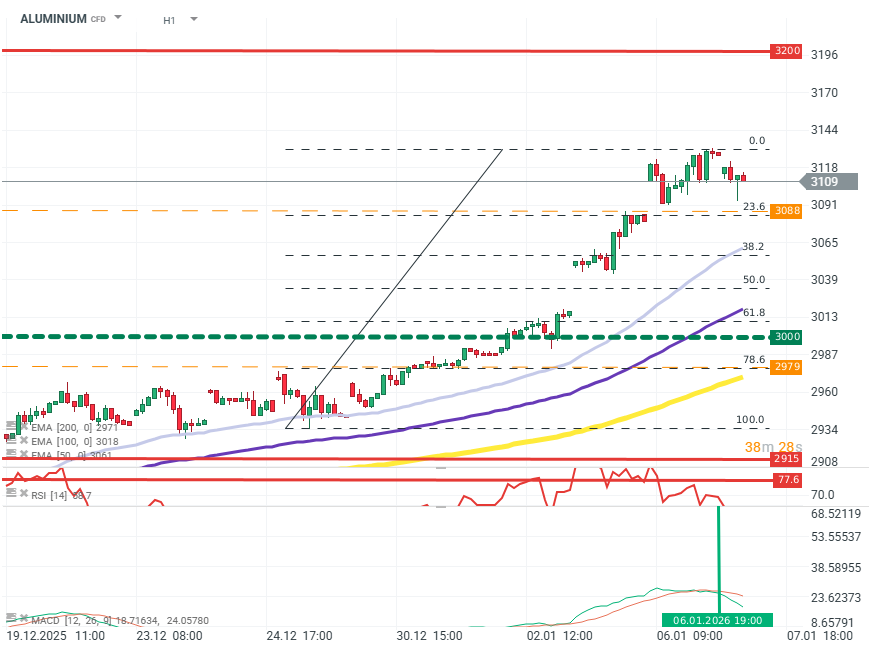
- RSI(14) on the D1 interval indicates a level above 77.
- On the H1 interval, the MACD indicator crosses the signal line from above.
Trade: Short position (SHORT) on ALUMINIUM at market price
- Target: 3000
- Stop: 3200
ALUMINUM (H1)
Source: xStation5
Opinion: The market expects significant aluminium shortages this year. A shortage scenario reaching even 400 thousand tons is already priced in, but investors ignore any risks to commodity valuations. Primarily, the market focuses on China’s production limit of 45 million tons, which is considered very significant because China alone produces about 60% of the aluminum on the market. It does not take into account that the same China, which has been struggling with structural economic problems for years, also accounts for about 40% of consumption. The USA is also facing problems, with its economic prospects becoming increasingly uncertain each quarter since the beginning of 2025. The fundamentals of commodity price growth based on AI infrastructure expansion remain questionable. Demand from EV and renewable energy sources remains relatively stable, but this is more a protection against excessive price drops rather than a reason for further increases.
Methodology and assumptions:
- The recommendation is based on technical analysis of the chart, particularly EMA averages, RSI, Fibonacci levels, and fundamental analysis of the industrial metals market.
- The target level was determined based on the dynamics and range of previous corrective movements and FIBO levels.
- The defensive stop-loss order was determined based on a favourable risk-to-reward ratio.