S&P 500 — US Large Cap Index
 FTSE 100 — UK Blue Chips
 Euro Stoxx 50 — Eurozone Leaders
 DAX 40 — German Equities
 CAC 40 — French Market Index
 Nikkei 225 — Japan Benchmark
 Hang Seng — Hong Kong Index
 Shanghai Composite — China Mainland
 ASX 200 — Australian Market
 TSX Composite — Canada Index
 Nifty 50 — India Large Cap
 STI Index — Singapore Market
 KOSPI — South Korea Index
 Bovespa — Brazil Equities
 JSE Top 40 — South Africa Index
 IPC Index — Mexico Market
Trade of The Week – Brent Oil Price Struggles Above $105 as Saudi Pipeline Repairs, Hormuz Transits and Record Supply Cap the Rally


The oil market entered the week with traders expecting a potentially sharp increase in crude prices after a major escalation in Middle Eastern supply risks. Attacks by the Houthis, an Iranian-backed group, targeted more than 70 sites in Saudi Arabia, including the strategically important East-West pipeline, which allows Saudi crude to bypass the Strait of Hormuz and reach international customers through the Red Sea.
The attacks caused a halt in production equivalent to approximately 4 million barrels per day, creating an immediate threat to global oil supply. Yet despite the scale of the disruption, the response in the futures market has been relatively restrained. Brent crude briefly climbed above $108 per barrel on Monday, but failed to reclaim the highs reached in May.
That raises the central question for oil traders:
Why has Brent remained below its previous highs despite a major disruption to Saudi oil infrastructure?
The answer lies in the market’s assessment of how quickly the damaged infrastructure can be restored, the continued movement of tankers through the Strait of Hormuz, and the availability of alternative sources of crude supply.
The physical oil market is showing considerably more stress than the futures market, with physical barrels trading at significant premiums as transportation, insurance and logistical costs increase. Futures, meanwhile, are behaving more like a financial asset, with traders balancing geopolitical risk against the possibility that supply disruptions will prove temporary.
Why Has Brent Oil Not Rallied More Sharply?
The initial reaction to the attacks was straightforward.
A major Saudi pipeline was disrupted, production was halted and tanker traffic through two critical Middle Eastern routes came under pressure.
Under normal circumstances, such a disruption would be expected to generate a substantial crude-price premium.
Instead, Brent’s rally has so far stalled around $108 per barrel.
Several factors explain the relatively limited upside.
The first is the expected speed of repairs to Saudi Arabia’s East-West pipeline.
The second is evidence that tanker traffic through the Strait of Hormuz has not completely stopped.
The third is the availability of alternative crude supplies from outside the immediate region.
The fourth is record US oil production, which provides an additional source of global supply.
Together, these factors have prevented traders from pricing the disruption as a prolonged loss of millions of barrels per day.
Saudi Arabia Plans to Restore East-West Pipeline Capacity
The East-West pipeline is strategically important because it provides Saudi Arabia with a route that bypasses the Strait of Hormuz.
The attacks therefore created two separate concerns.
First, Saudi production was disrupted.
Second, the country’s ability to move crude around the Strait of Hormuz was compromised.
American officials reportedly assessed the pipeline damage as relatively straightforward to repair, while Saudi Arabia has indicated that the pipeline should begin operating at approximately 50% capacity in the coming days.
That expectation has significantly altered the market’s assessment of the disruption.
If half of the affected capacity returns quickly, traders have less reason to price the full production interruption as a long-lasting global supply deficit.
The speed of the repair process is therefore one of the most important variables for Brent prices.
Strait of Hormuz Traffic Has Not Completely Stopped
The second major factor limiting Brent’s upside is tanker traffic through the Strait of Hormuz.
The situation remains precarious, with tankers having been attacked and the security environment remaining highly uncertain.
However, tankers are still reportedly making “dark transits”, whereby vessels turn off their transmitters while navigating the region.
Some reports suggest that this could restore as much as 70% of normal Strait of Hormuz traffic.
If accurate, that dramatically changes the supply implications of the disruption.
The market does not require completely normal traffic to avoid a total supply shock.
Even partial restoration can materially increase the volume of crude and petroleum products reaching international buyers.
For Brent traders, the key question is therefore not simply whether the Strait is safe.
It is how much oil is still moving through it.
Alternative Oil Supplies Are Limiting the Supply Shock
The global oil market is not dependent exclusively on Saudi Arabia.
Crude is continuing to enter the global system from alternative sources.
A notable example is Venezuela, where a record amount of oil is reportedly flowing into the US.
Meanwhile, US oil production itself is running at a record-high pace.
That additional supply provides some protection against the loss of Middle Eastern barrels.
It does not completely eliminate the geopolitical risk premium.
But it means traders have to assess the net global supply loss, rather than simply the volume temporarily removed from Saudi production.
This is one of the reasons the futures market has been more restrained than the physical market.
Physical Oil Prices Are Showing More Stress
The relatively contained move in Brent futures should not be interpreted as evidence that the physical oil market is unaffected.
Physical crude prices are trading at significant premiums.
The physical market must account for the rapidly rising costs associated with:
- Tanker transportation
- Insurance
- Security
- Longer shipping routes
- Supply-chain disruption
- Availability of specific crude grades
These additional costs can remain elevated even when futures prices are comparatively stable.
This creates an important divergence.
Physical oil can remain tight and expensive while futures prices struggle to extend their rally.
That difference is particularly important for refiners, physical traders and companies that actually need to source barrels rather than simply trade oil futures.
Futures Traders Are Treating Oil More Like a Financial Asset
The futures market is currently focused on probability rather than simply physical scarcity.
Traders are weighing the severity of the Saudi attacks against the likelihood that infrastructure will be repaired quickly.
They are also assessing whether tanker traffic can continue through the Strait of Hormuz, whether alternative supplies can compensate for disrupted barrels and whether US production can continue providing additional crude.
This explains why Brent has struggled to move decisively beyond $108 per barrel.
The market is effectively asking whether the disruption represents a temporary logistical shock or the beginning of a much larger and longer-lasting supply crisis.
So far, futures pricing is reflecting considerable uncertainty rather than assuming the worst-case scenario.
Oil Market Snapshot
| Market Factor | Latest Situation | Impact on Brent |
|---|---|---|
| Brent Monday High | Above $108/barrel | Key resistance |
| Saudi Production Disruption | ~4M bpd equivalent | Bullish |
| Saudi East-West Pipeline | Damaged | Bullish |
| Planned Pipeline Capacity | ~50% in coming days | Bearish/relief |
| Strait of Hormuz | Tanker traffic disrupted but continuing | Mixed |
| Dark Transits | Potentially restoring up to 70% of traffic | Bearish/relief |
| Saudi Crude Deliveries | Some European deliveries cancelled | Bullish |
| Venezuelan Oil to US | Record flows | Bearish |
| US Oil Production | Record-high pace | Bearish |
| Physical Oil Premiums | Significant | Bullish |
| Tanker & Insurance Costs | Elevated | Bullish |
| Brent Initial Support | $105 | Technical |
| Brent Secondary Support | $103.10 | Technical |
| Psychological Support | $100 | Technical |
| Stronger Support | $95-$96 | Technical |
| Key Resistance | $108 | Technical |
Bullish Sentiment
1. Saudi Production Has Been Disrupted
The attacks caused a production interruption equivalent to approximately 4 million barrels per day.
If the disruption lasts longer than currently expected, global supply concerns could intensify.
2. East-West Pipeline Damage Creates a Strategic Supply Risk
The pipeline provides Saudi Arabia with a route around the Strait of Hormuz.
Any prolonged reduction in its capacity increases the market’s dependence on the already-sensitive maritime route.
3. Strait of Hormuz Remains Precarious
Even though tankers continue to move, attacks and security concerns mean the risk of further disruption remains high.
A significant reduction in traffic could rapidly increase the global crude risk premium.
4. Physical Oil Markets Are Tight
Physical barrels are trading at substantial premiums as transportation and insurance costs rise.
This indicates that the disruption is having a more pronounced effect on the physical market than the headline futures price suggests.
5. Geopolitical Risk Can Escalate Quickly
Oil is currently being driven primarily by geopolitics rather than technical setups.
Another major attack on infrastructure, tankers or export facilities could rapidly change market expectations.
Bearish Sentiment
1. Saudi Arabia Expects Partial Pipeline Restoration
The expected return of approximately 50% of East-West pipeline capacity in the coming days reduces the probability that the full disruption will persist.
2. Tankers Are Still Moving Through Hormuz
Dark transits could potentially restore as much as 70% of Strait of Hormuz traffic, according to reports.
Even partial traffic would significantly reduce the potential global supply shortfall.
3. Alternative Sources Are Supplying the Market
Record Venezuelan oil flows into the US demonstrate that crude can be sourced from outside the immediate Middle Eastern disruption.
4. US Oil Production Is at Record Levels
High US production provides another source of crude supply and limits the extent to which the global market must depend on disrupted Middle Eastern barrels.
5. Brent Has Failed to Break Its Previous Highs
Despite briefly moving above $108, Brent has not returned to its May highs.
That suggests traders remain cautious about pricing a prolonged supply shock into futures contracts.
Technical Levels: $108 Resistance, $103.10 Key Support
Although geopolitics is dominating oil markets, several technical levels remain important.
Resistance: $108 per barrel
The Monday high above $108 is currently the most important upside reference point.
A sustained move above this area would indicate that traders are placing a larger premium on the possibility of prolonged supply disruption.
Initial Support: $105
The first level to watch on a pullback is around $105 per barrel.
A break below this level would indicate that some of the immediate geopolitical premium is being removed.
Key Support: $103.10
The next important level is $103.10.
A decisive move below this area would bring the $100 psychological level back into focus.
Psychological Support: $100
A move toward $100 would represent an important shift in sentiment because the market would be giving back a substantial portion of the geopolitical premium generated by the recent attacks.
Major Support: $95-$96
Chart 1: Brent crude oil
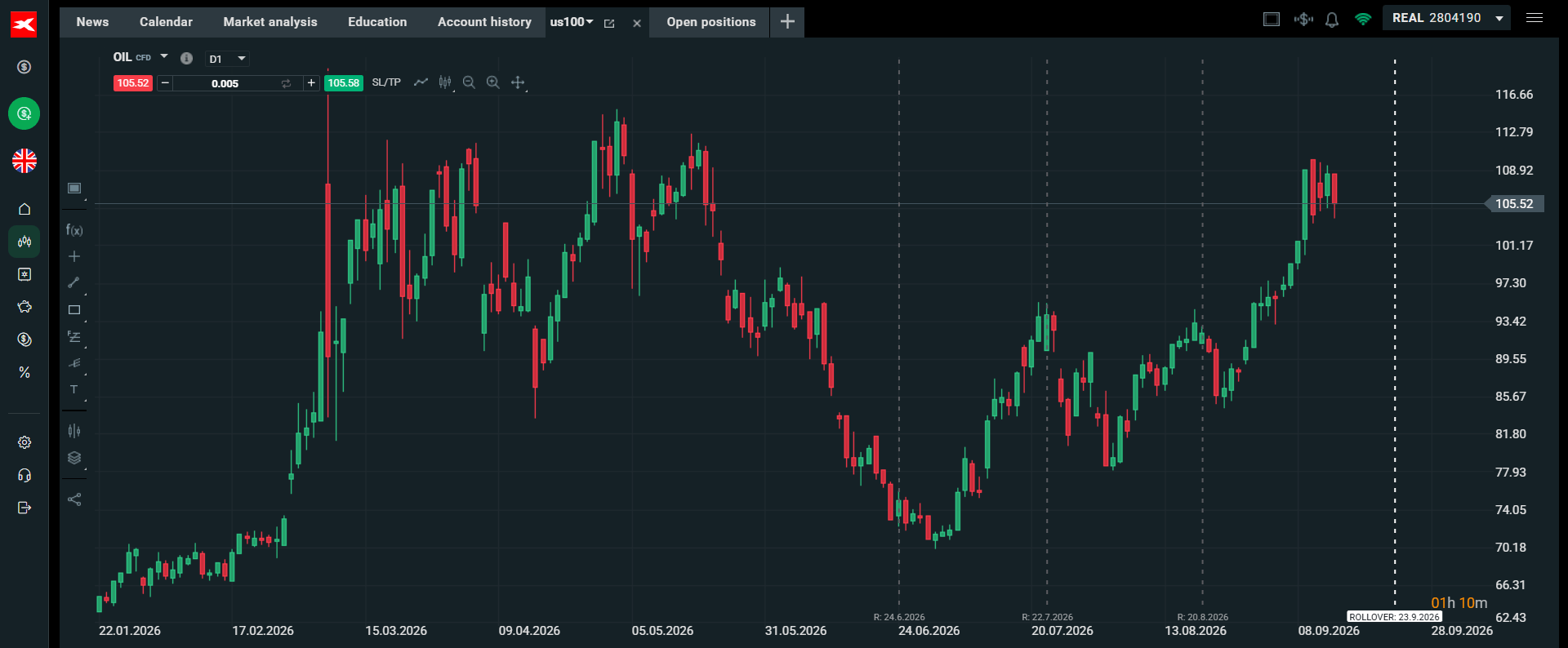
The $95-$96 area corresponds with the 20-day simple moving average, providing a more substantial technical reference point.
However, technical levels should currently be treated as secondary indicators.
Geopolitics remains the primary driver of crude prices.
The Critical Battle: Supply Disruption Versus Repair Speed
The next major move in oil will depend heavily on how quickly traders can determine whether the Saudi disruption is temporary or prolonged.
If the East-West pipeline returns to 50% capacity as expected, while tanker traffic through Hormuz remains operational and alternative crude supplies remain available, the market could continue struggling to move significantly above $108.
But if repairs are delayed, tanker traffic deteriorates further or new attacks occur, the supply-risk premium could increase sharply.
That is why oil remains particularly difficult to trade using technical indicators alone.
The fundamental picture can change in hours.
What Traders Are Watching Next
Oil traders will be monitoring:
- East-West pipeline repairs and the timing of the expected 50% capacity restoration.
- Saudi oil production levels following the disruption.
- Strait of Hormuz tanker traffic and the continuation of dark transits.
- Further attacks on Saudi infrastructure or tankers.
- Saudi crude deliveries to Europe and other customers.
- Venezuelan crude exports and US imports.
- US oil production, which remains at record levels.
- Physical crude premiums and regional price differentials.
- Tanker insurance and freight costs.
- Brent’s $108 resistance level.
- $105 and $103.10 support, followed by $100 and the $95-$96 20-day SMA.
- Any change in geopolitical risk that could alter the current supply assumptions.
Currency Hedger View
The oil market’s geopolitical volatility also creates significant foreign-exchange exposure for international energy businesses.
Crude oil is predominantly priced in US dollars, meaning companies purchasing or selling oil in dollars can experience a second layer of volatility through currency movements.
For an importer, a sharp rise in oil prices combined with a weaker domestic currency can substantially increase the effective cost of energy. Conversely, exporters receiving US-dollar revenues can have different FX exposure depending on their operating and reporting currencies.
Currency Hedger, the FX and hedging division of Octalas Group, focuses on helping businesses manage currency exposure associated with international payments, receipts and international commercial transactions.
For businesses exposed to oil, separating commodity risk from currency risk can provide a clearer picture of total financial exposure during periods of extreme market volatility.
Today Markets View
Oil markets are facing one of their most complicated geopolitical setups in recent months.
The attacks on Saudi Arabia and the East-West pipeline created a disruption equivalent to approximately 4 million barrels per day, while risks around the Strait of Hormuz have added another layer of uncertainty.
Yet Brent has so far remained relatively restrained, with Monday’s high above $108 per barrel failing to return the market to its May highs.
The explanation is largely based on supply expectations.
Saudi Arabia expects to restore around 50% of East-West pipeline capacity, tankers are still moving through the Strait of Hormuz, alternative sources such as Venezuelan crude are supplying the market, and US oil production remains at record levels.
At the same time, physical oil markets remain significantly tighter, with higher tanker, insurance and logistical costs creating substantial premiums.
The futures market is therefore balancing two competing possibilities: a temporary supply disruption that can be repaired and supplemented by alternative sources, versus a prolonged geopolitical escalation that could remove substantially more crude from global markets.
Technically, $108 remains the key resistance level, while $105 and $103.10 provide initial downside levels. A break below $103.10 would put $100 back into focus, while the $95-$96 region around the 20-day SMA represents a more substantial technical support zone.
For now, however, oil traders should treat technical levels as secondary to geopolitics.
The oil market can change direction rapidly if the physical supply situation changes, making disciplined risk management and caution particularly important while the Middle East remains the dominant price driver.
Louis Roche, Analyst, Today Markets