S&P 500 — US Large Cap Index
 FTSE 100 — UK Blue Chips
 Euro Stoxx 50 — Eurozone Leaders
 DAX 40 — German Equities
 CAC 40 — French Market Index
 Nikkei 225 — Japan Benchmark
 Hang Seng — Hong Kong Index
 Shanghai Composite — China Mainland
 ASX 200 — Australian Market
 TSX Composite — Canada Index
 Nifty 50 — India Large Cap
 STI Index — Singapore Market
 KOSPI — South Korea Index
 Bovespa — Brazil Equities
 JSE Top 40 — South Africa Index
 IPC Index — Mexico Market
US-Canada trade conflict escalates

It is no longer an exaggeration to say that trade and diplomatic relations between the United States and Canada have reached their most serious deadlock since the USMCA entered into force.
USDCAD Chart (D1)
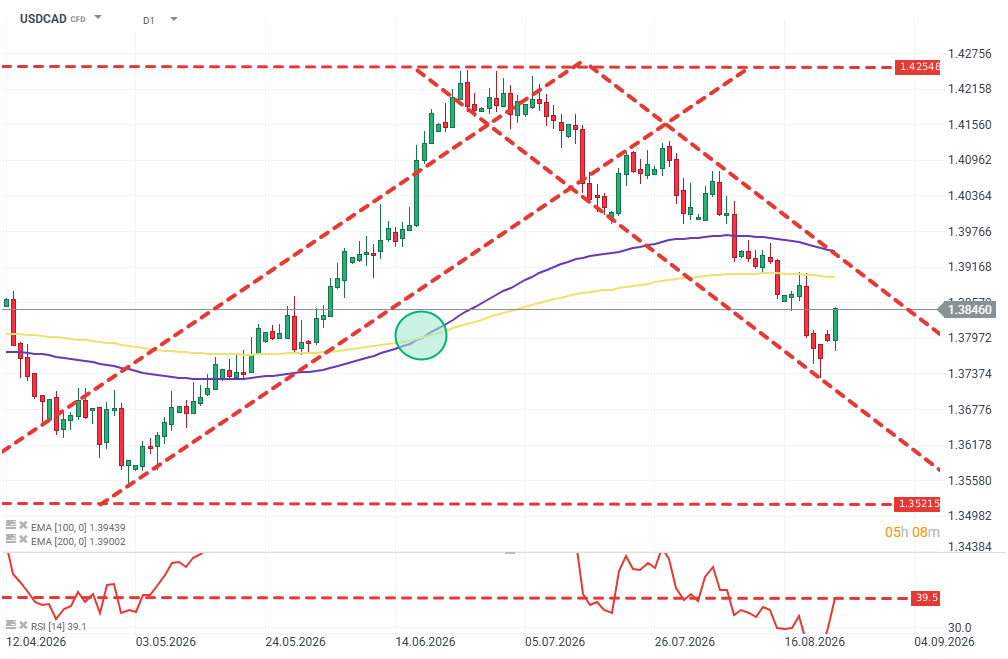
USDCAD expierenced increase of aprox. 0,3% on the news, although its worth pointing out that the pair was already over-sold in terms of RSI. Source: xStation5 After negotiations collapsed, the US administration imposed 50% tariffs on Canadian goods worth around USD 20 billion per year. Ottawa suspended the talks and announced proportional retaliation starting on 8 September.
- The new US tariffs cover, among other things, wine, dairy, furniture, cement, clothing, fishing and hockey equipment.
- The United States already applies 50% tariffs on Canadian steel and aluminum, tariffs on cars and components that do not contain a sufficient share of US production, as well as duties on construction lumber and some interior furnishings.
Unlike earlier restrictions, these measures also apply to goods that meet USMCA rules. However, energy, potash, certain strategically important raw materials, civil aircraft, and products already covered by separate sector-specific tariffs have been excluded. In this context, the question naturally arises: what exactly is the US trying to achieve by completely unprovoked and seemingly pointless antagonizing of Canada, a country on which the US, despite the huge imbalance, still has local but very serious dependencies.
Canada is preparing its response
- Retaliatory tariffs are expected to target, among other things, US steel, dairy products, agricultural machinery, home appliances, electronics, and paper goods.
- The government in Ottawa also maintains 25% retaliatory tariffs on US steel, aluminum, and cars, covering imports worth as much as CAD 51.4 billion.
- Negotiators were close to a partial agreement as recently as last week. However, the talks broke down over technical and political issues.The parties could not agree on how to calculate the share of US components in vehicles or on restrictions related to dairy.
- The parties could not agree on how to calculate the share of US components in vehicles or on restrictions related to dairy.
Although the talks focused mainly on trade and economic issues, it is hard to ignore demands that quite clearly undermine Canadian sovereignty. The US demanded veto rights over future trade agreements signed by Canada and demanded the removal of French as an official language in Quebec.
The stakes are high
- The value of bilateral trade in goods and services in 2025 was about USD 872 billion.
- The US exported about USD 426 billion in goods and services to Canada, importing about USD 446 billion.
The dependence remains clearly asymmetric. The United States accounts for more than two thirds of Canadian exports. For the US, Canada is the largest or one of the largest trading partners, but exports to Canada amount to only about 1.5% of the American economy.
Energy is the exception.
- Canada supplies about 63% of the oil imported by the United States. Excluding energy from the new tariffs shows that Washington wants to increase pressure on Ottawa without destabilizing its own refineries and fuel prices.
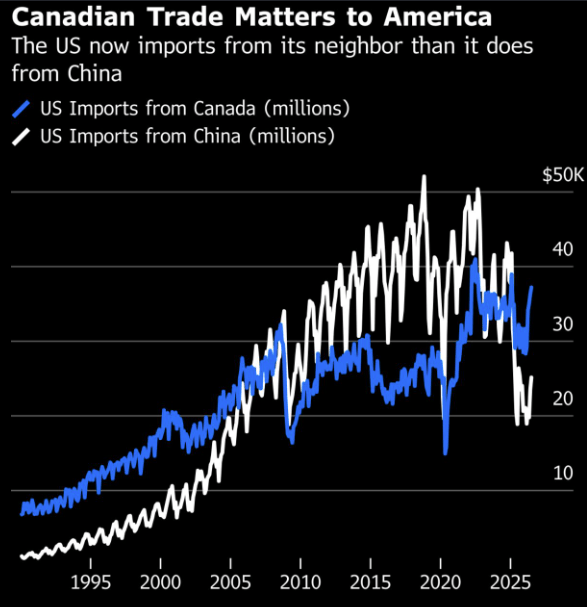
The most dangerous precedent, aside from the attempt to deprive Canada of sovereignty, is not the value of the new tariffs itself, but the gradual weakening of the USMCA. The agreement is the foundation of trade across the continent and one of the few remaining reasons why Canada and Mexico trade more with the US than, for example, with China. This trend is reverse for US – which due to its trade wars was forced to buy more and more from outside China. Analytical centers estimate that if the conflict expands to cover most trade, Canada could lose 1–4% of GDP, depending on the scale of the restrictions.
Both sides have reasons to compromise
- Pressure on Canada is economic in nature, but an unjustified trade war with its closest trading partner and the ostentatious support for separatists in the province of Alberta has triggered a wave of public support for the Canadian government.
- In the US, the situation is the opposite. Canada’s impact on the US economy is very small, but trade tensions will hit companies in border states the hardest. It is in Pennsylvania, Maine, Massachusetts, and Ohio that Republicans face the biggest challenges ahead of the upcoming elections. Undecided voters in this area may choose to show the Donald Trump government a red card.