S&P 500 — US Large Cap Index
 FTSE 100 — UK Blue Chips
 Euro Stoxx 50 — Eurozone Leaders
 DAX 40 — German Equities
 CAC 40 — French Market Index
 Nikkei 225 — Japan Benchmark
 Hang Seng — Hong Kong Index
 Shanghai Composite — China Mainland
 ASX 200 — Australian Market
 TSX Composite — Canada Index
 Nifty 50 — India Large Cap
 STI Index — Singapore Market
 KOSPI — South Korea Index
 Bovespa — Brazil Equities
 JSE Top 40 — South Africa Index
 IPC Index — Mexico Market

US NFP Preview: Economic Reality Hits as Jobs Data Puts Federal Reserve Rate Expectations to the Test


The US labour market faces another critical test as October non-farm payrolls are released, with investors assessing whether employment growth is recovering after a weak September reading or whether the economy remains locked in a low-hiring, low-firing environment.
The report is scheduled for 13:30 GMT, with analysts expecting 65,000 new jobs, compared with just 29,000 in September. The unemployment rate is forecast to remain unchanged at 4.2%, while monthly wage growth of 0.2% to 0.3% would be consistent with a relatively subdued labour market.
However, forecasts vary considerably, highlighting the uncertainty surrounding the employment outlook. Barclays expects 50,000 new jobs, KPMG forecasts 45,000, RSM anticipates 95,000, while Vanguard expects a stronger 120,000 increase.
The implications extend beyond employment. With inflation remaining central to Federal Reserve policy, a stronger-than-expected report could reinforce expectations of further monetary tightening, potentially placing additional pressure on equities, technology shares and other interest-rate-sensitive assets.
Market Snapshot
| Indicator | October Forecast / Previous Reading |
|---|---|
| US non-farm payrolls forecast | 65,000 |
| September payrolls | 29,000 |
| Unemployment rate forecast | 4.2% |
| Wage growth forecast | 0.2%–0.3% monthly |
| Barclays forecast | 50,000 |
| KPMG forecast | 45,000 |
| RSM forecast | 95,000 |
| Vanguard forecast | 120,000 |
| Release time | 13:30 GMT |
September Weakness Meets Improving Employment Indicators
The September employment report highlighted considerable weakness in the US labour market. Payroll growth reached only 29,000, falling below every estimate in a Bloomberg survey. Revisions to July and August also reduced previously reported employment growth by a combined 60,000 jobs.
Since then, several indicators have suggested that employment conditions may have improved.
ADP private-sector payrolls increased by 86,000 in October, exceeding expectations of 75,000. The latest JOLTS report also surprised to the upside, providing further evidence that labour-market conditions may have stabilised following the softer summer period.
These developments create uncertainty ahead of the official figures. Investors must determine whether the latest improvement represents a genuine recovery in employment momentum or simply a temporary strengthening following several weaker months.
The headline payroll number will be important, but revisions to previous readings and movements in unemployment could prove equally significant.
Payrolls and Federal Reserve Policy: Why Stronger Data Could Pressure Markets
The relationship between employment growth and Federal Reserve policy is particularly important for today’s release.
The central bank’s focus remains inflation, making the employment report relevant to the timing and probability of further monetary tightening.
According to the forecasts outlined in the market commentary, Barclays believes that a 50,000 payroll increase accompanied by slightly lower unemployment could keep a December rate hike in consideration. A stronger result could increase expectations of further rate increases during the first quarter of 2027.
This creates a potentially difficult environment for financial markets.
Stronger employment would normally indicate economic resilience. However, if investors interpret the figures as evidence that inflationary pressures could remain persistent, expectations of higher interest rates may increase.
That could push bond yields higher, strengthen the US dollar and place additional pressure on equities, particularly technology companies whose valuations are sensitive to borrowing costs and future earnings expectations.
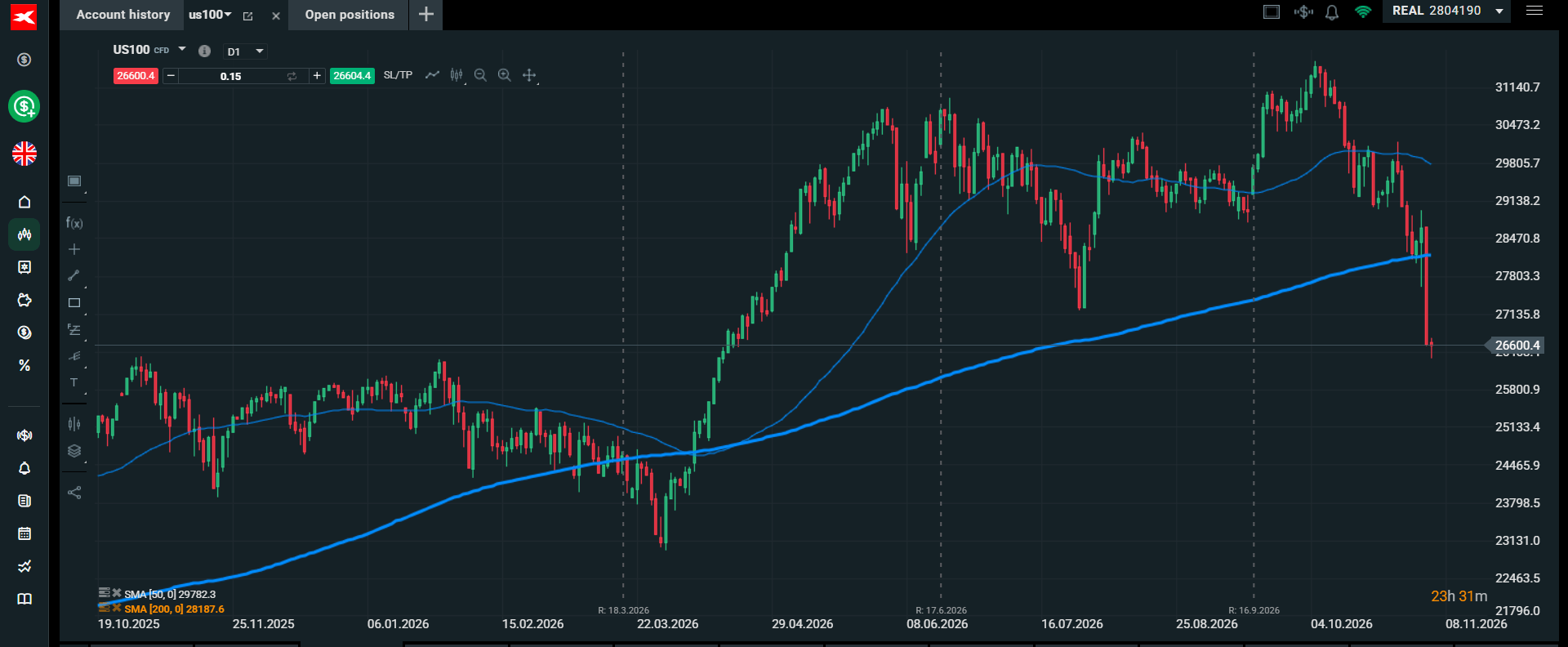
Chart 1: Nasdaq 100, drops below its 200-day sma to its lowest level since April
NFP Scenario Analysis: Three Outcomes That Could Move Markets
The employment report presents three broad scenarios for investors.
1. Soft Employment Reading: Below 40,000
A payroll increase below approximately 40,000, accompanied by a rising unemployment rate, could reduce expectations of a December rate hike.
Potential market implications include:
- US Treasury yields easing further.
- The US dollar weakening.
- Equities receiving short-term relief from reduced monetary tightening expectations.
- Growth stocks benefiting from lower yield expectations.
However, a particularly weak employment report could introduce a different concern: the possibility that economic growth is deteriorating more rapidly than anticipated.
The distinction between moderate labour-market weakness and a more serious deterioration will therefore be important.
2. In-Line Employment Reading: 50,000–70,000
A result broadly consistent with expectations, accompanied by unemployment remaining around 4.2%, could produce a relatively limited market reaction.
Investors may interpret such a reading as confirmation that employment growth remains subdued without showing signs of a sudden deterioration.
Attention would then shift towards upcoming inflation data, which remains central to expectations for Federal Reserve policy.
3. Hot Employment Reading: 100,000 or More
A payroll increase above 100,000, particularly alongside monthly wage growth of 0.3% or more, could trigger a more significant market reaction.
Potential consequences include:
- Increased expectations of further Federal Reserve rate increases.
- Higher Treasury yields.
- A stronger US dollar.
- Additional pressure on technology and growth stocks.
- Renewed volatility across global equity markets.
A stronger report could therefore become a negative catalyst for risk-sensitive assets, particularly if investors are already reducing exposure to expensive technology shares.
Semiconductor Stocks Face Additional Pressure
The employment report arrives at a particularly fragile moment for semiconductor and artificial intelligence-related equities.
The Philadelphia Semiconductor Index reportedly fell 14% on Thursday, wiping out approximately $2 trillion in market value. Nvidia also declined nearly 10%, as investors reassessed the outlook for artificial intelligence investment and the risks facing the sector.
Concerns include potential regulatory restrictions, possible limitations on AI development and data-centre expansion, as well as questions surrounding excessive investment and leverage.
Semiconductor companies are especially sensitive to movements in bond yields because their valuations are heavily influenced by expectations of future earnings growth.
A stronger payroll reading could increase concerns that interest rates will remain higher for longer, potentially adding further pressure to an already vulnerable technology sector.
Potential AI Sector Outcomes Following NFP
Hot employment reading
A strong payroll increase could become another catalyst for semiconductor weakness as investors price in a greater possibility of further rate increases. Nvidia, AMD, Broadcom and Micron could face additional selling pressure.
Soft but stable employment reading
This would potentially represent the most favourable outcome for the sector. Lower rate-hike expectations could support valuations without necessarily signalling a significant deterioration in economic demand.
Very weak employment reading
The reaction could be mixed. Lower bond yields may support technology valuations, but concerns about economic growth and future AI-related capital expenditure could weigh on companies exposed to the investment cycle.
Bullish Market Sentiment
- Moderate employment growth: A payroll reading close to expectations could support the view that the labour market is slowing without entering a more severe downturn.
- Lower rate-hike expectations: A softer employment result could reduce pressure on Treasury yields and provide relief for equities.
- Stable unemployment: An unchanged unemployment rate around 4.2% could reinforce expectations of a gradual rather than abrupt labour-market adjustment.
- Technology valuation support: Lower yields could help stabilise semiconductor and other growth stocks following recent declines.
Bearish Market Sentiment
- Stronger-than-expected payrolls: Employment growth above 100,000 could strengthen expectations of additional Federal Reserve tightening.
- Wage inflation: Monthly wage growth at the upper end of expectations could reinforce concerns about persistent inflationary pressure.
- Higher bond yields: Rising yields could place further pressure on equities, particularly companies valued on future earnings growth.
- Semiconductor vulnerability: The technology sector is already facing significant selling pressure, leaving it exposed to another negative catalyst.
- Market uncertainty: Large differences between individual forecasts increase the potential for a significant reaction if the actual figures surprise investors.
Price Forecast: What Traders Are Watching
The US dollar, Treasury yields, equity indices and semiconductor stocks are likely to be particularly sensitive to the employment figures.
The initial market reaction will depend on how the headline payroll number compares with the 65,000 consensus forecast. However, investors should also pay close attention to unemployment, average earnings and revisions to previous months.
A weaker reading could ease expectations of further monetary tightening and provide temporary support for equities. Conversely, a stronger report could reinforce expectations of higher interest rates and support the dollar.
The reaction across technology stocks may be especially pronounced because the semiconductor sector is already experiencing significant valuation pressure.
Market Outlook for the Coming Sessions
Today’s non-farm payrolls report arrives at a delicate point for market sentiment. The combination of uncertainty surrounding Federal Reserve policy, recent weakness in technology shares and widely differing employment forecasts increases the potential for volatility.
A result close to expectations may leave markets waiting for the next inflation indicators before making significant adjustments to interest-rate expectations.
A stronger reading, however, could reinforce the prospect of further monetary tightening into 2027, placing additional pressure on equities and potentially supporting the US dollar.
A weaker result could provide short-term relief for risk assets, although an unexpectedly sharp deterioration in employment would introduce renewed concerns about economic growth.
For traders, the most important consideration will be the relationship between payroll growth, unemployment and wage inflation rather than the headline employment figure in isolation.
Today Markets Analysis
The October employment report could become an important catalyst for financial markets, particularly as investors reassess the balance between economic resilience and persistent inflation risks.
The wide range of forecasts highlights the uncertainty surrounding the US labour market. With technology shares already under pressure, a stronger-than-expected reading could intensify market volatility, while a softer result may offer temporary relief.
The reaction in Treasury yields and the US dollar will provide important signals about how investors interpret the implications for Federal Reserve policy.
Currency Hedger View
The US dollar could experience increased volatility following the employment release.
A stronger-than-expected payroll reading, particularly when accompanied by firm wage growth, could support the dollar if markets increase expectations of further Federal Reserve rate increases.
A weaker report could have the opposite effect, easing monetary tightening expectations and potentially reducing demand for the US currency.
For businesses making international payments, these movements can directly affect the cost of cross-border transactions. Companies purchasing US dollars may face higher costs if the dollar strengthens, while businesses receiving USD revenues could benefit when converting those funds into other currencies.
Currency Hedger highlights the importance of monitoring exchange-rate exposure around major US economic releases, particularly when payment obligations involve significant dollar-denominated transactions.
Manage your international payments and currency exposure:
Open a Currency Hedger Account
Disclaimer
This article is provided for informational and market commentary purposes only. It does not constitute investment advice, financial advice, trading recommendations or an offer to buy or sell any financial instrument. Economic forecasts and market scenarios are subject to uncertainty, and actual outcomes may differ materially from expectations. Trading foreign exchange, CFDs and other leveraged financial instruments involves significant risk and may result in losses exceeding initial investments. Readers should conduct their own research and seek independent professional advice where appropriate.