S&P 500 — US Large Cap Index
 FTSE 100 — UK Blue Chips
 Euro Stoxx 50 — Eurozone Leaders
 DAX 40 — German Equities
 CAC 40 — French Market Index
 Nikkei 225 — Japan Benchmark
 Hang Seng — Hong Kong Index
 Shanghai Composite — China Mainland
 ASX 200 — Australian Market
 TSX Composite — Canada Index
 Nifty 50 — India Large Cap
 STI Index — Singapore Market
 KOSPI — South Korea Index
 Bovespa — Brazil Equities
 JSE Top 40 — South Africa Index
 IPC Index — Mexico Market

Volkswagen Share Price Forecast: VW Stock Near 2010 Levels as Wage Freeze, Job Cuts and Strike Risks Deepen Crisis


Volkswagen Restructuring: Job Cuts and Factory Uncertainty
The proposed wage freeze forms part of a broader restructuring programme aimed at improving Volkswagen’s cost base and competitiveness. The supplied report refers to a further reduction of 50,000 positions worldwide, alongside earlier workforce-reduction plans.
However, the employment figures require careful interpretation. The proposed reduction is a restructuring target, not confirmation that 50,000 additional employees have already been dismissed. Similarly, the future of individual factories should be distinguished from formally approved closure decisions.
The main concerns for investors are whether Volkswagen can reduce costs without undermining production capacity, employee morale or the development of competitive new vehicles.
The reported uncertainty surrounding Emden, Hanover, Zwickau and Neckarsulm adds another layer of risk. Decisions about future production allocations, investment and model launches will influence whether these facilities remain commercially viable beyond the current planning period.
Why Volkswagen Is Under Pressure
Several structural challenges are affecting the group’s competitive position:
- High German production costs: Labour, energy and operating expenses can make it more difficult to compete on price.
- The transition to electric vehicles: Volkswagen must fund new vehicle platforms, software development, battery technology and manufacturing changes while managing its existing business.
- Chinese competition: Lower-priced electric vehicles and faster product-development cycles are putting pressure on established manufacturers.
- Weak profitability expectations: Investors need evidence that restructuring will translate into durable improvements in operating margins and cash flow.
- Organisational complexity: Simplifying operations and reducing overheads may be necessary, but implementation can be difficult across a large international group.
The wage dispute is therefore one element of a broader challenge. Cost reductions may improve the financial position, but they cannot by themselves guarantee that Volkswagen will develop more competitive products or regain market share.
Bullish Sentiment: What Could Support Volkswagen Shares?
- Successful cost reductions: Lower personnel and operating expenses could improve profitability if savings are achieved without materially disrupting production.
- A negotiated labour agreement: A compromise with IG Metall could reduce uncertainty around strikes, production schedules and restructuring implementation.
- Improved electric vehicle competitiveness: More attractive models, better software and stronger pricing could help Volkswagen defend market share.
- Stronger operating margins: Evidence of improved earnings, cash generation and capital discipline could encourage investors to reassess the company’s valuation.
- A potential valuation recovery: The reported long-term share-price decline may attract investors who believe the market has already discounted a substantial amount of negative news. However, a low share price alone does not establish that the stock is undervalued.
- Greater strategic clarity: Clear decisions about factory investment, production allocation and future vehicle launches could reduce uncertainty over Volkswagen’s long-term prospects.
Bearish Sentiment: Risks That Could Extend the Decline
- Prolonged labour disputes: Failed negotiations or industrial action could disrupt production and increase operating costs.
- Restructuring execution risk: Workforce reductions and factory changes may take time to deliver meaningful financial benefits.
- Persistent competitive pressure: Chinese manufacturers could continue challenging Volkswagen on price, technology and product-development speed.
- Weak demand or pricing pressure: Lower vehicle sales or discounting could offset the benefits of cost reductions.
- Higher transition costs: Investment in electric vehicles, software and manufacturing transformation could continue weighing on cash flow.
- Uncertainty over the wage proposal: Volkswagen has described the wage-freeze reports as speculation and pointed to forthcoming negotiations. Until the details are confirmed, investors face uncertainty over the eventual agreement.
- Technical weakness: If the share price remains below its long-term trend indicators, buying interest may remain limited even if short-term rebounds occur.
Volkswagen Share Price Forecast: What Investors Are Watching
The Volkswagen share price outlook depends on whether the company can demonstrate measurable progress in restructuring while preserving industrial stability and improving its competitive position.
Bullish scenario: Shares could recover if management and employee representatives reach a workable agreement, cost savings become visible in financial results and Volkswagen demonstrates progress in electric vehicle competitiveness. Improved guidance, stronger cash flow or a more convincing product strategy could help restore investor confidence.
Bearish scenario: The stock could remain under pressure if negotiations deteriorate, industrial action disrupts production or financial results show that restructuring is failing to offset competitive and transition-related costs. Further deterioration in vehicle demand or margins would add to the downside risks.
Consolidation scenario: Shares could remain volatile and range-bound while investors await clarity on wage negotiations, workforce plans and future factory investment. In this case, announcements and earnings guidance may matter more than short-term price movements.
The supplied figures do not establish a reliable numerical price target. A recovery towards previous trading levels should not be assumed without evidence of improving fundamentals and a change in market sentiment.
Technical Analysis: Can VOW1.DE Break Its Downtrend?
The supplied technical assessment identifies the 200-period exponential moving average as an important reference point for Volkswagen shares.
A sustained move above a declining long-term average could indicate that selling pressure is easing, particularly if accompanied by stronger trading volume and improving fundamental news. However, a brief move above the indicator would not necessarily confirm a lasting reversal.
If the shares remain below the 200-period EMA and continue establishing lower highs and lower lows, the broader downtrend would remain a concern.
Investors should also distinguish between technical recovery and fundamental improvement. A share-price rebound driven by short covering or expectations of a labour agreement may prove temporary if operating performance continues to deteriorate.
The current value of the 200-period EMA was not supplied, so a precise breakout level cannot be established from the available figures.
Stocks: a slump lasting more than a dozen years
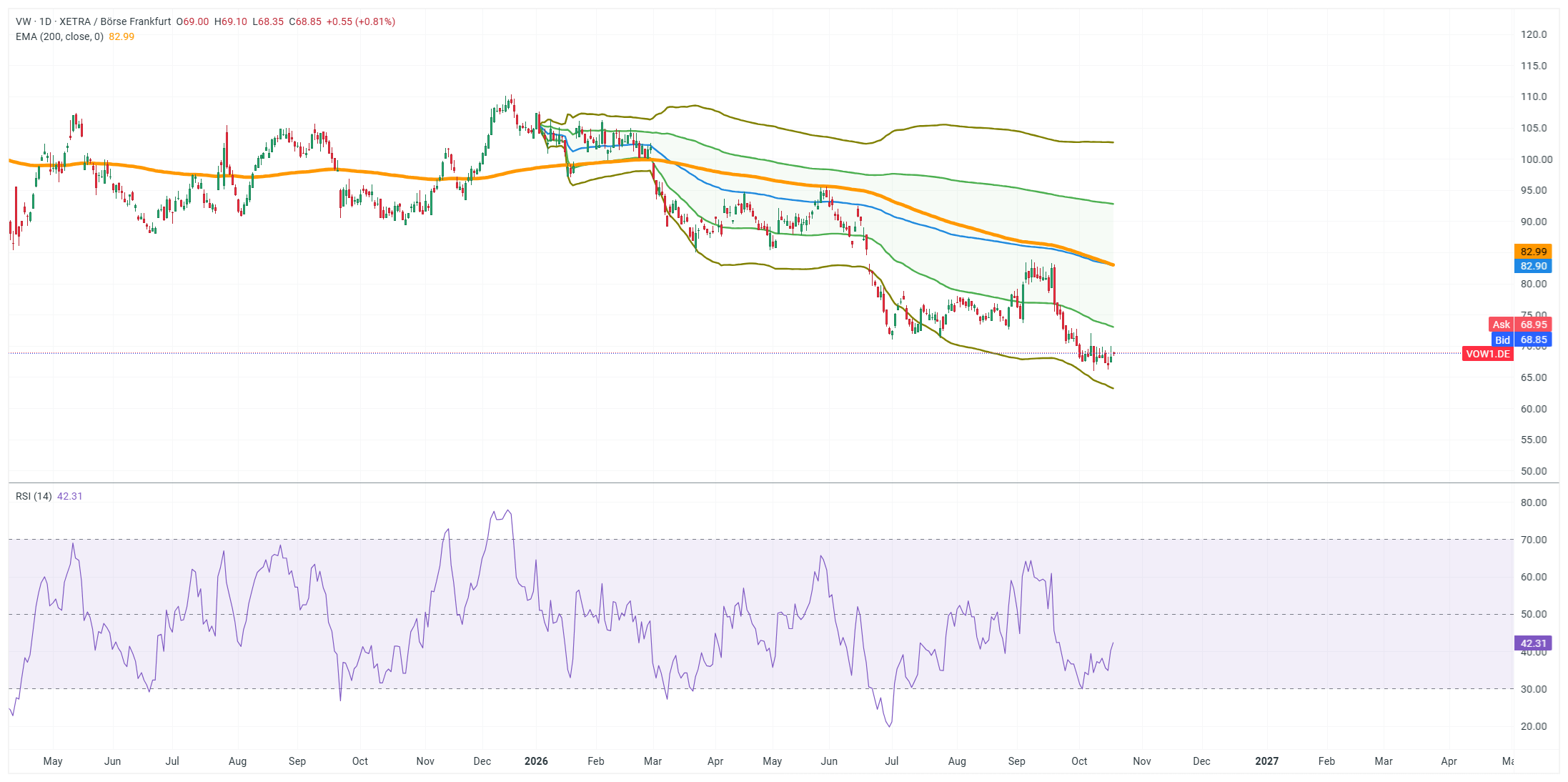
November Wage Negotiations: The Next Major Catalyst
The reported collective bargaining negotiations expected in late November could become an important catalyst for Volkswagen shares.
A negotiated settlement could provide greater clarity on personnel costs, employee compensation and the implementation of the restructuring programme. It could also reduce the risk of industrial action affecting production.
Conversely, a breakdown in negotiations could increase uncertainty over operating schedules and the timing of planned cost reductions. The possibility of strikes from January 2027, as described in the supplied report, makes the outcome particularly relevant to the company’s near-term outlook.
Investors should watch for confirmed announcements from Volkswagen and employee representatives rather than assume that the proposed wage freeze will be implemented exactly as reported.
Market Outlook for the Coming Sessions
Volkswagen shares remain exposed to both restructuring opportunities and significant execution risks. The key developments to monitor are:
- Collective bargaining negotiations: Whether management and IG Metall reach an agreement.
- Cost-reduction targets: Whether planned savings translate into measurable improvements in margins and cash flow.
- Workforce and factory plans: Whether proposed changes are formally approved and how they affect production capacity.
- Electric vehicle competitiveness: Whether Volkswagen can improve pricing, technology and product appeal.
- China exposure: Whether the company can stabilise its position in one of the world’s most competitive automotive markets.
- Financial guidance: Whether management’s outlook supports expectations for a recovery in profitability.
- Technical confirmation: Whether the share price can establish a sustained recovery rather than a short-lived rebound.
The outlook remains uncertain. A labour settlement and tangible operating improvements could support a recovery, while prolonged disputes and weak financial performance could keep the shares under pressure.
Currency Hedger View: Volkswagen and Foreign-Exchange Exposure
Volkswagen’s international operations expose the group and its supply chain to currency movements as well as changes in vehicle demand, production costs and trade conditions.
Exchange-rate fluctuations can affect the translated value of overseas earnings, the cost of imported components and the competitiveness of vehicles sold in different markets. For automotive suppliers and businesses trading internationally, currency movements can also influence margins and cash-flow forecasts.
Companies with recurring cross-border payments should assess their currency exposure alongside broader operating risks. Appropriate currency hedging arrangements may help improve the predictability of future payment costs, depending on the currency pair and business requirements. Hedging does not remove the underlying commercial risks facing automotive manufacturers.
Manage international currency exposure with Currency Hedger:
Today Markets Analysis
Volkswagen shares are facing a difficult combination of restructuring uncertainty, labour tensions and competitive pressure from the global transition to electric vehicles. The reported decline to levels last seen in 2010 reflects substantial investor concern, although the share price alone does not establish the company’s intrinsic value.
The proposed wage freeze and workforce reductions could improve the cost base if successfully negotiated and implemented. However, those measures will not independently resolve challenges involving product competitiveness, software, electric vehicle economics and market share.
The immediate focus is the forthcoming labour negotiations and whether management can secure a workable agreement without prolonged production disruption. Beyond that, a sustained share-price recovery will require evidence of stronger profitability, improved cash generation and a more convincing long-term competitive position.
For investors, the distinction is clear: cost-cutting may support the turnaround, but operational execution will determine whether Volkswagen can rebuild market confidence.
Market analysis by Today Markets, with international payment and currency exposure insights from Currency Hedger.
Risk Disclaimer: This material is provided for informational and educational purposes only and does not constitute investment advice, financial advice, or a recommendation to buy or sell any financial instrument. Equities can be volatile, and investors may lose some or all of their invested capital. Forecasts and market scenarios are conditional and are not guarantees of future performance. Investors should conduct their own research and assess their financial circumstances and risk tolerance before making investment decisions.