S&P 500 — US Large Cap Index
 FTSE 100 — UK Blue Chips
 Euro Stoxx 50 — Eurozone Leaders
 DAX 40 — German Equities
 CAC 40 — French Market Index
 Nikkei 225 — Japan Benchmark
 Hang Seng — Hong Kong Index
 Shanghai Composite — China Mainland
 ASX 200 — Australian Market
 TSX Composite — Canada Index
 Nifty 50 — India Large Cap
 STI Index — Singapore Market
 KOSPI — South Korea Index
 Bovespa — Brazil Equities
 JSE Top 40 — South Africa Index
 IPC Index — Mexico Market

Chart of The Day – Cocoa sell-off continues. Record ICE inventories and index rebalancing in focus


London cocoa futures (COCOA.EU) are down 2.5% and are extending a sell-off that has now lasted for around three weeks, falling to their lowest levels in roughly four months. Prices are being pressured by rising ICE inventories, fund selling and announced reductions in cocoa weightings across major commodity indices, although medium-term support remains in place due to El Niño-related supply risks and weaker crop prospects in West Africa.
- The sell-off in cocoa futures on both sides of the Atlantic, from New York to London, has accelerated as fund activity increased and the technical picture deteriorated after several weeks of persistent price declines.
- One of the key sources of pressure is the rise in ICE inventories, which have reached 3.75 million bags, the highest level in 2.5 years.
- At the same time, the S&P GSCI and Bloomberg Commodity Index have announced plans to reduce their exposure to cocoa, increasing expectations of additional selling by index-tracking funds.
- Deliveries from Ivory Coast remain weak, StoneX expects the market to move into deficit in the 2026/27 season, while an exceptionally strong El Niño raises the risk of lower production across West Africa.
Are funds starting to front-run the rebalancing?
One of the most important short-term drivers for the cocoa market is no longer just crop data, but capital flows. The S&P GSCI has announced that cocoa’s weighting in the index will be cut by more than half in 2027, while the Bloomberg Commodity Index is also planning to reduce its exposure to the commodity. For the futures market, this has real implications. Passive funds tracking those indices will have to reduce positions during the formal rebalancing process, and some investors are already trying to front-run those flows. As a result, selling pressure may be driven not only by fundamentals, but also by mechanical portfolio adjustments, which can amplify downside momentum in the short term.
Rising inventories weaken the chronic shortage narrative
The second major pillar behind the current decline is inventories. Cocoa stocks held in ICE-monitored warehouses have risen to 3.751 million bags, the highest level in around 2.5 years. This marks a significant change from the period when the market was dominated by concerns over the physical availability of cocoa. The larger the exchange inventories, the lower the premium for immediate access to cocoa and the weaker the argument for maintaining extremely elevated prices. In addition, Nigerian cocoa bean exports rose 33% YoY in September to 19.343 thousand tonnes, further supporting the view that near-term availability has improved.
West Africa remains the biggest upside risk
The strongest counterargument against further declines comes from Ivory Coast and Ghana. In the week ended November 8, deliveries to Ivorian ports amounted to just 55.3 thousand tonnes, compared with more than 107 thousand tonnes a year earlier. Season-to-date arrivals have fallen 45% YoY to 228.5 thousand tonnes. StoneX expects global production in the 2026/27 season to decline by 9.6% to 4.74 million tonnes, while the market is projected to swing from a large surplus in 2025/26 to a deficit of around 64 thousand tonnes.
Could El Niño quickly change the balance?
Weather risks also remain impossible to ignore. The US Climate Prediction Center estimates that the current El Niño could rank among the strongest in more than 75 years, and this type of weather pattern typically brings warmer and drier conditions to West Africa. That raises the risk of lower soil moisture, increased stress on cocoa trees and weaker yields. Early estimates for Ivory Coast point to production of around 1.8 million tonnes, potentially down as much as 18% from the previous season, while Ghana is also facing the risk of a meaningful decline in output.
Demand is sending mixed signals
The demand picture is far from clear-cut. North American cocoa grindings fell 2.5% YoY in Q3, reinforcing concerns that high prices are weighing on consumption, while grindings in Asia surged 29% YoY and rose 3.2% in Europe. For now, short-term capital flows and rising inventories are clearly working in favor of the bears, but weather risks and production problems in West Africa continue to limit the scope for a sustained normalization in prices.
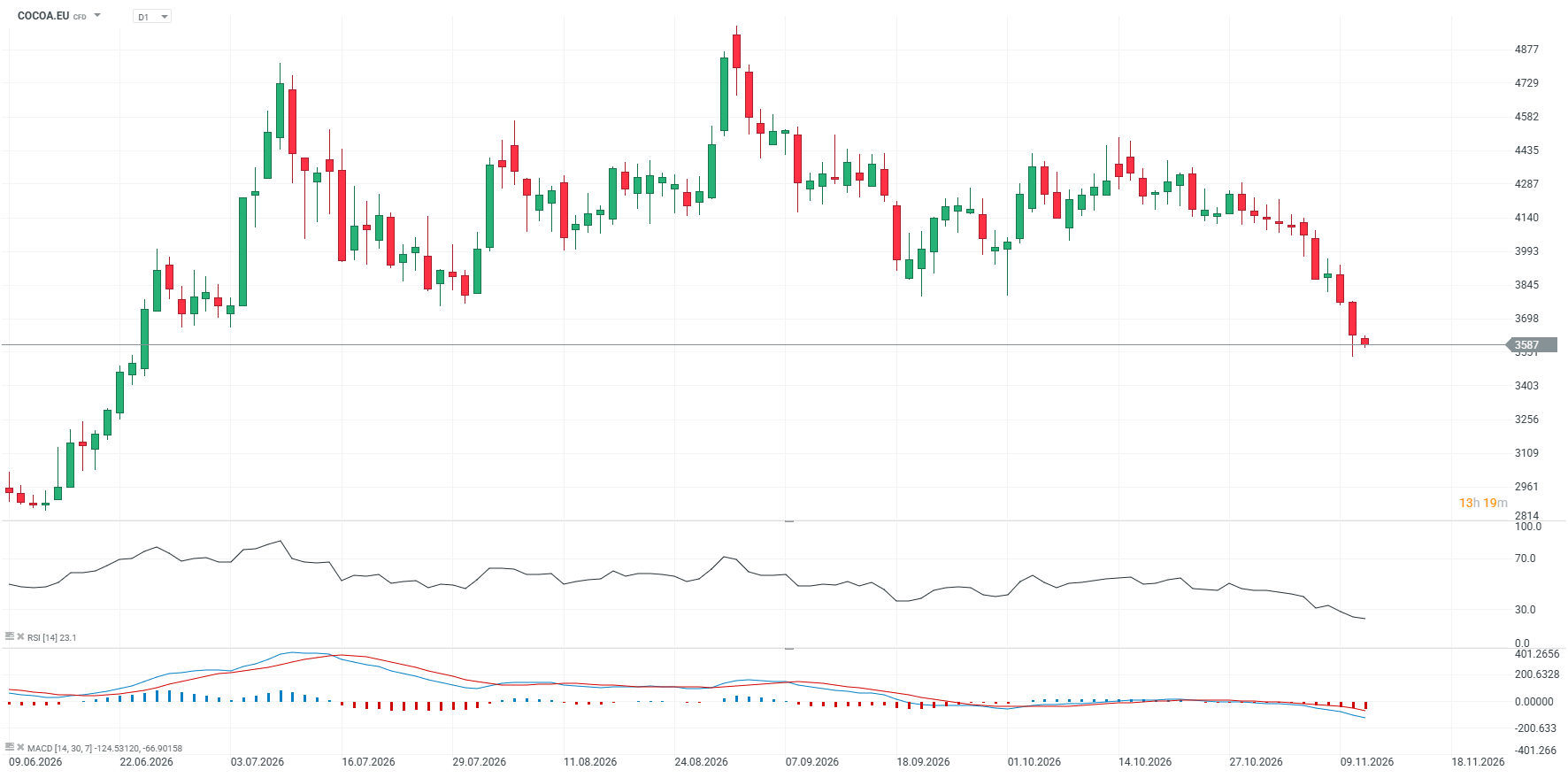
COCOA.EU chart (D1 interval)
Cocoa futures on ICE Futures Europe are falling to levels not seen since the second half of June and are now down almost 30% from the record high of GBP 5,000 per tonne. A key risk for the market is further mixed grinding data pointing to subdued demand from the food industry, alongside limited El Niño effects and continued growth in ICE inventories. Compared with November 4 levels alone, the contract has already fallen by more than 12%. The European cocoa price contract, based on London ICE Futures Europe prices, remains in a downtrend and is scheduled to roll over on November 12. The COCOA instrument based on ICE US contracts rolled over overnight from November 10 to November 11, although trading in the instrument has not yet reopened.
Source: XTB