S&P 500 — US Large Cap Index
 FTSE 100 — UK Blue Chips
 Euro Stoxx 50 — Eurozone Leaders
 DAX 40 — German Equities
 CAC 40 — French Market Index
 Nikkei 225 — Japan Benchmark
 Hang Seng — Hong Kong Index
 Shanghai Composite — China Mainland
 ASX 200 — Australian Market
 TSX Composite — Canada Index
 Nifty 50 — India Large Cap
 STI Index — Singapore Market
 KOSPI — South Korea Index
 Bovespa — Brazil Equities
 JSE Top 40 — South Africa Index
 IPC Index — Mexico Market

Market Situation
In the energy commodities market, we are seeing a strong sell-off today, led by WTI crude (-4.35%) and Brent (-3.65%), which have already lost 9.58% and 8.65% respectively on a weekly basis. This sharp sell-off is a direct reaction to media reports of advanced talks and the possible imminent opening of the strategic Strait of Hormuz, which has drastically reduced supply concerns and lowered the risk premium. Precious metals are trading in a completely different mood today, with platinum gaining 6.05% and palladium rising 5.09%. In the long term, the entire group of metals shows extremely high valuations relative to historical norms, as indicated by high Z-score indicators for copper (+3.23σ), gold (+2.80σ), and silver (+2.54σ). On the other hand, in the short term, precious and industrial metals are not as heavily deviated from their means. The dynamic increases in metals coincide with speculation around Fed monetary policy, while falling oil prices bring temporary relief to debt markets ahead of the publication of key macroeconomic data. In the near future, it is important to watch closely whether the de-escalation of tensions around the Strait of Hormuz will permanently maintain downward pressure on the fuel sector.
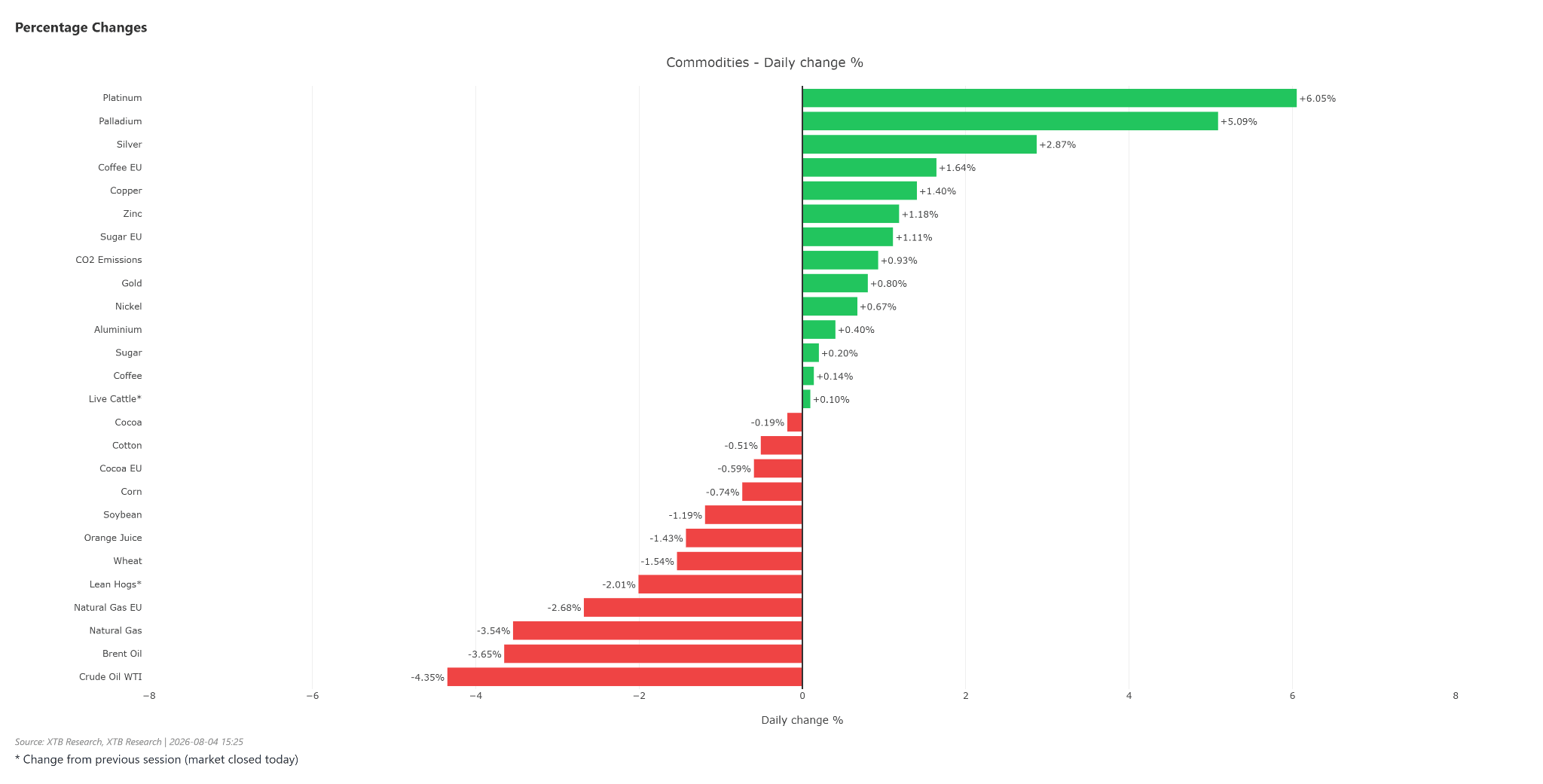
Daily changes in the commodity market. Falling energy commodity prices are boosting metals to rise. The agricultural commodity market remains calm after the recent higher volatility. Source: XTB
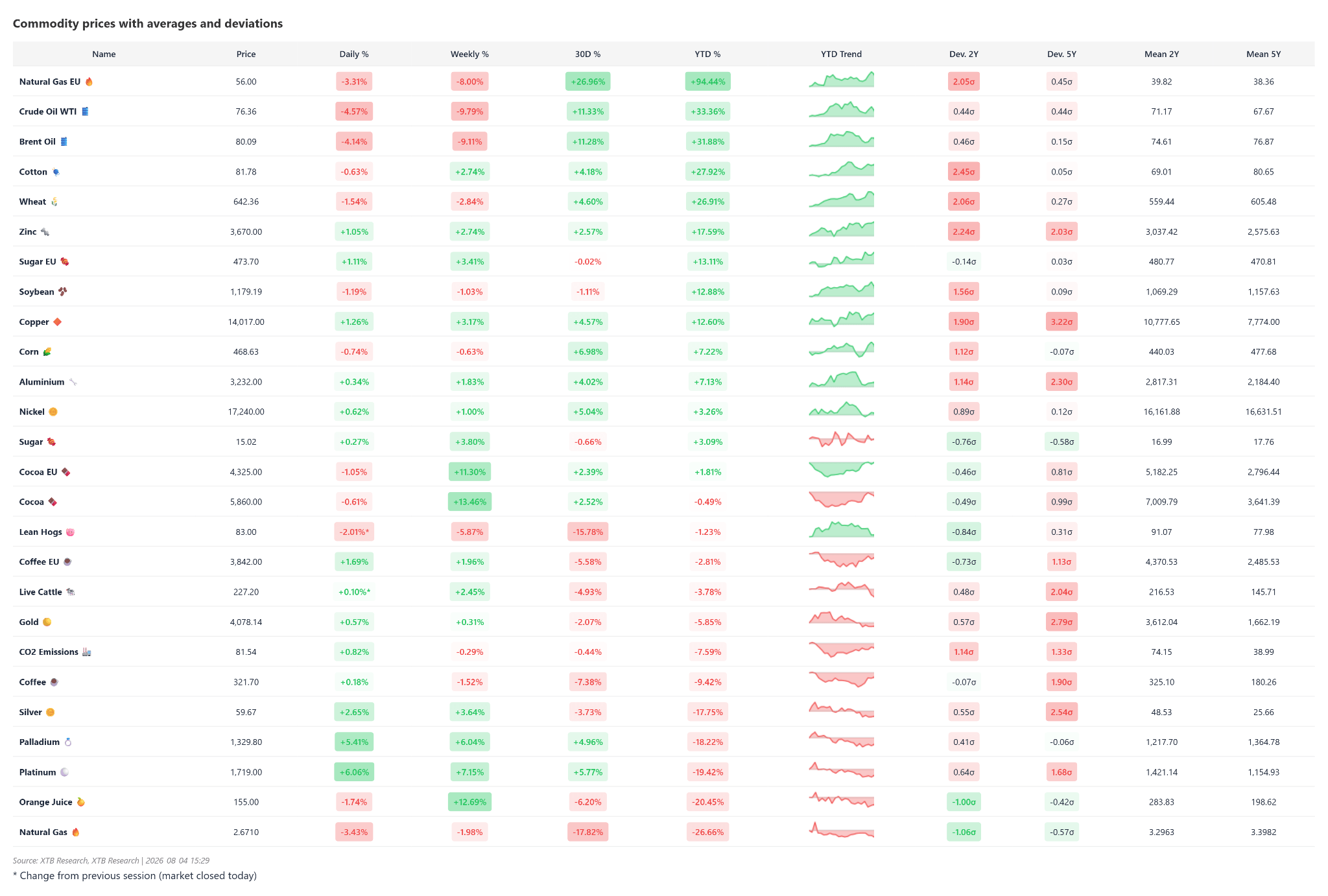
From a two-year perspective, TTF natural gas, cotton, wheat, and zinc remain the most overbought. Source: XTB
Crude Oil
- Brent oil prices rose at the beginning of Tuesday’s session towards $85 per barrel, and WTI exceeded $81 per barrel, attempting to recover part of the 8% decline from the beginning of this week. At 1:00 PM CET, information regarding a potential agreement began to surface, and prices not only negated the entire morning’s gains but began to lose even over 4% from yesterday’s close.
- President Donald Trump announced the cancellation of a mass attack on Iran, giving Tehran a “last chance” for an agreement on unblocking transport in the Strait of Hormuz.
- The Iranian side denies direct talks with the US, but confirms advanced negotiations with Oman on creating a temporary maritime route for merchant ships. It is this factor that is causing the greatest pressure on prices at the moment.
- The price drop in the second part of Tuesday’s session is the result of speculation about a “short-term agreement.” The Qatari side points to a short-term solution but does not mention any specifics.
- Scott Bessent is responsible for the declines today, indicating that a potential short-term agreement to open the Strait of Hormuz could be announced later today or tomorrow.
- Increased investor activity was also observed in put spread options for Brent oil (including November $70/$69 positions) and WTI, aimed at hedging OTC positions.
- Exports from Saudi Arabia fell slightly in July due to shipping hazards, while production in Kuwait rose to its highest level since the outbreak of fighting.
- Saudi Arabia reports that oil exports to Asia via the Suez Canal result in an increase in delivery time by about 20-25 days.
- At least 30 Ukrainian attacks on Russian oil infrastructure were recorded in July.
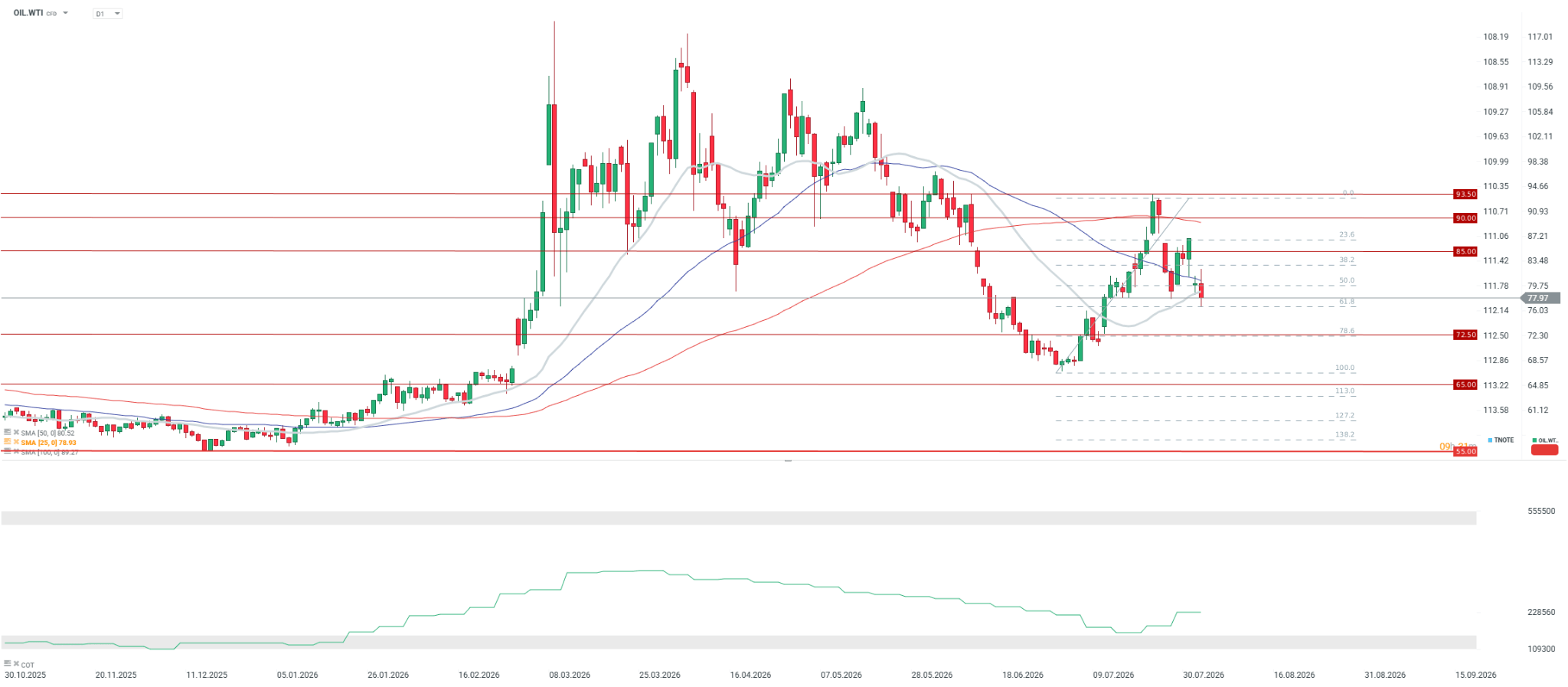
Crude oil prices return to declines after an early attempt to rebound and are trading at the lowest levels since mid-July. The price is falling not only below the 50-period average but also below the 25-period average, which is an important signal of short-term supply pressure. Source: xStation5
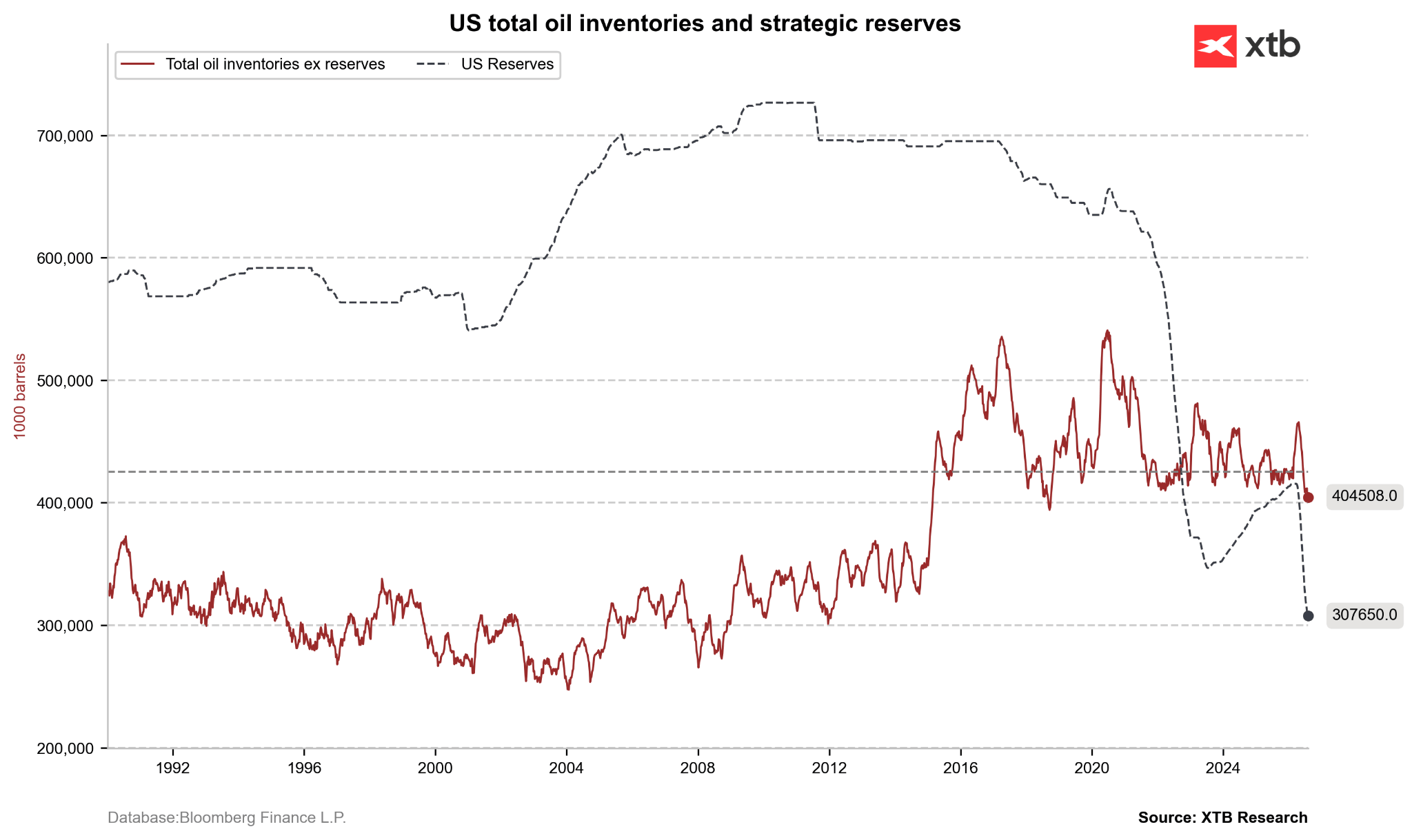
The situation in US inventories and reserves is becoming increasingly tight, but the market is ignoring the issue of physical tension at the moment. Source: Bloomberg Finance LP, XTB
Natural Gas
- TC Energy raised its ten-year natural gas demand forecast in North America by 40% (an increase of 51 bcf per day by 2035), driven by LNG exports and the dynamic development of AI data centers (e.g., the newly announced $13 billion Meta project in Alberta).
- AECO gas spot prices in Alberta were 1.52 CAD/Mcf against the US benchmark of 2.70 USD/MMBtu. Low prices prompted Canada’s largest producer, Tourmaline Oil, to limit production and redirect gas to storage.
- During the May-July period, LNG imports to India rose by 15.4% y/y to 7.08 million tons. The collapse in supplies from Qatar (-91.3% y/y) as a result of the Hormuz crisis was more than offset by increased volumes from the USA (+252.8%), Oman (+340.9%), Nigeria, and Angola.
- Kpler analysts predict that Asian LNG spot prices will remain high at 19-20 USD/MMBtu in the second half of the year due to limited availability and direct competition for cargoes with Europe.
- Gas exports in the US are accelerating but remain below the maximum capacity of approximately 20 BCfd.
- Temperatury in the perspective of the next two weeks are expected to remain above averages, but seasonally we are already past the peak consumption of the summer period.
- In view of the approaching winter period, US inventory levels remain high, and extreme El Nino may reduce heating needs in early November.
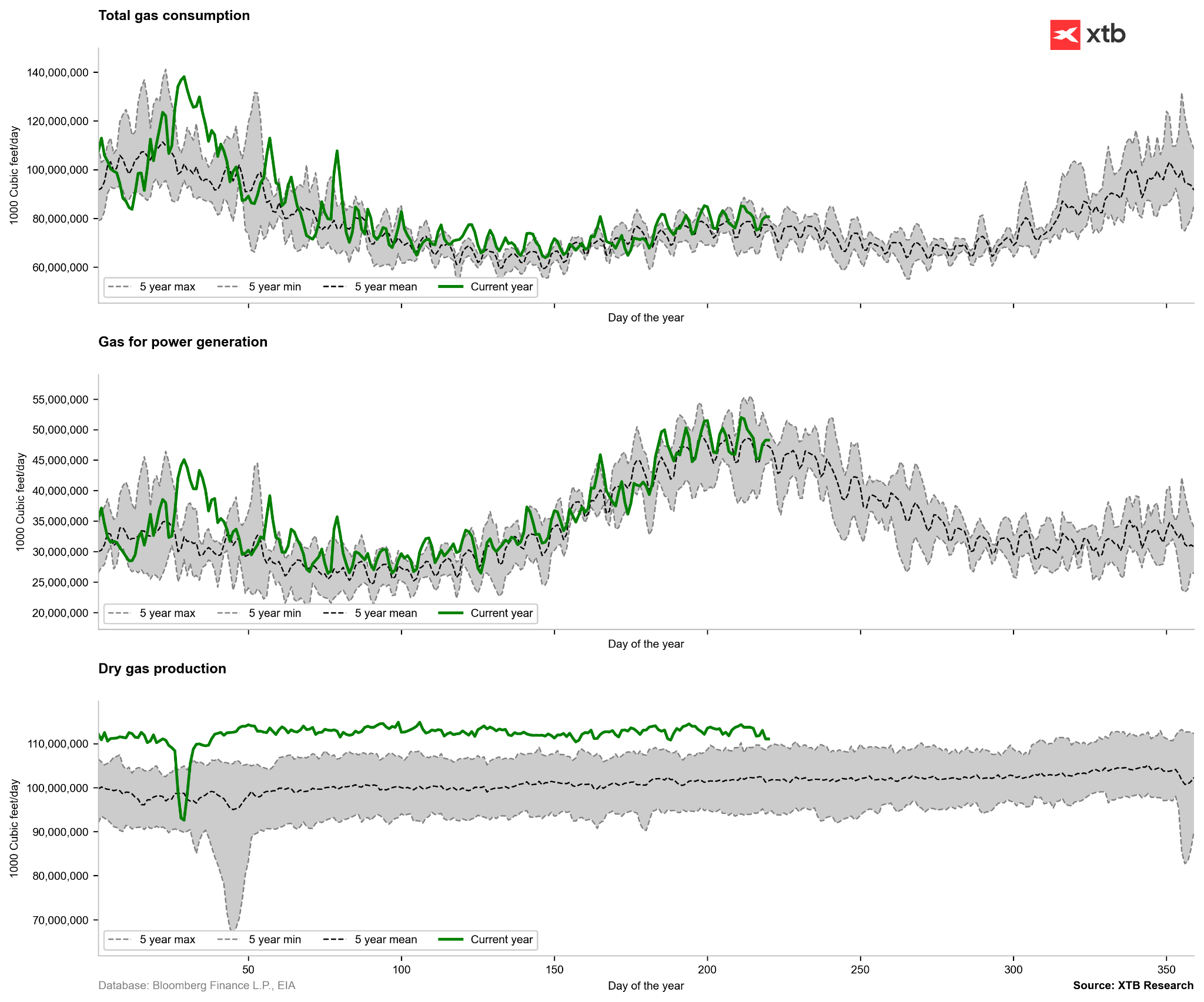
Gas consumption in the summer season is already outside the seasonal peak. Source: Bloomberg Finance LP, XTB
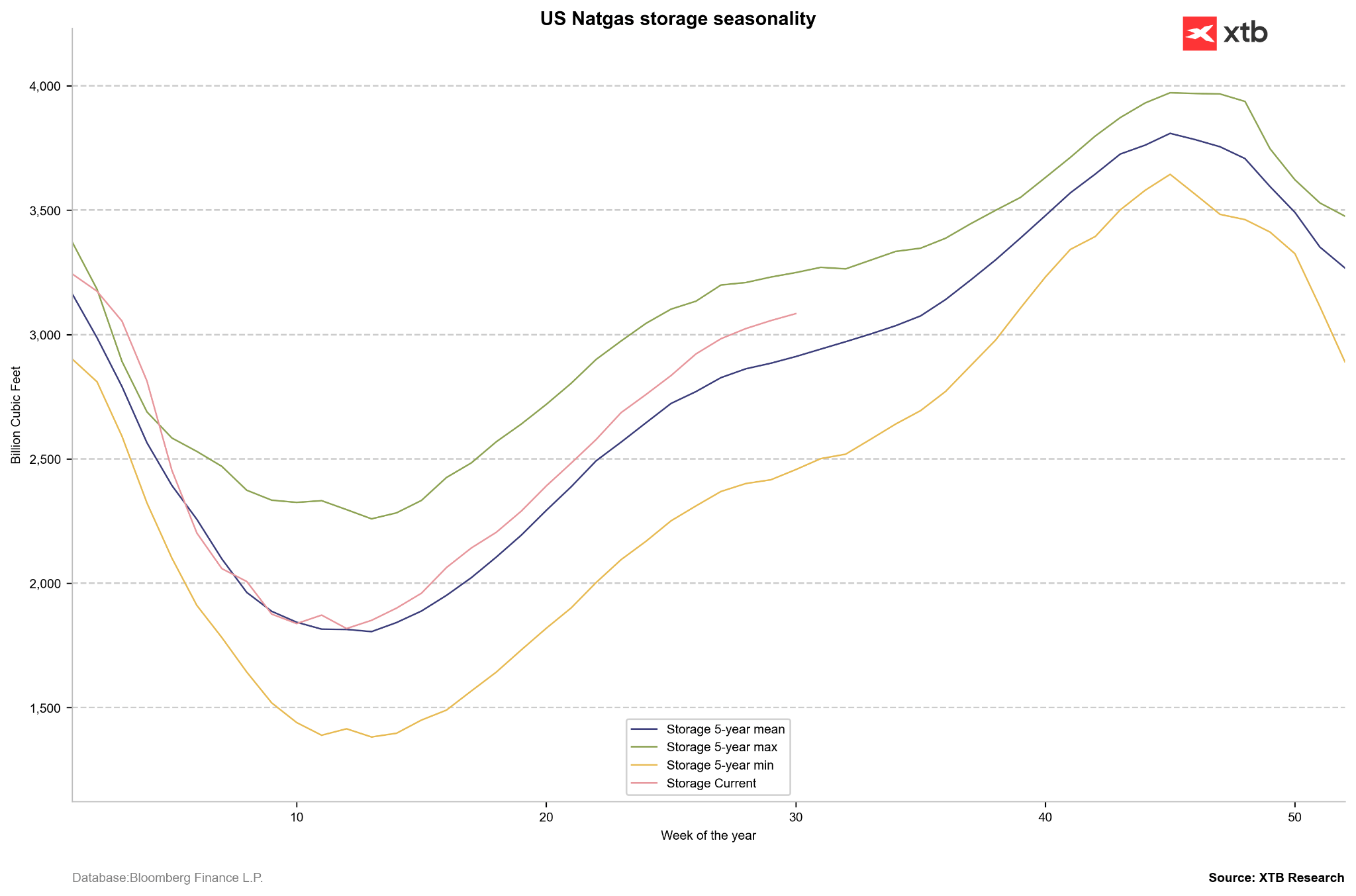
US inventory levels remain significantly above the 5-year average. Although the currently implied inventory change for the next few weeks is low, the distance from the 5-year average will most likely remain the same or even increase. Source: Bloomberg Finance LP, XTB
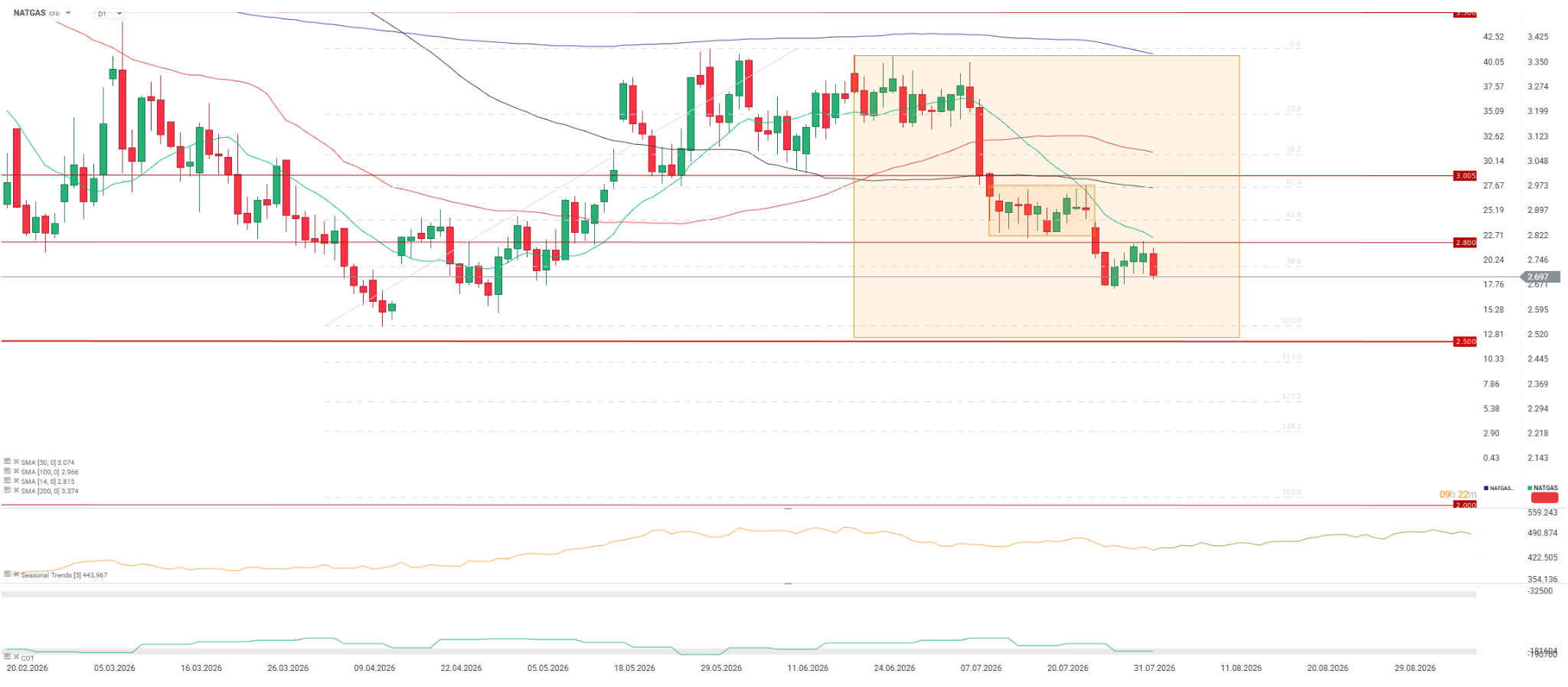
Price returns to declines and after breaking support at 2.65, the next wave could lead to testing the vicinity of 2.5 USD/MMBtu. Source: xStation5
Cocoa
- Cocoa futures in New York jumped over 10% at the start of the week, returning to around $6,000 per ton after earlier declines at the end of July below $5,000.
- The direct impulse for the increases were estimates from the Ghanaian regulator, forecasting a 16% drop in harvests in the 2026/2027 season as a result of unfavorable weather and the growing risk of a strong El Niño phenomenon.
- A sudden change in sentiment led to a wave of forced short covering by speculative investors.
- Farmers in Côte d’Ivoire and Cameroon are fighting the spread of swollen shoot and black pod diseases, intensifying chemical spraying.
- Large transactions on call spreads were noted on the ICE exchange in New York for July 2027, which may suggest expectations of supply problems for next year.
- Despite concerns regarding future supply, we observe a continued strong increase in inventories in the market, which may indicate a strong harvest season with limited demand.
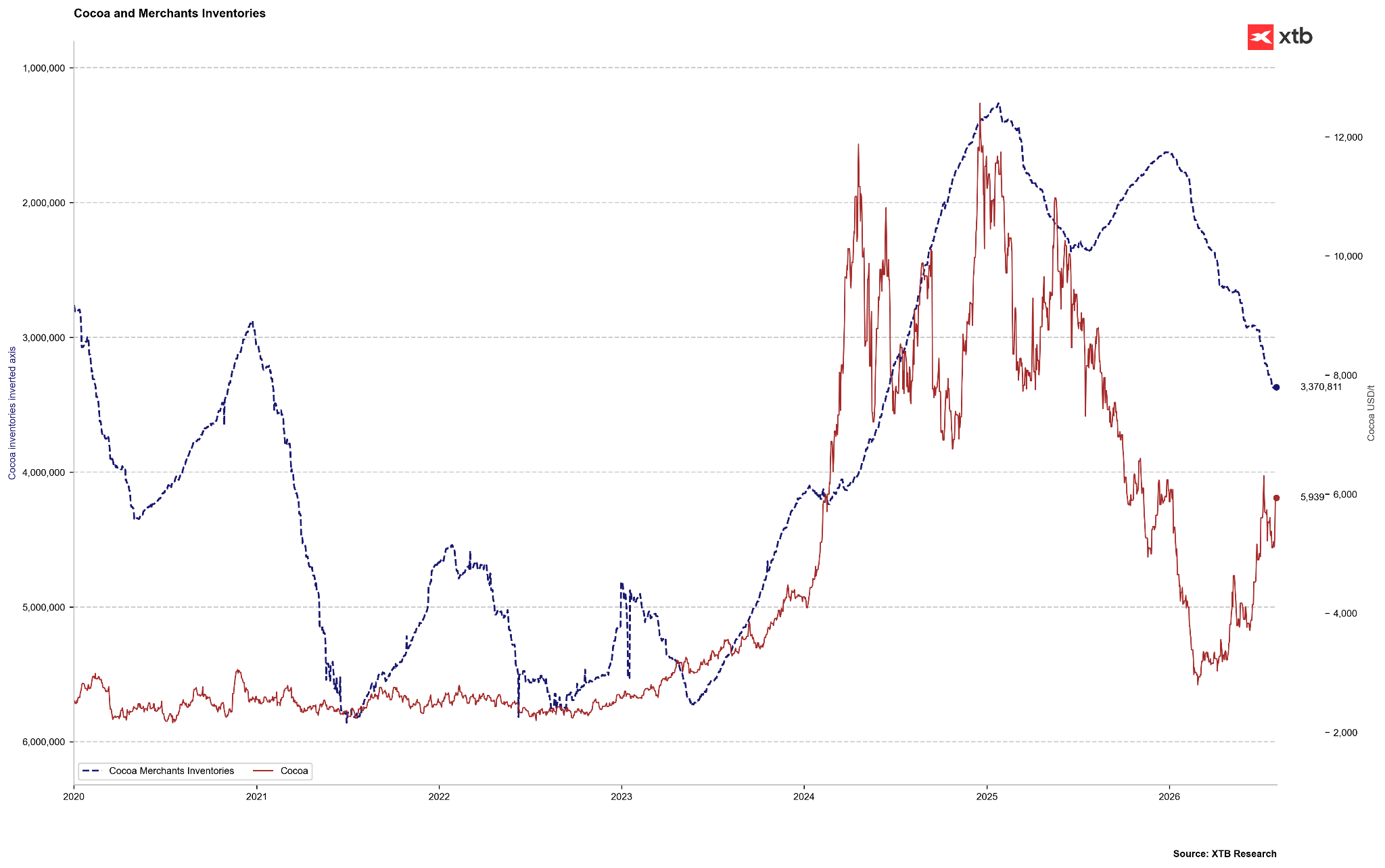
Since the beginning of this year, cocoa inventories on ICE have increased by over 1 million bags. The current situation resembles 2021. If inventories rise to over 4 million bags this year, the price increase above $6,000 per ton will not be justified. Source: Bloomberg Finance LP, XTB
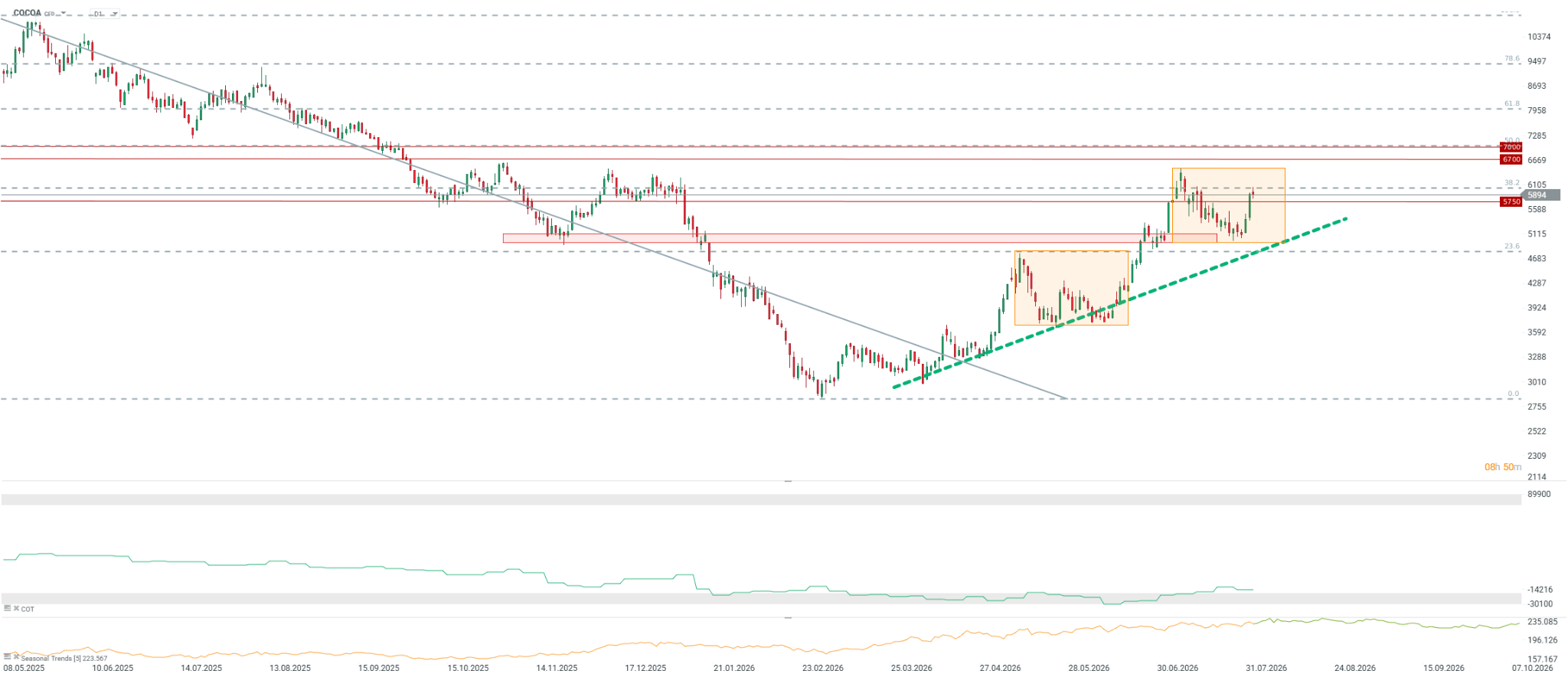
The cocoa price rebounded again but shows similar behavior as at the turn of April and May, which could mean that after the current rebound, it will again test levels close to $5,000. Source: xStation5
Wheat
- Winter wheat harvests in the United States reached 86% (in line with the multi-year average).
- The condition of spring wheat ranks 55% in the good or excellent category, and the condition index rose to 97 points (compared to 96 points a week earlier).
- Wheat inspections for export at the end of the week in July fell by nearly 20% compared to the previous week and were simultaneously half as low as last year. US wheat deliveries in the current marketing year remain 27% below last year’s levels.
- Western and Central Europe (including France, Germany, England) are struggling with heatwaves reaching 31-35 degrees Celsius and limited, local rainfall.
- Good, wet weather favors crop development in central Russia and on the Canadian prairie (outside the dry southwestern region).
- Uneven rains in Australia and the ongoing drought in Argentina create unfavorable conditions for vegetation. Wheat crops in Australia typically lose very heavily on a strong El Nino.
- On the CBOT exchange, investors were acquiring call spreads on Kansas City wheat.
- Wheat still remains at an elevated level, which is related to Russia’s export problems, but with the start of the spring wheat harvest in the US and Europe, supply pressure should decrease, which could lead to a reduction in prices from the recent high levels.
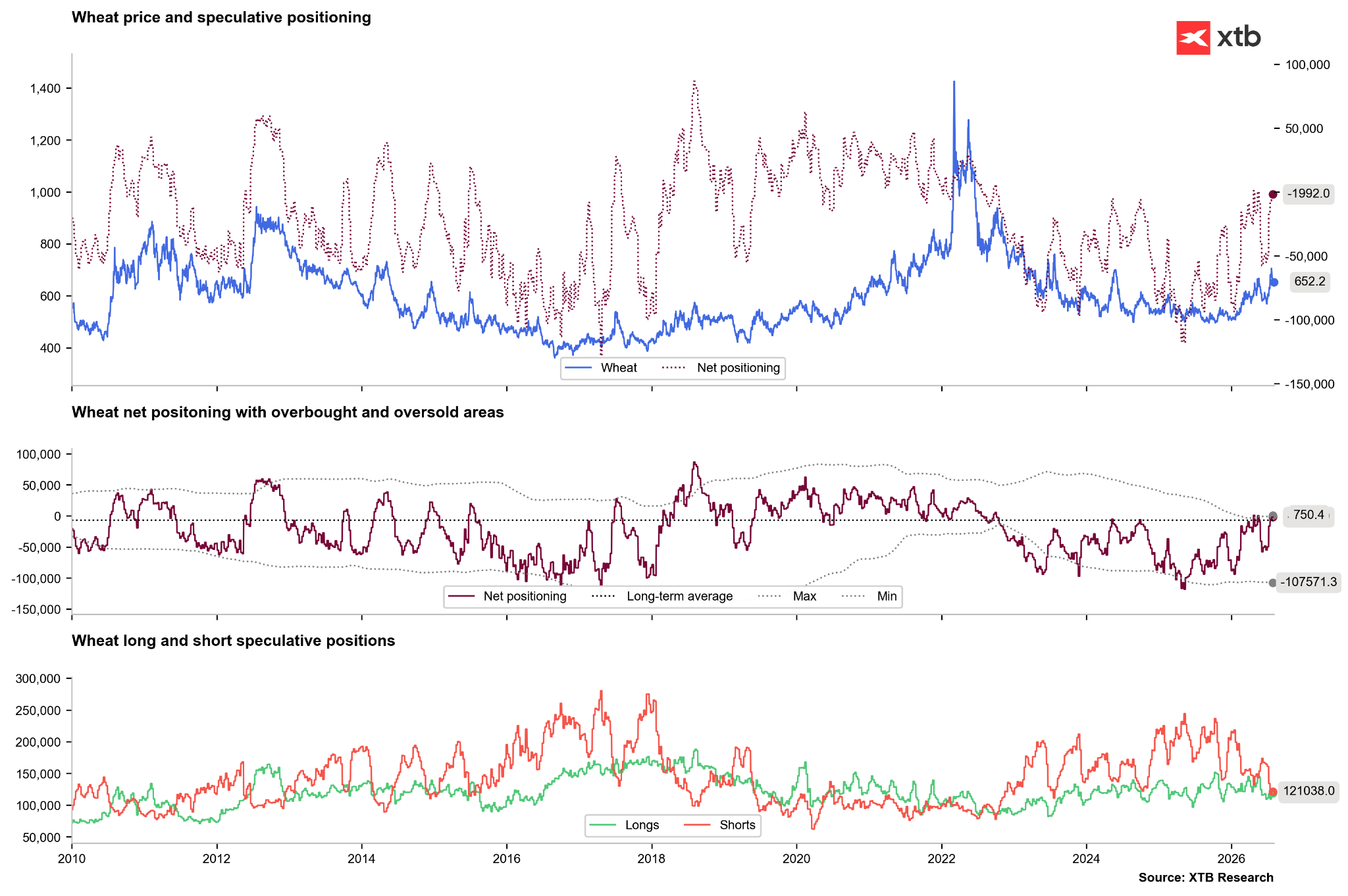
Short positions on wheat have been clearly reduced and net positions are minimally negative. At the same time, looking at the situation in recent years, net positions are at an extremely high level from the perspective of the last 3 years, which may indicate a potential return of sellers. Source: Bloomberg Finance LP, XTB
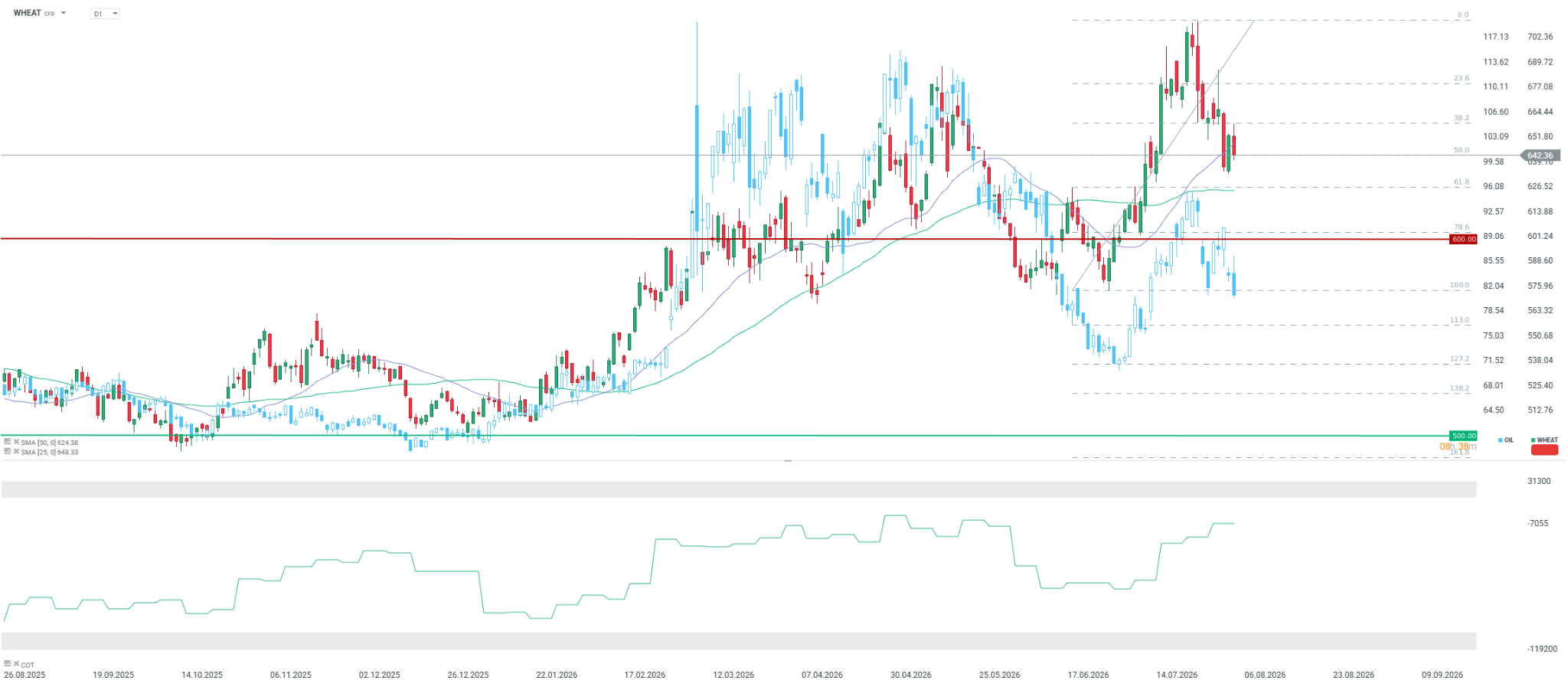
Wheat and other agricultural commodities are clearly correlated with crude oil prices. Nevertheless, apart from oil itself, current fundamentals do not indicate that wheat is lacking in the market, so further price reductions cannot be ruled out. Source: xStation5