S&P 500 — US Large Cap Index
 FTSE 100 — UK Blue Chips
 Euro Stoxx 50 — Eurozone Leaders
 DAX 40 — German Equities
 CAC 40 — French Market Index
 Nikkei 225 — Japan Benchmark
 Hang Seng — Hong Kong Index
 Shanghai Composite — China Mainland
 ASX 200 — Australian Market
 TSX Composite — Canada Index
 Nifty 50 — India Large Cap
 STI Index — Singapore Market
 KOSPI — South Korea Index
 Bovespa — Brazil Equities
 JSE Top 40 — South Africa Index
 IPC Index — Mexico Market
Private Credit Shows Early Signs of Stabilisation as Blue Owl Redemption Pressure Eases


Private credit markets are showing early signs that the intense redemption pressure seen during 2026 may be starting to moderate. Blue Owl Capital has become one of the clearest indicators of investor stress in the sector, and the latest figures show withdrawal requests from two major funds declining for a second consecutive quarter.
Investors sought to withdraw approximately $4.2 billion from two Blue Owl private credit funds during the latest tender period, down from $4.7 billion in the previous quarter and a peak of roughly $5.4 billion earlier in the year. The funds will continue to apply the customary 5% redemption limit, meaning the reduction in requests does not yet translate into full liquidity for investors.
The latest data therefore point toward improving conditions, but not a complete resolution of the problems that have pressured private credit throughout the year.
Market Snapshot
| Indicator | Current Situation |
|---|---|
| Blue Owl redemption requests | $4.2 billion |
| Previous quarter | $4.7 billion |
| Earlier peak | Approximately $5.4 billion |
| Standard redemption limit | 5% |
| Blue Owl Credit Income Corp. requests | 16.8% of shares |
| Blue Owl Technology Income Corp. requests | Approximately 39% of shares |
| OWL share price | Around $9.10 |
| Main concern | Private-credit liquidity and software exposure |
| Key market issue | Whether redemption pressure continues to decline |
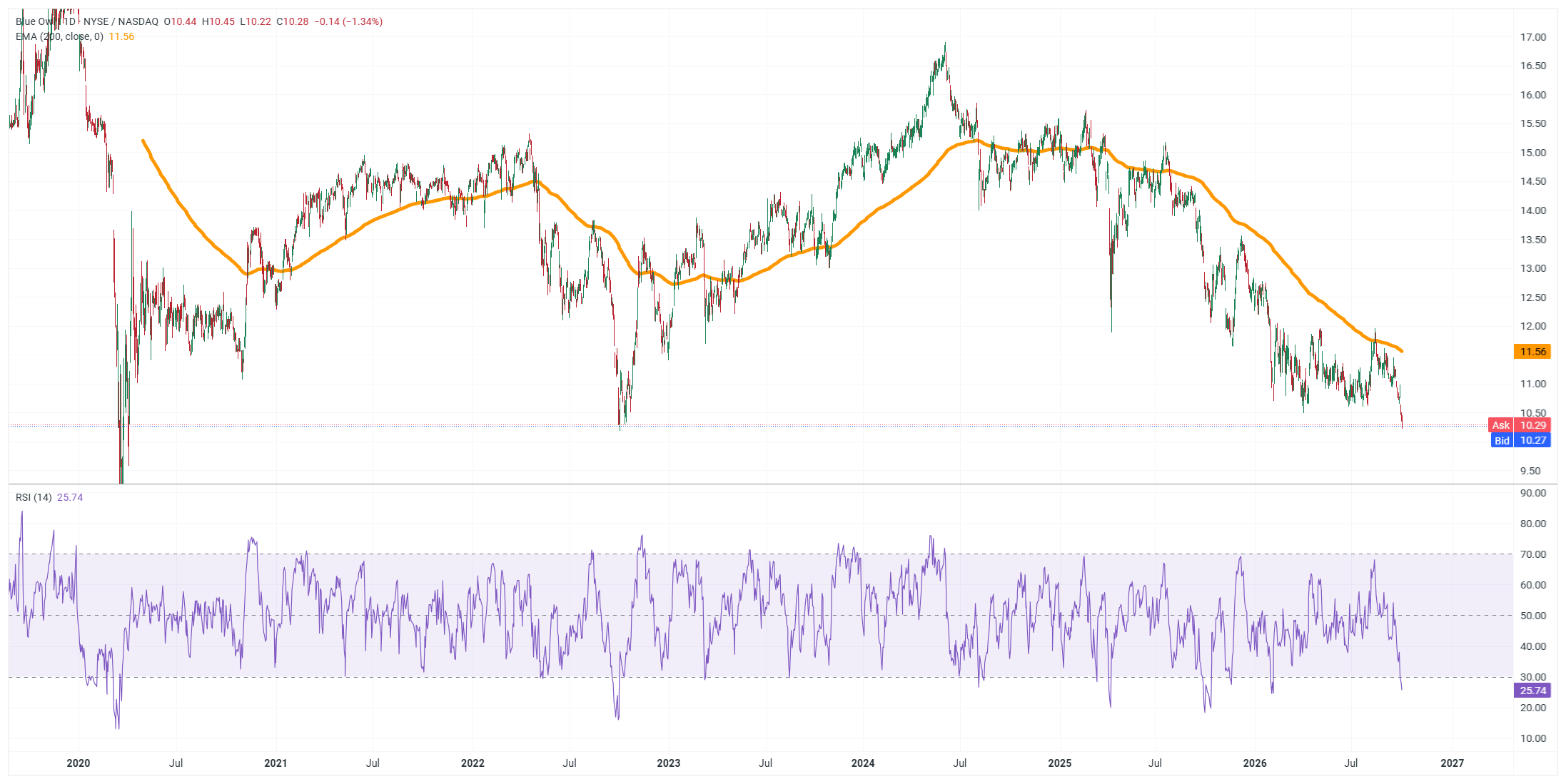
Blue Owl Capital shares closed around $9.10 on October 2, after trading as low as approximately $8.93 during the session. The stock remains under significant pressure compared with earlier levels, reflecting continuing investor concern around the company’s private-credit franchise and the wider sector.
Private Credit Redemption Pressure Begins to Ease
The most important development is the direction of redemption requests.
Investors requested approximately $4.2 billion from two Blue Owl funds in the latest period, compared with $4.7 billion previously. That follows the earlier peak of around $5.4 billion, creating a sequence of declining requests.
This is significant because private credit funds do not operate like highly liquid public equity funds. When redemption requests exceed the amount that a fund is permitted to repurchase, investors can remain in a queue and resubmit their requests during subsequent tender periods.
Blue Owl has indicated that a substantial proportion of recent requests represents investors who were previously unable to exit because of the redemption limits. This means the headline redemption figure can remain elevated even while the number of investors newly seeking to leave the funds is falling.
The distinction between new redemption demand and repeated redemption requests will therefore be critical for assessing whether the current improvement represents genuine stabilisation.
The 5% Redemption Limit Remains Important
The reduction in requests should not be interpreted as investors suddenly receiving unrestricted access to their capital.
Blue Owl’s funds continue to operate with a 5% repurchase threshold. The latest redemption requests were substantially larger than the amount that can be returned during a single tender window.
That creates an important liquidity dynamic.
If redemption requests continue falling below previous peaks, the backlog can gradually be reduced. However, if investors continue to submit large requests, the queue can remain significant even if each quarterly figure becomes smaller.
For the market, the key question is therefore not simply whether requests have declined, but whether they continue to decline over the next several quarters.
Technology Credit Remains the Major Pressure Point
The technology-focused portion of Blue Owl’s business remains more exposed to investor concerns.
Blue Owl Technology Income Corp. received redemption requests equivalent to approximately 39% of shares, or about $1.1 billion, during the latest period. That compares with approximately 38.1% previously.
The concentration of investor concern around technology lending reflects uncertainty about the impact of artificial intelligence on traditional software businesses.
The issue is not simply whether individual software companies can remain profitable. Private lenders must also assess whether borrowers’ cash flows, valuations and refinancing capacity remain sufficient to support existing debt structures.
Rapid advances in AI could improve productivity for some software businesses while simultaneously reducing the value of certain traditional software products. This creates a more complicated credit environment for lenders with concentrated exposure to the sector.
Credit Fundamentals Remain a Second Question
Redemption pressure is only one side of the private-credit equation.
The other is the underlying quality of the loan portfolios.
Blue Owl has argued that the credit fundamentals of its funds remain resilient despite investor concerns surrounding software and AI disruption. The company has also highlighted the distinction between market sentiment and actual borrower performance.
This distinction will become increasingly important.
If borrowers continue making scheduled interest and principal payments, private credit valuations can remain relatively stable even when public-market sentiment is weak.
Conversely, if software weakness begins translating into higher defaults, restructurings or significant valuation reductions, the redemption problem could become more difficult to contain.
Private Credit Stabilisation Is Broader Than Blue Owl
Blue Owl is not operating in isolation.
Other major private-credit managers have also experienced elevated withdrawal requests during 2026, although the latest data indicate that redemption pressure is beginning to moderate across parts of the industry.
Goldman Sachs’ private-credit fund, for example, reported third-quarter withdrawal requests equivalent to around 2% of shareholders, down from 3.2% previously and below the customary 5% threshold. Other major private-credit funds have continued to experience substantially higher demand for withdrawals.
The broader evidence therefore suggests that private credit remains under pressure, but the pace of deterioration has become less severe.
Blue Owl Shares Remain Under Pressure
The equity market has not yet fully accepted the improvement in redemption data.
Blue Owl shares remain close to recent lows, with the stock closing near $9.10 at the end of the latest session. Recent trading has also been accompanied by substantial volume, highlighting the degree of investor attention surrounding the company.
The share price therefore continues to reflect concerns that go beyond the immediate redemption figures.
Investors are assessing the potential effect of lower asset-management fees, slower fundraising, private-credit performance, software exposure and the possibility that prolonged redemption queues could constrain the business.
Bullish Scenario
The stabilisation case would strengthen if redemption requests continue falling over the coming quarters.
A sustained reduction in new redemption applications would gradually allow funds to work through existing queues. At the same time, stable borrower performance and low levels of credit deterioration could reduce concerns about the quality of private-credit portfolios.
A recovery in investor confidence could then support new subscriptions and improve the operating environment for private-credit managers.
For Blue Owl, evidence that technology borrowers are adapting successfully to AI disruption would also be important.
Bearish Scenario
The main risk is that the apparent improvement in redemption requests proves temporary.
If investors continue submitting substantial withdrawal requests, the 5% redemption limit could maintain a large backlog. That would keep liquidity concerns in focus and potentially increase pressure on fund managers to sell assets or raise additional liquidity.
A deterioration in software-credit fundamentals would represent a second major risk.
Defaults, restructurings, declining valuations or weaker refinancing conditions among technology borrowers could reinforce investor concerns and generate another wave of redemption requests.
Private Credit Outlook
The private-credit market appears to be moving from an acute liquidity shock toward a more gradual process of normalisation.
However, the latest data do not establish that the stress has ended.
The most constructive signal is the decline in aggregate redemption requests from the Blue Owl funds. The most important counterpoint is that requests remain well above the 5% repurchase threshold, while the technology-focused fund continues to experience exceptionally high withdrawal demand.
The next phase will therefore depend increasingly on credit performance rather than redemption headlines alone.
If underlying portfolios remain resilient while redemption queues decline, the sector could gradually regain investor confidence. If credit losses begin accelerating, the liquidity pressure could return quickly.
Blue Owl Stock Outlook
Blue Owl shares remain highly sensitive to developments in private-credit sentiment.
The recent price action shows that investors continue to demand a substantial risk premium from the company. The stock’s recent lows have occurred alongside renewed concerns surrounding software lending and private-credit valuations.
A sustained improvement in redemption data could help reduce that pressure, but the equity market is likely to require evidence that the improvement is durable.
The next meaningful signal will therefore be whether redemption requests continue to decline while fund performance and credit quality remain stable.
Private Credit Supply Outlook
Private credit remains a major source of corporate financing, particularly for middle-market and sponsor-backed companies.
The sector’s ability to continue expanding will depend on investor willingness to provide long-duration capital and accept the limited liquidity associated with private funds.
A prolonged redemption cycle could constrain new lending capacity, while stabilising flows would allow managers to focus again on new originations.
The balance between fundraising, redemptions and asset quality will remain central to the sector’s growth prospects.
Private Credit Demand Outlook
Demand for private credit from borrowers remains supported by its ability to provide customised financing outside traditional bank lending channels.
However, lenders are likely to become more selective where borrowers have significant exposure to software disruption, refinancing requirements or uncertain cash-flow growth.
The AI-driven transformation of the technology sector could therefore produce a wider divergence between strong borrowers and companies whose business models face structural pressure.
Louis Roche Analysis
The latest Blue Owl figures provide an important change in direction for private credit, but the market should distinguish stabilisation from resolution.
The decline from $5.4 billion to $4.7 billion and then to $4.2 billion in redemption requests is encouraging from a trend perspective. It suggests that the intensity of investor withdrawals may have peaked.
However, the absolute level remains substantial, and the 5% redemption limit means the industry is still dealing with a liquidity mismatch between what investors want to withdraw and what funds can currently return.
The more important development now is the composition of those requests.
If a growing proportion represents old redemption applications moving through the queue, while new requests continue to decline, private credit could gradually move toward a more normal liquidity environment.
The technology-credit segment remains the critical test. Investors will be watching whether AI disruption translates into measurable deterioration in software borrowers or whether concerns prove greater than the actual impact on credit performance.
For Blue Owl, the coming quarters will therefore be less about whether redemption requests remain elevated and more about whether the direction of new requests, portfolio performance and asset quality all begin moving in the same direction.
Coming Sessions
Markets are likely to focus on:
- Further updates on private-credit redemption requests
- The size of outstanding redemption queues
- Credit performance across software and technology borrowers
- Default, restructuring and non-accrual trends
- Private-credit valuations and portfolio marks
- New fundraising and investor subscription activity
- Blue Owl’s next financial results and management commentary
- Developments across other major private-credit managers
- Evidence of whether AI disruption is translating into weaker software credit fundamentals
The private-credit market is showing early signs of breathing space, but the next several reporting periods will determine whether this becomes a sustained stabilisation or simply a temporary pause in investor withdrawals.
Currency Hedger View
Private-credit developments can influence broader financial-market risk sentiment, particularly when concerns surrounding corporate credit, liquidity and asset valuations spill into equities, currencies and funding markets.
Currency Hedger monitors foreign exchange markets alongside broader commodity and macroeconomic conditions, helping businesses assess and manage their international currency exposure.
Open an account with Currency Hedger:
Open a Currency Hedger Account
Visit Currency Hedger:
Contributor: Currency Hedger
Market analysis prepared for Today Markets. For informational purposes only and not intended as investment, trading, financial or commodity advice.