S&P 500 — US Large Cap Index
 FTSE 100 — UK Blue Chips
 Euro Stoxx 50 — Eurozone Leaders
 DAX 40 — German Equities
 CAC 40 — French Market Index
 Nikkei 225 — Japan Benchmark
 Hang Seng — Hong Kong Index
 Shanghai Composite — China Mainland
 ASX 200 — Australian Market
 TSX Composite — Canada Index
 Nifty 50 — India Large Cap
 STI Index — Singapore Market
 KOSPI — South Korea Index
 Bovespa — Brazil Equities
 JSE Top 40 — South Africa Index
 IPC Index — Mexico Market

The Mexican Peso is recovering modestly against the US Dollar, but the broader trend remains under pressure as a narrowing US-Mexico interest-rate differential continues to weaken the appeal of the Mexican carry trade.
USD/MXN has eased from a recent high near 18.35 to around 18.21, while the Peso remains on course for a weekly decline of approximately 3%. The latest US employment data have provided some relief for MXN by sharply reducing expectations for an October Federal Reserve rate increase, although Mexico’s declining rate advantage remains an important medium-term consideration.
Market Snapshot
| Market Factor | Current Reading | Market Implication |
|---|---|---|
| USD/MXN | Around 18.21 | Elevated near-term USD demand |
| Recent USD/MXN High | 18.35 | Key recent resistance area |
| Weekly MXN Performance | Approximately -3% | Peso remains under pressure |
| Mexico Policy Rate | 6.5% | Significant but narrowing carry advantage |
| US-Mexico Rate Differential | Around 2.25% if Fed hikes | Potentially weaker carry support |
| US September NFP | 29K | Sharp downside surprise |
| US Unemployment Rate | 4.2% | Modest deterioration |
| October Fed Hike Odds | 23% | Lower tightening expectations |
| USD/MXN RSI | 77 | Overbought conditions |
Mexican Peso Recovers as Dollar Rally Pauses
The Mexican Peso is finding some buying interest after a sharp period of weakness.
USD/MXN has pulled back from approximately 18.35, reaching around 18.21, as softer US employment data reduce expectations for an immediate Federal Reserve rate increase.
However, the recovery remains modest relative to the Peso’s broader weekly decline.
The underlying concern is the changing interest-rate differential between Mexico and the United States. Mexico’s historically attractive carry advantage has become less pronounced, reducing one of the major sources of support for the Peso.
Carry Trade Advantage Continues to Narrow
The interest-rate differential between Mexico and the United States has narrowed to its lowest level since 2015, according to the supplied market analysis.
That shift is important for the Mexican Peso because the currency has historically benefited from investors borrowing in lower-yielding currencies and allocating capital toward higher-yielding Mexican assets.
As the differential narrows, the compensation available from holding Peso-denominated assets becomes less attractive relative to the associated currency risk.
The result can be reduced demand for MXN carry positions and increased sensitivity to changes in US and Mexican monetary-policy expectations.
Banxico Outlook Remains Important
The Bank of Mexico’s latest private economists’ survey indicates that most economists expect the Mexican policy rate to remain at 6.5% through the end of 2027.
That expectation provides an important reference point for the Peso because a relatively high domestic interest rate can continue to provide carry support.
However, the strength of that support depends on the corresponding US rate outlook.
If the Federal Reserve remains restrictive while Banxico maintains rates, the differential could remain supportive. If US rates rise relative to Mexican rates, the advantage would narrow further.
Weak US Payrolls Change Fed Expectations
The US labour-market data have provided an immediate counterweight to the Dollar’s strength.
September Nonfarm Payrolls increased by only 29,000, significantly below the 90,000 estimate and down from 133,000 previously.
The US unemployment rate also increased from 4.1% to 4.2%.
The increase in unemployment was partly associated with a higher participation rate, but the very weak payroll growth nevertheless provides markets with evidence of softer labour-market momentum.
This has reduced expectations for an October Federal Reserve rate increase.
October Fed Hike Odds Fall Sharply
Market pricing currently places the probability of a Federal Reserve rate hike at approximately 23%, compared with 77% for a hold.
The shift follows the weaker employment report as well as dovish comments from Federal Reserve officials including New York Fed President John Williams and Vice Chair Philip Jefferson.
Lower expectations for an October hike can reduce upward pressure on US Treasury yields and the Dollar, giving the Mexican Peso some room to recover.
The longer-term question, however, is whether this represents a temporary adjustment or a more sustained change in the US rate outlook.
Mexican Manufacturing Shows Expansion but Remains Fragile
Mexico’s manufacturing activity expanded during September according to S&P Global data.
However, the report also described the underlying economy as remaining fragile.
This creates a mixed domestic backdrop for the Peso.
Continued economic expansion can provide support for MXN assets, while evidence of weak domestic activity could constrain the ability of Banxico to maintain restrictive policy indefinitely.
The forthcoming Banxico minutes should therefore provide additional information about policymakers’ assessment of growth, inflation and interest rates.
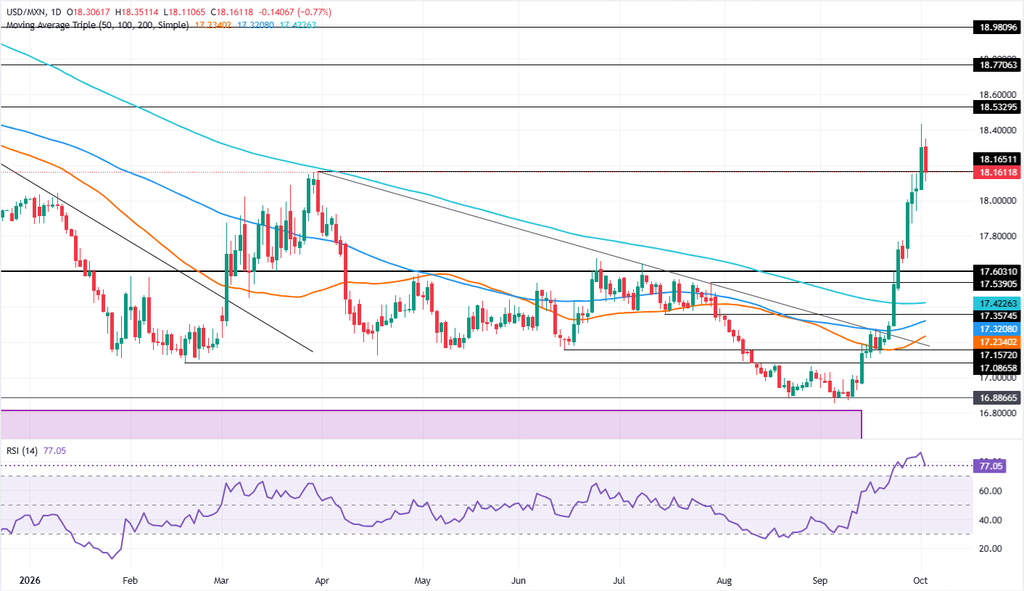
USD/MXN Technical Outlook
USD/MXN is trading around 18.16–18.21 and remains above the previous descending resistance trendline area near 18.12.
The break above that area has kept the near-term technical structure tilted toward further Dollar strength against the Peso.
The pair is also trading substantially above its triple simple moving-average cluster around 17.23.
However, the Relative Strength Index is around 77, indicating that USD/MXN is in technically overbought territory.
This does not necessarily establish a reversal, but it suggests that the recent upward momentum has become stretched and increases the potential for consolidation or profit-taking.
Key USD/MXN Levels
The first important downside reference is the reclaimed trendline around 18.12.
A sustained move below that area would weaken the immediate bullish structure and could bring the broader moving-average cluster around 17.23 back into focus.
A deeper correction could potentially expose horizontal support around 16.89.
On the topside, the recent 18.35 area remains an important reference following the latest advance.
With limited clearly defined resistance above the recent high, momentum, positioning and profit-taking could become increasingly important if USD/MXN continues to rise.
Bullish USD/MXN Scenario
USD/MXN could remain supported if:
- The US Federal Reserve maintains a restrictive policy stance.
- US economic data remain sufficiently strong to revive rate-hike expectations.
- The US-Mexico rate differential narrows further.
- Investors continue reducing MXN carry positions.
- Mexican economic growth remains fragile.
- USD/MXN maintains its position above 18.12.
A sustained move above the recent 18.35 high would place greater emphasis on momentum as the pair searches for new technical reference points.
Bearish USD/MXN Scenario
USD/MXN could face renewed downside pressure if:
- US employment weakness becomes more persistent.
- Expectations for an October Fed hike continue to decline.
- US Treasury yields fall.
- The Federal Reserve adopts a more accommodative policy outlook.
- Banxico maintains relatively high domestic interest rates.
- Investors return to Mexican carry positions.
- USD/MXN falls back below the 18.12 trendline area.
A sustained break below 18.12 would weaken the current near-term technical structure and potentially increase the scope for a deeper correction.
Mexican Peso Outlook
The Peso’s immediate recovery is being supported by the sharp decline in US rate-hike expectations.
However, the currency continues to face a structural challenge from the narrowing US-Mexico interest-rate differential.
The next phase of the MXN outlook will therefore depend heavily on whether the Federal Reserve becomes less restrictive at the same time as Banxico maintains relatively high domestic rates.
If that relationship moves in favour of Mexico, the carry trade could regain some support. If the differential continues to narrow, the Peso could remain vulnerable to further position reductions.
US Dollar Outlook
The Dollar’s recent strength against the Peso is encountering resistance from weaker US labour-market data.
The decline in October Fed hike expectations is particularly important because US interest-rate expectations remain one of the primary drivers of the Dollar.
Further evidence of slowing employment or economic activity could place additional pressure on US yields and reduce Dollar support.
Conversely, stronger economic data could quickly restore expectations for a restrictive Federal Reserve policy and reinforce USD/MXN upside momentum.
Rate Differential Outlook
The interest-rate differential remains the central fundamental variable for USD/MXN.
Mexico’s 6.5% policy rate continues to provide a substantial yield advantage, but that advantage has become less attractive as the US rate structure changes.
The direction of the differential rather than its absolute size is likely to remain critical for carry-trade flows.
Louis Roche Analysis
The Mexican Peso is currently caught between two opposing monetary-policy forces.
The narrowing US-Mexico interest-rate differential is reducing one of the currency’s traditional sources of support and has contributed to the reported reduction in carry-trade exposure.
At the same time, the latest US employment data have sharply reduced expectations for an October Federal Reserve rate increase. September payroll growth of just 29,000 is a significant downside surprise and provides the Peso with an opportunity to recover some ground against the Dollar.
The technical picture remains more challenging. USD/MXN has broken above the previous descending resistance area around 18.12, while an RSI reading near 77 indicates stretched upside momentum.
This creates an important technical crossroads.
If USD/MXN holds above 18.12, the broader upward structure remains intact. A sustained break back below that level would indicate that the latest Dollar advance is losing momentum and would bring the 17.23 moving-average region into focus.
For the coming sessions, the most important variables are likely to be US rate expectations, Treasury yields, Banxico’s policy guidance and the behaviour of MXN carry positions.
The Peso’s ability to extend its recovery will depend not simply on weaker US employment data, but on whether those data lead to a more persistent change in the relative monetary-policy outlook between Mexico and the United States.
Coming Sessions
Market attention will remain focused on:
- Banxico’s latest meeting minutes.
- US ISM Services PMI.
- Further US labour-market data.
- FOMC meeting minutes.
- Federal Reserve commentary, including Governor Bowman.
- University of Michigan consumer sentiment and inflation expectations.
- US Treasury yield movements.
- Changes in October Fed rate expectations.
- USD/MXN’s reaction around the 18.12 technical level.
- Developments in MXN carry-trade positioning.
The combination of US monetary-policy expectations and Mexico’s interest-rate outlook should remain central to the Peso’s direction.
Currency Hedger View
The Mexican Peso remains highly sensitive to changes in US interest rates, Treasury yields and international capital flows. For companies with MXN exposure, movements in USD/MXN can affect cross-border payments, operating costs, revenues and the value of international cash flows.
Currency Hedger monitors foreign exchange markets alongside broader commodity and macroeconomic conditions, helping businesses assess and manage their international currency exposure.
Open an account with Currency Hedger:
Open a Currency Hedger Account
Visit Currency Hedger:
Contributor: Currency Hedger
Market analysis prepared for Today Markets. For informational purposes only and not intended as investment, trading, financial or commodity advice.