S&P 500 — US Large Cap Index
 FTSE 100 — UK Blue Chips
 Euro Stoxx 50 — Eurozone Leaders
 DAX 40 — German Equities
 CAC 40 — French Market Index
 Nikkei 225 — Japan Benchmark
 Hang Seng — Hong Kong Index
 Shanghai Composite — China Mainland
 ASX 200 — Australian Market
 TSX Composite — Canada Index
 Nifty 50 — India Large Cap
 STI Index — Singapore Market
 KOSPI — South Korea Index
 Bovespa — Brazil Equities
 JSE Top 40 — South Africa Index
 IPC Index — Mexico Market
Economic Calendar – Global series of manufacturing PMI indicators and a marathon of central bankers’ speeches


Key takeaways
- Australia reported a trade surplus of 0.50 billion AUD, falling short of the expected 2.00 billion AUD.
- Japanese manufacturing sentiment improved, though the Tankan index reading slightly missed consensus forecasts.
- Traders are focusing on US ISM manufacturing data and speeches from major central bank officials.
- The Asian session was marked by the release of the Japanese Tankan report and disappointing foreign trade data from Australia. Japanese manufacturing sentiment improved relative to the previous quarter, but the reading fell slightly short of forecasts, while the service sector saw a slight weakening.
- In turn, Australia’s trade surplus shrank drastically to just AUD 0.50 billion compared to the expected AUD 2.00 billion, putting pressure on Antipodean currencies.
- During the day, investors will focus on the final manufacturing PMI readings from the Eurozone and the UK, and in the afternoon on the key US ISM manufacturing index and weekly jobless claims.
- The day is also characterized by an exceptionally dense schedule of public appearances by members of the FOMC (including Waller, Bowman, Jefferson), the ECB (Christine Lagarde), and Bank of England Governor Andrew Bailey. In China, it is a public holiday (bank holiday).
Key Releases from the Asian Session
- Japan: Tankan Index for manufacturing stood at 24 pts vs. 25 pts consensus and previous reading of 22 pts. Despite the quarterly improvement, the result slightly disappointed markets.
- Japan: Tankan Index for services fell to 35 pts (forecast: 36 pts, previous: 37 pts), indicating a moderate cooling of sentiment in the non-manufacturing sector.
- Japan: Final Manufacturing PMI reached 54.1 pts, perfectly matching the consensus and preliminary reading (54.1 pts), confirming solid expansion in the sector.
- Australia: Goods trade balance closed with a surplus of just AUD 0.50 billion vs. forecasted AUD 2.00 billion (previous: AUD 1.35 billion), impacted by strong import growth (+5.8%).
Macroeconomic Calendar
- All day China – Bank Holiday (market closed)
- 00:00 US – Speech by FOMC member Neel Kashkari
- 01:50 Japan – BOJ Summary of Opinions
- 03:30 Australia – RBA Financial Stability Review
- 08:00 UK – Nationwide House Price Index m/m. Consensus: 0.0%. Previous reading: 0.2%.
- 08:30 Australia – Commodity Prices y/y. Previous reading: 15.5%.
- 08:30 Switzerland – Consumer Price Index (CPI) m/m. Consensus: 0.0%. Previous reading: 0.4%.
- 08:30 Switzerland – Retail Sales y/y. Consensus: 2.1%. Previous reading: 2.3%.
- 09:15 Eurozone – Spain: Manufacturing PMI. Consensus: 50.2. Previous reading: 49.5.
- 09:50 Eurozone – France: Final Manufacturing PMI. Consensus: 50.3. Previous reading: 50.3.
- 09:55 Eurozone – Germany: Final Manufacturing PMI. Consensus: 53.8. Previous reading: 53.8.
- 10:00 Eurozone – Final Manufacturing PMI. Consensus: 52.7. Previous reading: 52.7.
- 10:00 Eurozone – Italy: Monthly Unemployment Rate. Consensus: 5.8%. Previous reading: 5.8%.
- 10:00 UK – Speech by BoE Governor Andrew Bailey
- 10:30 UK – Final Manufacturing PMI. Consensus: 52.0. Previous reading: 52.0.
- 11:00 Eurozone – Unemployment Rate. Consensus: 6.4%. Previous reading: 6.4%.
- 11:30 US – Challenger Job Cuts y/y. Previous reading: -38.5%.
- 12:35 Eurozone – Speech by Bundesbank President Joachim Nagel
- 14:00 UK – Speech by MPC member Catherine Mann
- 14:30 US – Weekly Jobless Claims. Consensus: 201k. Previous reading: 197k.
- 15:05 US – Speech by FOMC member Thomas Barkin
- 15:05 US – Speech by FOMC member Susan Collins
- 15:05 US – Speech by FOMC member Jeffrey Schmid
- 15:30 Canada – Manufacturing PMI. Previous reading: 53.0.
- 15:30 Eurozone – Speech by ECB President Christine Lagarde
- 15:45 US – Final Manufacturing PMI. Consensus: 56.9. Previous reading: 57.0.
- 16:00 US – Speech by FOMC member Christopher Waller
- 16:00 US – ISM Manufacturing Index. Consensus: 54.8. Previous reading: 54.6.
- 16:00 US – ISM Manufacturing Prices Paid Sub-index. Consensus: 72.9. Previous reading: 71.1.
- 16:30 US – Natural Gas Storage Change. Consensus: 63 billion cubic feet (bcf). Previous reading: 53 billion cubic feet (bcf).
- 17:30 Switzerland – Speech by SNB President Martin Schlegel
- 19:30 US – Speech by FOMC Vice Chair Philip Jefferson
- 21:00 US – Speech by FOMC member Michelle Bowman
- 21:05 Canada – Speech by BoC Senior Deputy Governor Carolyn Rogers
- 21:30 US – Speech by FOMC member Lisa Cook
Corporate Earnings
- Accenture (before market open)
- Nike (after market close)
Markets to Watch
- USDJPY — The pair is rising towards the 158.20 level due to monetary divergence and weaker-than-expected Tankan readings, and today’s series of speeches by Federal Reserve members as well as the ISM index could trigger increased volatility.
- AUDUSD — The Australian dollar remains under heavy pressure following a worse-than-projected August trade balance (surplus of just AUD 495 million vs. expected AUD 2 billion) and amid concerns over commodity market health and the absence of Chinese investors.
- EURUSD — The European currency will react to a series of final manufacturing PMI readings from key Eurozone economies and Christine Lagarde’s speech at 15:30, before facing key US ISM data.
USDJPY: Technical Analysis (D1)
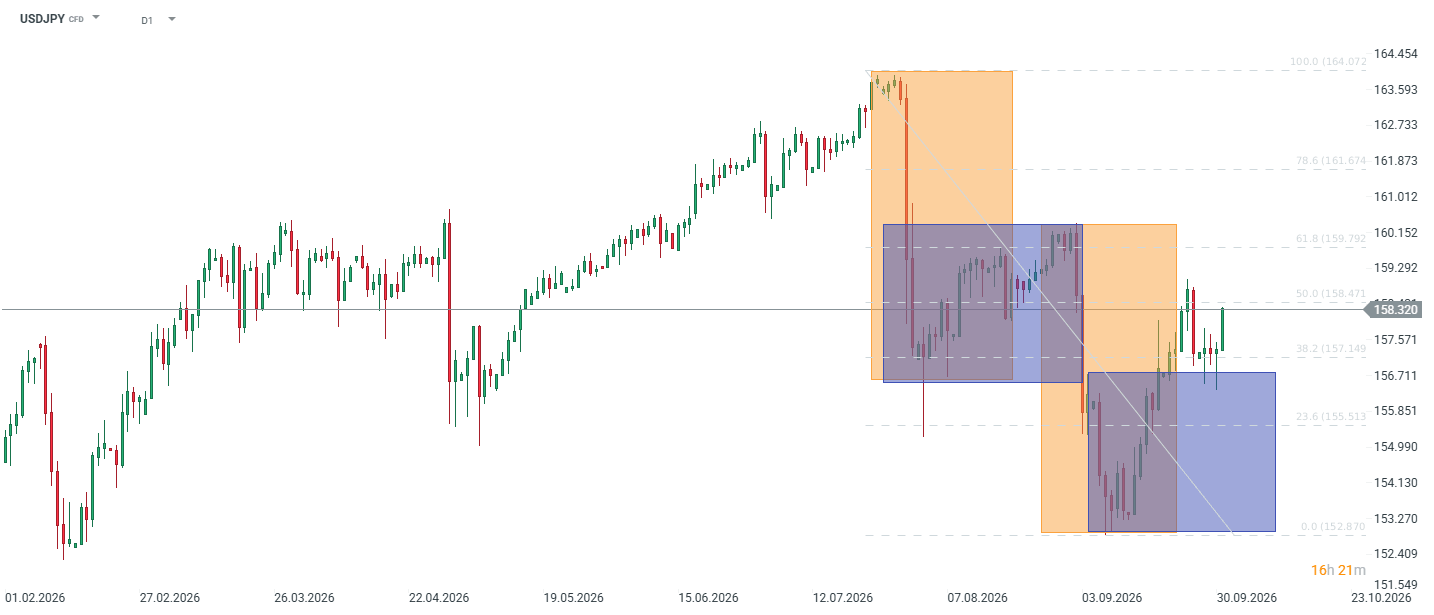
The pair is defending the support zone at the 38.2% Fibonacci retracement level (157.15) of the entire downward movement from 164.07 to 152.87. The reaction is visible as the price rebounds and returns to 158.32, right around the 50% retracement level at 158.47. After peaking in mid-July, the market dropped to 152.87 in early September before initiating a rebound that halted at 160.15 near the 61.8 percent retracement (159.79). Another downward wave brought quotes back down to 38.2%, where demand re-emerged. As long as 157.15 remains intact on daily closes, the initiative belongs to the buyers. The nearest resistance is 158.47, and overcoming it opens the way to 159.79 and the peak at 160.15. Losing support, on the other hand, means testing 155.51 (23.6 percent retracement), and lower down, the September low at 152.87.