S&P 500 — US Large Cap Index
 FTSE 100 — UK Blue Chips
 Euro Stoxx 50 — Eurozone Leaders
 DAX 40 — German Equities
 CAC 40 — French Market Index
 Nikkei 225 — Japan Benchmark
 Hang Seng — Hong Kong Index
 Shanghai Composite — China Mainland
 ASX 200 — Australian Market
 TSX Composite — Canada Index
 Nifty 50 — India Large Cap
 STI Index — Singapore Market
 KOSPI — South Korea Index
 Bovespa — Brazil Equities
 JSE Top 40 — South Africa Index
 IPC Index — Mexico Market

The main European indices are showing mixed but generally modest movements on Tuesday, whilst Wall Street futures are signalling a weaker start to the day due to a sell-off in the chip sector. The Nasdaq 100 is down by around 0.7% in futures trading, whilst the S&P 500 is falling slightly; the Dow Jones, however, is up 0.3%, reflecting the divergence between the technology sector and the rest of the market. In Europe, the STOXX 600 rose by around 0.3 per cent, the DAX gained a modest 0.10 per cent, the Spanish IBEX and the British FTSE rose by 0.4–0.5 per cent, whilst the EuroStoxx 50 fell by 0.22 per cent.
The main factor driving market sentiment is the sharp sell-off in semiconductor companies worldwide, following reports that Chinese firms are launching their own production of DUV lithography machines, which has hit ASML’s position and that of the technology sector as a whole. Concerns over hyperscalers’ excessive spending on AI infrastructure and growing competition from China are providing a further negative impetus for the chip market, leading to a fall of over 10 per cent in the KOSPI index and a sell-off in Nvidia and Micron shares in pre-market trading.
Oil prices continue their three-day decline – Brent and WTI have hit their lowest levels in over a week following the suspension of attacks between the US and Iran and reports of ‘positive talks’ between President Trump and Tehran. The dollar remains under pressure from falling oil prices, although growing expectations of a rate rise by the Fed on Wednesday (the market is pricing in a probability of around 35–37 per cent) are providing support for the US currency against the euro and the yen.
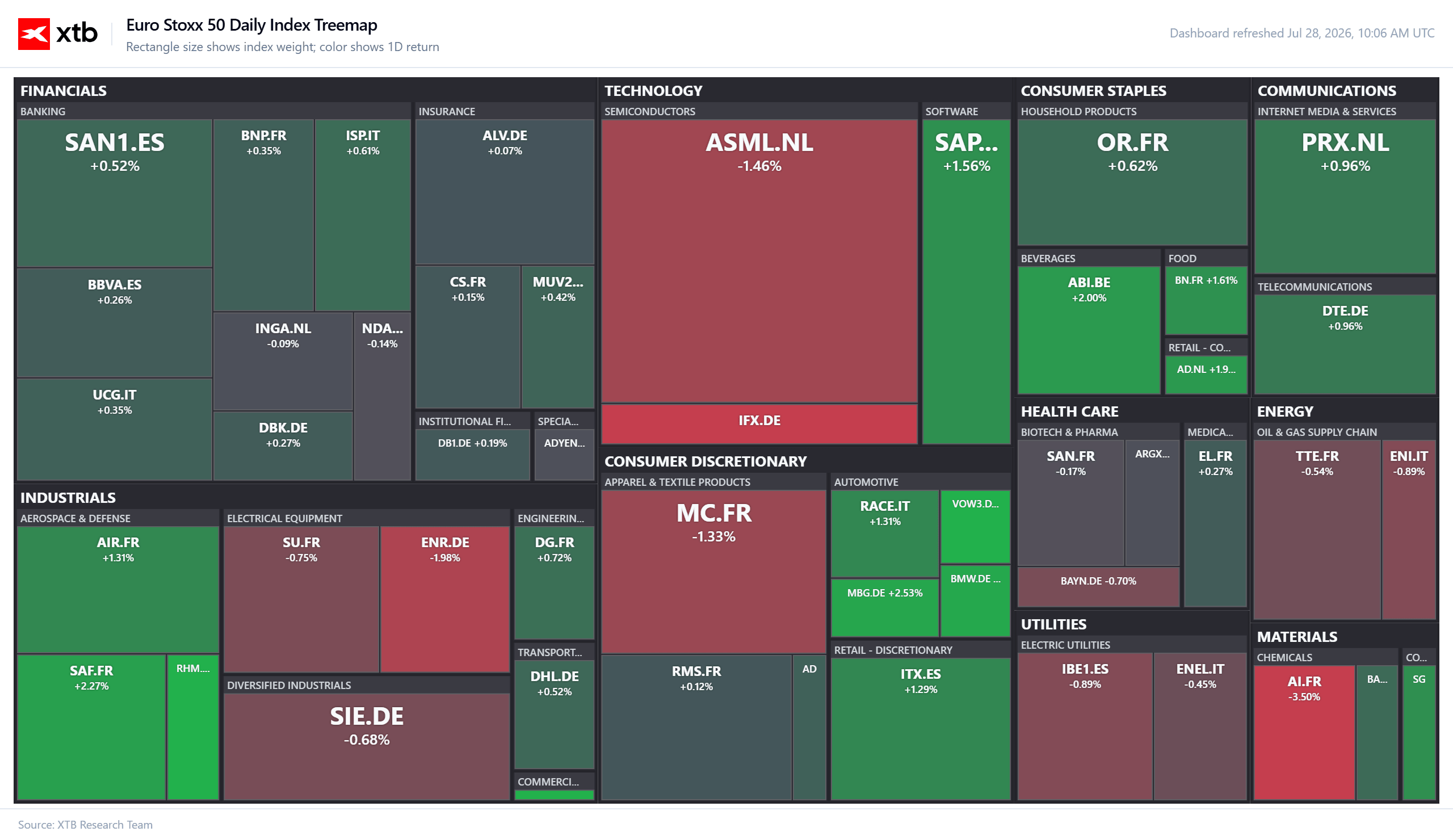
The consumer sector (food and discretionary) is performing best on the stock market today, thanks to strong results from Unilever and Mercedes, as is the heavy industry sector, driven by defence companies (Rheinmetall, Safran). The energy and materials sectors are performing the worst under pressure from falling oil prices (Air Liquide, TotalEnergies, Eni), whilst the technology sector continues to suffer from the sell-off in the semiconductor segment (Infineon, ASML).
Company information
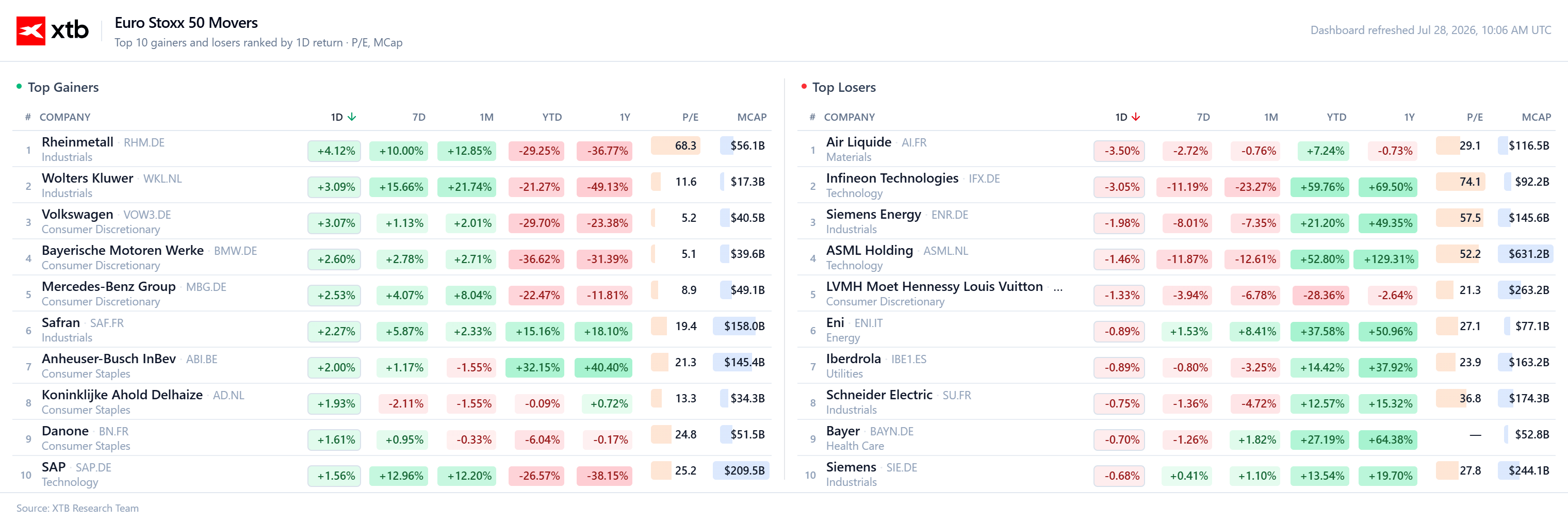
- Unilever soared by as much as 6.8 per cent – its biggest rise in two years – after its second quarter delivered the strongest growth in sales volumes in over a decade, and the company raised its full-year forecast to 4–6 per cent organic sales growth. The company is continuing with the Reverse Morris Trust transaction with McCormick, under which Unilever’s food division will merge with the US seasoning manufacturer to create an entity worth around $65 billion, with Unilever shareholders retaining a 65 per cent stake and receiving $15.7 billion in cash. The deal, announced in March, initially caused concern amongst investors due to the lengthy timetable and antitrust risks, causing the share price to fall by 7% at the time. Chief Financial Officer Srinivas Phatak confirmed on Tuesday that the process of spinning off the food division is proceeding according to plan and is due to be completed by mid-2027 at the latest.
- Mercedes-Benz rose by over 2.5% after its operating profit for the second quarter increased by 22% year-on-year, although the company simultaneously lowered its full-year sales forecast due to weaker demand in China. Apart from the 22% rise in operating profit itself, Mercedes’ EBIT of €1.5bn fell slightly short of the analysts’ consensus estimate (€1.6bn), whilst the margin in the passenger car segment fell by as much as 26% year-on-year to €909m. Sales in China plummeted by 30% in the second quarter, whilst the average selling price per vehicle fell to €64,700 from €67,700 a year earlier, reflecting price pressure in the price war with local EV manufacturers. The company has revised down its full-year forecast – it now expects group sales and revenue to be slightly below 2025 levels, having previously anticipated stagnation, although at the same time it has raised its target for the share of electrified vehicles to 23–25 per cent.
- Despite a 17 per cent rise in pre-tax profit in the first half of the year, Barclays saw its share price fall by nearly 5 per cent, as its performance on the stock market failed to match that of its Wall Street rivals, and the bank announced an additional £500 million in restructuring costs. The bank announced a new share buyback programme worth £1bn, exceeding market expectations (£831m), and also declared a dividend of £800m for shareholders. Results in the investment banking segment were solid – revenue from equities rose by 45 per cent year-on-year, though this is still below the average 69 per cent growth seen among US rivals, buoyed by SpaceX’s IPO. Barclays also raised its full-year revenue forecast to £31.5bn from £31bn, despite announcing an additional £500m in restructuring costs for the second half of the year.
- Philips fell by 9 per cent, its biggest drop in 17 months, following weaker-than-expected orders and warnings about a more challenging market in China, despite raising its full-year margin forecast. Aside from weaker orders, CEO Roy Jakobs emphasised that some large, multi-million contracts in the US had simply been postponed rather than lost, describing this as a “timing issue” rather than an actual loss of business. In China, new rules introduced in July requiring public healthcare institutions to purchase equipment through centralised tender programmes have disrupted the market and weakened demand, particularly in the Diagnosis & Treatment division. Chief Financial Officer Charlotte Hanneman warned that the adjusted EBITDA margin in the third quarter would be lower than a year earlier, whilst RBC analysts noted that the required margin improvement in the second half of the year, particularly in the fourth quarter, would be more difficult to achieve.
- ASML fell by more than 1 per cent following reports that China had started producing its own DUV lithography machines, which threatens the Dutch manufacturer’s long-standing dominance in this market.
- Safran’s share price rose after the company raised its full-year financial targets, buoyed by a record operating margin of 18.4 per cent in the first half of the year, thanks to strong demand for aircraft engine spare parts.