S&P 500 — US Large Cap Index
 FTSE 100 — UK Blue Chips
 Euro Stoxx 50 — Eurozone Leaders
 DAX 40 — German Equities
 CAC 40 — French Market Index
 Nikkei 225 — Japan Benchmark
 Hang Seng — Hong Kong Index
 Shanghai Composite — China Mainland
 ASX 200 — Australian Market
 TSX Composite — Canada Index
 Nifty 50 — India Large Cap
 STI Index — Singapore Market
 KOSPI — South Korea Index
 Bovespa — Brazil Equities
 JSE Top 40 — South Africa Index
 IPC Index — Mexico Market

Growth in the eurozone’s industrial sector unexpectedly accelerated in September to its fastest pace in more than four years, driven by strong demand for capital goods. Upward trends are also evident in key European economies, although rising inflationary pressures and falling demand for consumer goods are raising concerns about the next steps central banks will take. Here is an updated summary of the key PMI data for the manufacturing sector:
- Eurozone: The final PMI index stood at 52.9 points in September (up from 52.7 points in August; expectations were for 52.7 points), marking the highest reading since May 2022 and beating preliminary estimates. The recovery is being driven by demand for equipment related to, among other things, artificial intelligence (AI) and defense. The production subindex reached a 55-month high of 53.6 points, and companies have once again begun to increase hiring. The Netherlands is leading the expansion in the region. However, the main risk remains accelerating inflation in input costs and final prices, which is prompting markets to price in as many as three consecutive interest rate hikes by the ECB through mid-2027.
- Germany: Europe’s main growth engine maintained a strong upward trend, with a final PMI reading of 53.9 points (vs. an expected 53.8). Production has been rising here for the ninth consecutive month, and export orders are accelerating (thanks to demand from Asia, Europe, and the U.S.), despite higher costs driven by global energy prices.
- France: The sector recorded its second consecutive month of expansion, reaching 50.6 points (above the forecast of 50.3). However, there was a noticeable decline in new orders for the fifth consecutive month, which slowed the overall pace of growth.
- Italy: Economic activity returned to expansionary territory, and the PMI rose to 50.4 points in September from 49.6 in August (expectations were for 50.0). Optimism among companies for the coming year remains high, and employment is rising, although export orders have declined for the first time in three months.
Despite positive data from Europe, the U.S. dollar continues to gain against most major currencies. The dollar index is showing a steady increase of 0.23%.
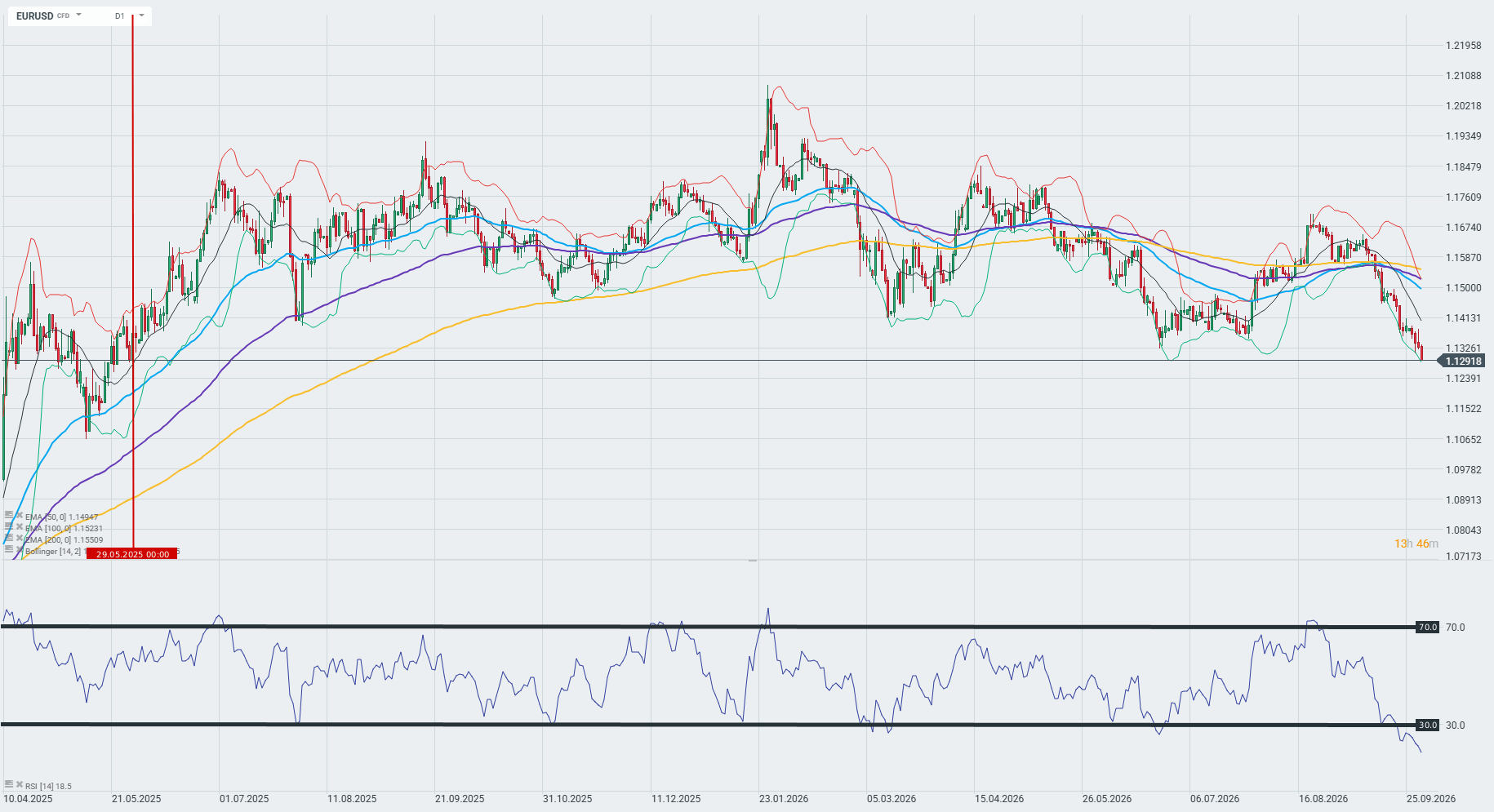
The EUR/USD pair is already down 0.3% today and is trading at its lowest levels since May 2025. Source: XTB