S&P 500 — US Large Cap Index
 FTSE 100 — UK Blue Chips
 Euro Stoxx 50 — Eurozone Leaders
 DAX 40 — German Equities
 CAC 40 — French Market Index
 Nikkei 225 — Japan Benchmark
 Hang Seng — Hong Kong Index
 Shanghai Composite — China Mainland
 ASX 200 — Australian Market
 TSX Composite — Canada Index
 Nifty 50 — India Large Cap
 STI Index — Singapore Market
 KOSPI — South Korea Index
 Bovespa — Brazil Equities
 JSE Top 40 — South Africa Index
 IPC Index — Mexico Market

Gold has climbed back above the $4,000-per-ounce level and is attempting to hold above it despite rising oil prices and escalating tensions in the Middle East.
The metal’s resilience may suggest that investors are increasingly focusing on the longer-term consequences of energy shocks and slower economic growth rather than reacting solely to near-term inflation risks. Additional support has come from weaker-than-expected U.S. inflation data, with both CPI and PPI easing concerns about further Federal Reserve tightening. Investors appear increasingly reluctant to sell gold simply because inflation expectations have risen. If concerns about slowing economic growth begin to outweigh inflation fears, gold’s defensive qualities could once again become the primary driver of prices. A sustained breakout above the $4,200-$4,300 range could signal a more durable return of investor capital to precious metals. Conversely, a move below $3,900 would suggest that a stronger U.S. dollar, higher Treasury yields, and renewed inflation concerns have once again become the dominant market drivers. The most bullish scenario for gold would involve a gradual easing of tensions in the Strait of Hormuz, accompanied by lower oil prices and, consequently, an increasingly dovish Federal Reserve. However, that outcome is far from certain. The oil market could remain structurally tight for an extended period, potentially keeping bond yields elevated and the U.S. dollar stronger, both of which would likely continue to weigh on gold.
GOLD (D1 interval) The technical picture still points to a prevailing downtrend, with gold trading roughly 8% below its 200-day EMA (red line). The key resistance level remains the 23.6% Fibonacci retracement of the winter selloff, located around $4,330 per ounce . On the downside, $3,900 remains the most important support level.
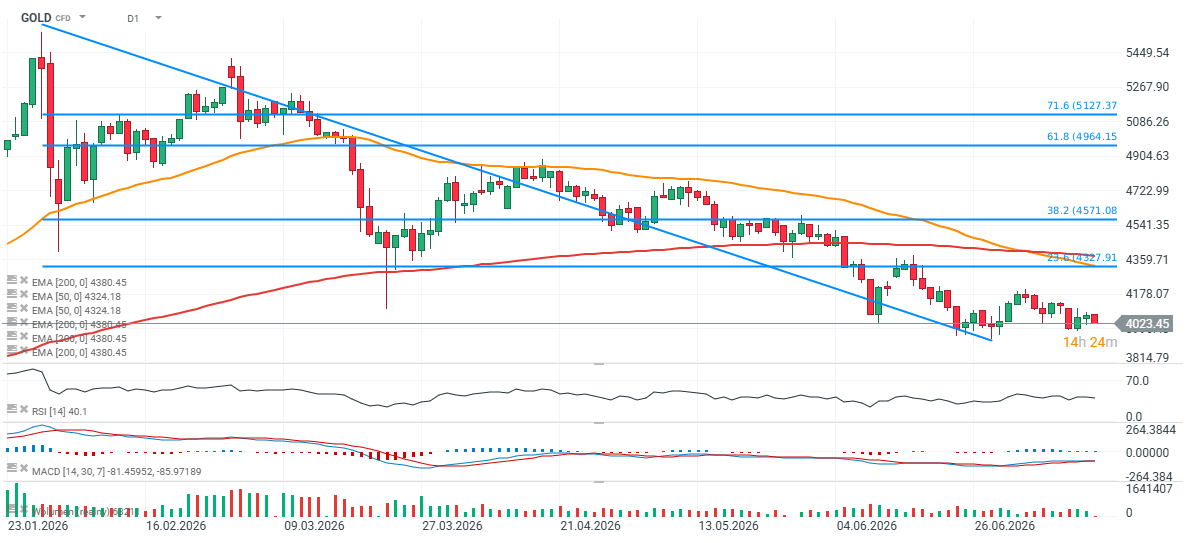
Source: xStation5