S&P 500 — US Large Cap Index
 FTSE 100 — UK Blue Chips
 Euro Stoxx 50 — Eurozone Leaders
 DAX 40 — German Equities
 CAC 40 — French Market Index
 Nikkei 225 — Japan Benchmark
 Hang Seng — Hong Kong Index
 Shanghai Composite — China Mainland
 ASX 200 — Australian Market
 TSX Composite — Canada Index
 Nifty 50 — India Large Cap
 STI Index — Singapore Market
 KOSPI — South Korea Index
 Bovespa — Brazil Equities
 JSE Top 40 — South Africa Index
 IPC Index — Mexico Market
Goldman Sachs – Mixed Results Diluted a Strong Quater

Goldman Sachs started 2026 with a very strong quarter, significantly beating market expectations at the level of revenue, earnings, and profitability. The results highlight a clear rebound in capital markets activity, particularly in mergers and acquisitions as well as equity and debt issuance, alongside very strong conditions in equity trading. At the same time, the report reveals a notable imbalance between segments, where very strong equities and investment banking are contrasted by a weaker FICC performance. Operating expenses increased slightly, while the CET1 capital ratio came in below market expectations.
Despite solid underlying fundamentals, market reaction remains cautious. In pre-market trading, the stock is down around 3% from the previous close, suggesting that investors are not fully embracing the results and are focusing on weaker areas of the report, particularly FICC and the CET1 capital ratio.
Key financial results
- Net revenue: 17.23 billion USD (+14% YoY)
- Earnings per share (EPS): 17.55 USD (expected: 16.34 USD)
- Return on equity (ROE): 19.8%
- Return on tangible equity (ROTE): 21.3%
- Global Banking & Markets: 12.74 billion USD (+19% YoY)
- Equity trading revenue: 5.33 billion USD (above expectations)
- FICC trading revenue: 4.01 billion USD (below expectations)
- Investment banking revenue: 2.84 billion USD
- Advisory: 1.49 billion USD
- Deposits: 561 billion USD
- CET1 ratio: 12.5%
- Operating expenses: 10.43 billion USD
Financial performance and profitability
The most important figure of the quarter is 17.23 billion USD in net revenue, reflecting both the scale of operations and strong year-on-year growth. This confirms that the bank is effectively benefiting from favorable market conditions and maintaining strong activity across key business segments.
EPS at 17.55 USD shows that revenue growth translated directly into higher profitability, which is particularly important for investment banks, where conversion of revenue into earnings is a key performance driver.
ROE close to 20% and ROTE above 21% confirm exceptionally strong capital profitability, which remains one of Goldman Sachs’ key competitive advantages.
Equity trading
Equity trading revenue reached 5.33 billion USD, significantly beating market expectations. This reflects strong institutional client activity and favorable market conditions, including elevated volatility and strong capital flows.
This segment was one of the main drivers of the quarterly beat and confirms Goldman Sachs’ strong positioning in global equity trading and its ability to generate high revenues in a risk-on environment.
FICC – what it is and why it underperformed
FICC stands for Fixed Income, Currencies and Commodities. It includes trading in bonds (government and corporate), foreign exchange, and commodities. It is a core investment banking segment that generates revenue from interest rate volatility, currency movements, and client hedging activity.
FICC revenue came in at 4.01 billion USD versus expectations of 4.87 billion USD, representing a clear disappointment. The weaker result suggests less favorable conditions in fixed income and FX markets, as well as lower client activity in rates and credit derivatives.
The divergence between strong equities and weaker FICC highlights highly uneven market conditions, which clearly favored equity exposure over fixed income strategies.
Investment banking
Global Banking & Markets generated 12.74 billion USD in revenue, up 19% year-on-year and above expectations.
The standout segment was advisory, which increased by 89% year-on-year to 1.49 billion USD. This signals a clear rebound in M&A activity and improving sentiment among corporates and investors.
Underwriting results were also solid, indicating increased activity in equity and debt issuance and a gradual reopening of capital markets.
Costs and risk
Operating expenses reached 10.43 billion USD, slightly above expectations, indicating moderate cost pressure alongside growing business activity.
Compensation expenses were slightly below forecasts, partially offsetting higher other operating costs. Credit provisions amounted to 315 million USD, reflecting a cautious approach to credit risk and conservative macro assumptions.
Capital and balance sheet
The capital position remains stable, although the CET1 ratio at 12.5% came in below expectations. This may limit near-term capital flexibility, including share buyback capacity.
Deposits increased to 561 billion USD, up 12% quarter-on-quarter, while assets under management reached 3.65 trillion USD, up 15% year-on-year. Net inflows of 62 billion USD further strengthen the wealth management franchise and increase the share of stable fee-based income.
Key risks
The main risk remains high earnings cyclicality and strong dependence on market conditions. FICC results show that not all segments benefit equally from improving sentiment. Additionally, the weaker CET1 ratio may constrain capital flexibility. A relatively high cost base also increases pressure on margins in less favorable market environments.
Opportunities and positives
The key opportunity remains continued recovery in M&A activity, already visible in the strong growth in advisory revenue. Supportive equity market conditions also benefit trading and underwriting activity.
Additionally, higher crude oil prices may add upward pressure on inflation, increasing the likelihood that the Federal Reserve keeps interest rates higher for longer. This scenario could support investment bank earnings in coming quarters through higher net interest income and increased activity in rates and FX markets.
Outlook
In the coming quarters, sustaining momentum in investment banking and equity trading will be critical. If market conditions remain supportive and M&A activity continues, Goldman Sachs could maintain strong performance.
FICC remains the key variable, and any recovery in this segment could significantly improve revenue mix. Cost discipline and CET1 development will also remain important focus areas, particularly in the context of capital return policy.
Key takeaways
The first quarter of 2026 for Goldman Sachs was clearly positive. Results were driven by very strong equity trading and a sharp rebound in investment banking, especially advisory. Weaker FICC performance and higher costs do not change the overall positive picture of the company, which remains one of the key beneficiaries of improving capital markets activity.
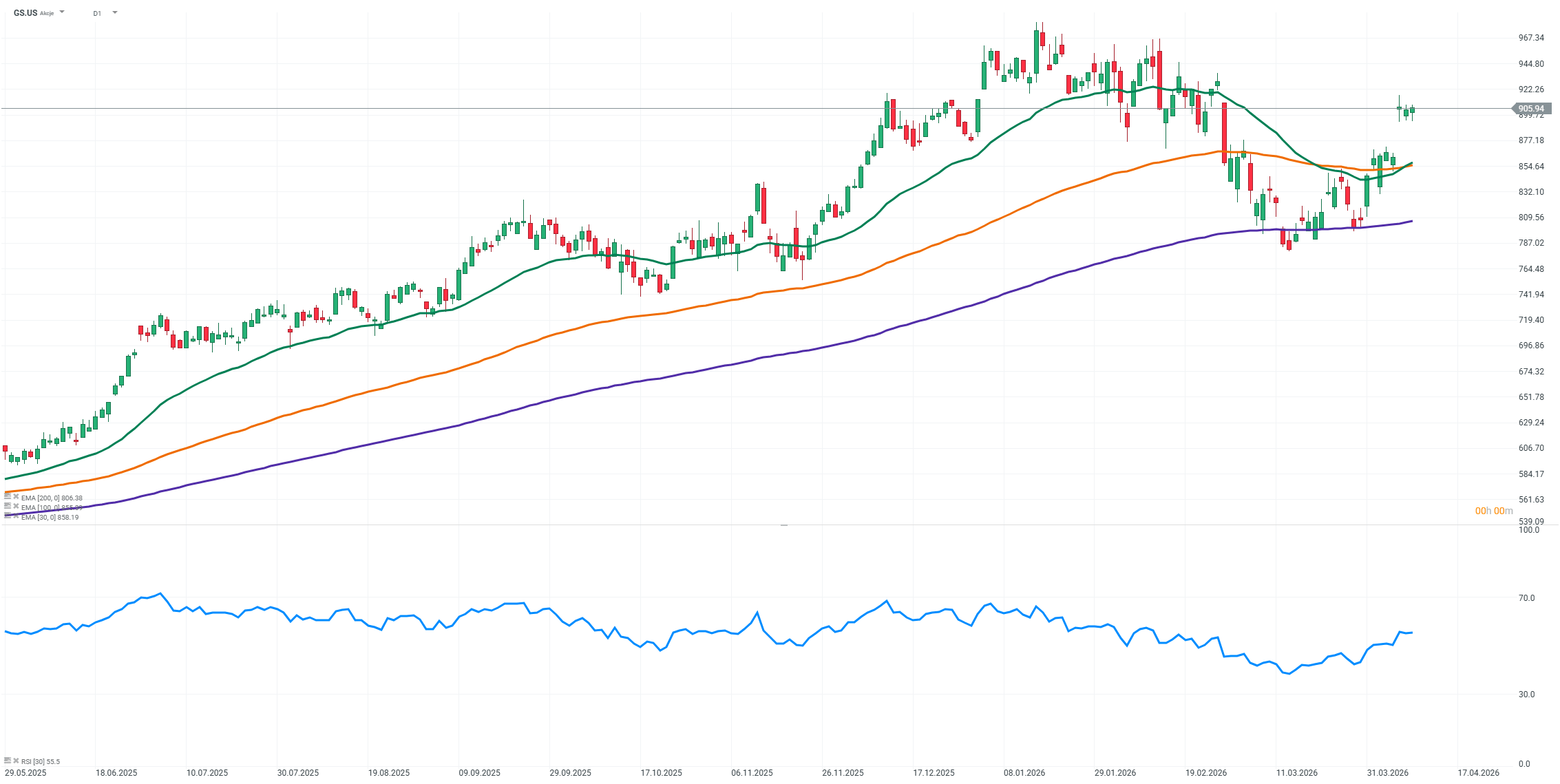
Source: xStation5
The material on this page does not constitute financial advice and does not take into account your level of understanding, investment objectives, financial situation or any other specific needs. All information provided, including opinions, market research, mathematical results and technical analyzes published on the Website or transmitted To you by other means, it is provided for information purposes only and should in no way be construed as an offer or solicitation for a transaction in any financial instrument, nor should the information provided be construed as advice of a legal or financial nature on which any investment decisions you make should be based exclusively To your level of understanding, investment objectives, financial situation, or other specific needs, any decision to act on the information published on the Website or sent to you by other means is entirely at your own risk if you In doubt or unsure about your understanding of a particular product, instrument, service or transaction, you should seek professional or legal advice before trading. Investing in CFDs carries a high level of risk, as they are leveraged products and have small movements Often the market can result in much larger movements in the value of your investment, and this can work against you or in your favor. Please ensure you fully understand the risks involved, taking into account investments objectives and level of experience, before trading and, if necessary, seek independent advice.