S&P 500 — US Large Cap Index
 FTSE 100 — UK Blue Chips
 Euro Stoxx 50 — Eurozone Leaders
 DAX 40 — German Equities
 CAC 40 — French Market Index
 Nikkei 225 — Japan Benchmark
 Hang Seng — Hong Kong Index
 Shanghai Composite — China Mainland
 ASX 200 — Australian Market
 TSX Composite — Canada Index
 Nifty 50 — India Large Cap
 STI Index — Singapore Market
 KOSPI — South Korea Index
 Bovespa — Brazil Equities
 JSE Top 40 — South Africa Index
 IPC Index — Mexico Market


- The Indian Rupee rallies further against the US Dollar due to multiple tailwinds.
- Lower energy prices and the continued inflow of foreign funds into the Indian stock market have strengthened the INR.
- Concerns about the AI investment outlook have improved the appeal of Indian stocks.
The Indian Rupee (INR) continues to outperform the US Dollar (USD) on the back of significant inflow of foreign funds into the Indian stock market and a continued decline in oil prices. As of writing, the USD/INR pair posts a fresh five-month low near 93.70.
FIIs buying remains significant in past trading days
There has been relentless buying in the Indian stock market by Foreign Institutional Investors (FIIs) in the past trading days.
So far in November, FIIs have remained net buyers in full trading days and have poured a cumulative investment worth Rs. 53,172.24 crore.
Currencies from economies, such as India, which are in their developing stage, tend to outperform when they become attractive investment spots for overseas investors.
What has made India an attractive bet for foreign investors?
According to a report from NDTV Profit, India’s relative lack of massive, over-hyped Artificial Intelligence (AI) hardware/infrastructure concentration is now viewed as a defensive advantage, offering better earnings visibility and stability.
Global AI infrastructure-related stocks have seen a massive sell-off since the defeat of United States (US) Republicans in midterm elections.
Strategists at ABN Amro said after the outcome of US midterm elections that the “AI investment story acquired a political risk premium” after “disappointing guidance suggested the Democratic midterm victory could bring greater congressional oversight of AI data infrastructure investment,” undermining sentiment toward AI-related assets and broader risk appetite.
Additionally, fears that Jensen Huang’s days as Nvidia CEO are numbered following reports of his affair with alleged Chinese spy Alice Huang have heightened concerns regarding the outlook of spending on AI infrastructure across the globe.
On Kalshi, speculators say there’s just a 17% chance Huang is gone by 2027. Those odds rise to 30% by 2028, and 35% by 2029. However, they think there is a 75% probability that Huang will depart by 2031, CNBC reported.
Oil prices continue to decline on US-Iran deal hopes
Oil prices have fallen significantly after remarks from US President Donald Trump pointing to no further military action against Iran.
Analysts at MUFG note that investor optimism has been further buoyed by a softer tone from Washington, after President Trump told CNN it is “highly unlikely” he will need to order fresh military strikes on Iran if talks continue to show progress. MUFG highlights that Trump also stressed the outcome still hinges on the quality of any deal, stating that “it depends on whether or not they sign a very strong agreement,” a nuance the bank sees as crucial for sustaining the recent pullback in geopolitical risk premia.
As of writing, the MCX Crude Oil contract expiring on November 19 is 0.6% higher to near Rs. 8,148, but is close to its two-month low of Rs. 7,861 posted on Tuesday.
Technical Analysis
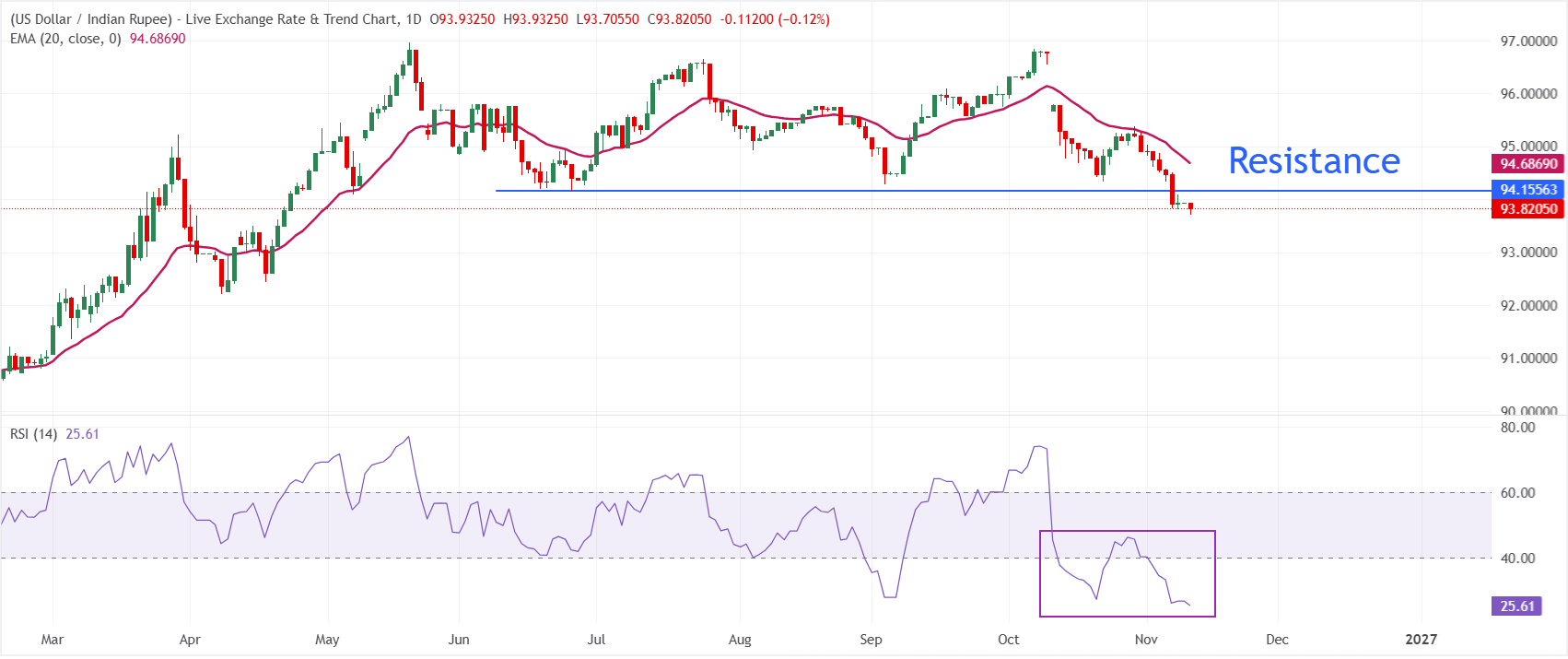
On Wednesday, USD/INR falls to near 93.70, extending a clear bearish bias as spot holds below the 20-day exponential moving average (EMA) at 94.69. The break and sustained trade under this short-term EMA suggest sellers remain in control, while the Relative Strength Index (RSI) near 25 signals oversold conditions that could slow the downside rather than immediately reverse it.
On the topside, the 20-day EMA at 94.69 is the meaningful resistance after the June 25 low at 94.15, and a daily close back above the dynamic brrier would be needed to ease immediate downside pressure and hint at a corrective bounce.
Looking down, the pair is likely to find suppourt near 93.00.