S&P 500 — US Large Cap Index
 FTSE 100 — UK Blue Chips
 Euro Stoxx 50 — Eurozone Leaders
 DAX 40 — German Equities
 CAC 40 — French Market Index
 Nikkei 225 — Japan Benchmark
 Hang Seng — Hong Kong Index
 Shanghai Composite — China Mainland
 ASX 200 — Australian Market
 TSX Composite — Canada Index
 Nifty 50 — India Large Cap
 STI Index — Singapore Market
 KOSPI — South Korea Index
 Bovespa — Brazil Equities
 JSE Top 40 — South Africa Index
 IPC Index — Mexico Market
- The Japanese Yen attracts some intraday sellers on Tuesday, though the downside risk remains limited.
- Trade-related uncertainties and geopolitical risks help limit the downside for the safe-haven JPY.
- The divergent BoJ-Fed expectations contribute to capping USD/JPY ahead of the FOMC meeting.
The Japanese Yen (JPY) edged lower against its American counterpart during the Asian session on Tuesday, though it lacks any follow-through selling. Despite the Bank of Japan’s (BoJ) dovish guidance last Thursday, the broadening inflation in Japan and prospects of sustained wage hikes keep the door open for further tightening by the central bank. Apart from this, the uncertainty over US President Donald Trump’s trade policies and rising geopolitical tensions continue to act as a tailwind for the safe-haven JPY.
Meanwhile, the prospects for more aggressive rate cuts by the Federal Reserve (Fed) fail to assist the US Dollar (USD) to attract any meaningful buyers and contribute to capping the upside for the USD/JPY pair. Traders also seem reluctant and opt to wait for more cues about the Fed’s policy outlook before positioning for the next leg of a directional move. Hence, the focus will remain on the outcome of a two-day FOMC meeting starting this Tuesday, which will drive the USD and provide a fresh impetus.
Japanese Yen bulls have the upper hand amid sustained safe-haven demand
- The Bank of Japan struck a cautious tone last week by slashing its growth and inflation forecasts, forcing investors to scale back their bets for the next rate hike in June or July. The central bank, however, reiterated that it remains committed to raising rates further if the economy and prices move in line with its forecasts.
- US President Donald Trump’s erratic trade policies overshadow the optimism led by signs of easing US-China trade tensions and keep investors on edge. In fact, Trump on Sunday announced a 100% tariff on all movies produced in foreign countries. Moreover, geopolitical risks lend support to the safe-haven Japanese Yen.
- Russia’s defense ministry said that Ukraine launched a drone attack targeting Moscow for the second night in a row on Monday. This follows reports of fresh attempts by Ukraine to cross into Russia’s Kursk region. This comes days after Russian President Vladimir Putin declared a three-day ceasefire over May 8-10.
- Adding to this, Israel struck targets in Yemen in response to the Iranian-backed Houthis’ ballistic missile attack that hit Israel’s main airport on Sunday. The Houthis warned on Sunday that they could strike again and would impose a comprehensive air blockade on Israel by repeatedly targeting airports.
- Meanwhile, Trump hinted at possible trade agreements with certain countries as early as this week and also signaled that he is open to lowering massive tariffs imposed on China. Furthermore, China’s Commerce Ministry said last Friday that it was evaluating the possibility of trade talks with the US.
- On the economic data front, the Institute for Supply Management (ISM) survey showed on Monday that the growth in the US services sector picked up in April. Adding to this, signs of a still resilient US labor market help ease concerns about a US recession and act as a tailwind for the US Dollar.
- Traders, however, seem reluctant to place aggressive bets and opt to move to the sidelines ahead of a two-day FOMC policy meeting starting this Tuesday. Investors will look for fresh cues about the Fed’s future interest rate-cut path, which, in turn, will influence the USD and the USD/JPY pair.
USD/JPY might struggle to capitalize on any attempted recovery beyond 144.00
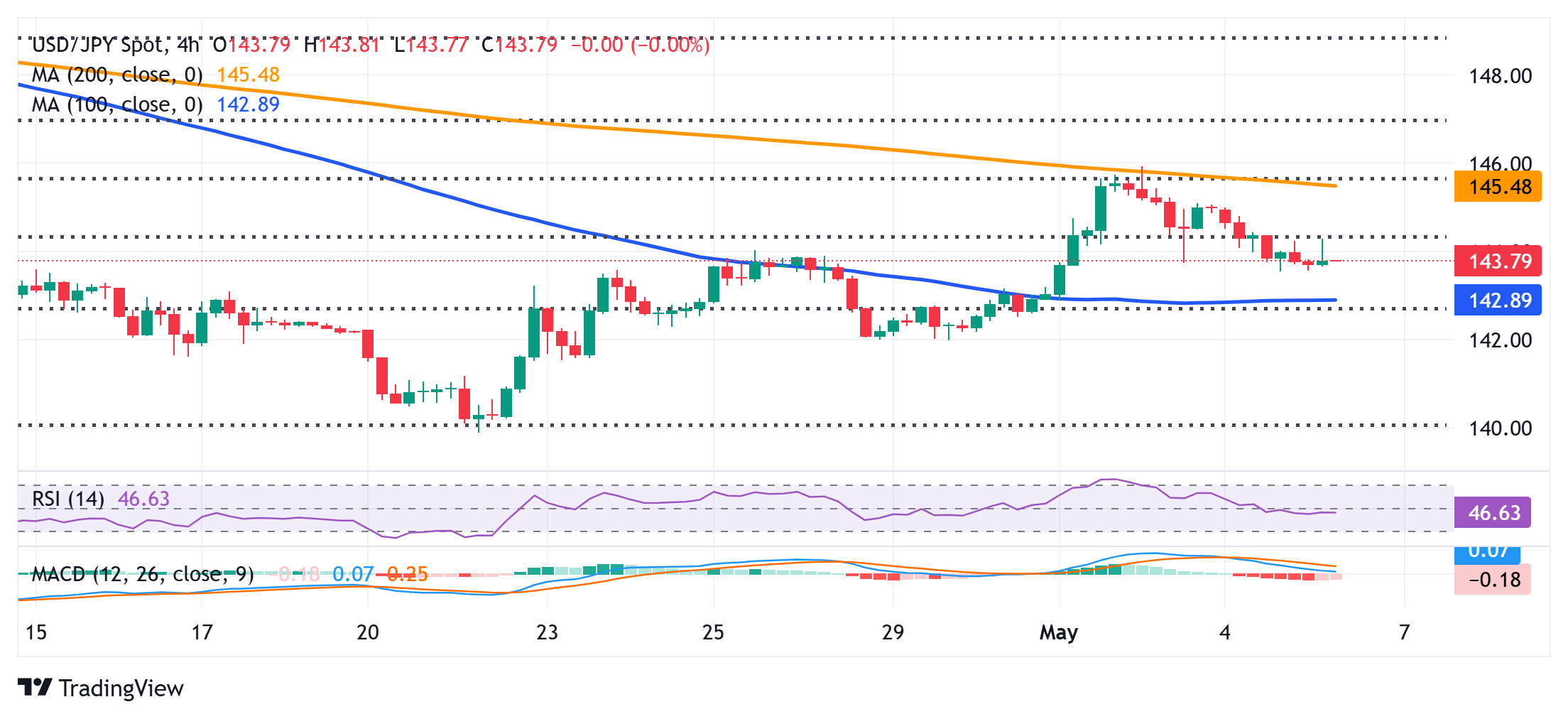
From a technical perspective, the USD/JPY pair last week struggled to find acceptance above the 50% Fibonacci retracement level of the March-April downfall and faced rejection near the 200-period Simple Moving Average (SMA) on the 4-hour chart. The subsequent decline and negative oscillators on daily/hourly charts suggest that the path of least resistance for spot prices is to the downside. Hence, any attempted recovery back above the 144.00 mark might still be seen as a selling opportunity near the 144.25-144.30 supply zone. A sustained strength beyond the latter, however, could trigger a short-covering rally and allow spot prices to reclaim the 145.00 psychological mark.
On the flip side, weakness below the Asian session low, around the 143.55-143.50 area, has the potential to drag the USD/JPY pair to the 143.30 intermediate support en route to the 143.00 mark. The next relevant support is pegged near the 142.65 region, which if broken decisively would expose the 142.00 level before the currency pair eventually drops to the 141.60-141.55 zone and the 141.00 round figure.