S&P 500 — US Large Cap Index
 FTSE 100 — UK Blue Chips
 Euro Stoxx 50 — Eurozone Leaders
 DAX 40 — German Equities
 CAC 40 — French Market Index
 Nikkei 225 — Japan Benchmark
 Hang Seng — Hong Kong Index
 Shanghai Composite — China Mainland
 ASX 200 — Australian Market
 TSX Composite — Canada Index
 Nifty 50 — India Large Cap
 STI Index — Singapore Market
 KOSPI — South Korea Index
 Bovespa — Brazil Equities
 JSE Top 40 — South Africa Index
 IPC Index — Mexico Market
McDonald’s shares slightly up despite mixed Q2 earnings report

McDonald’s (MCD.US) shares are up around 2% after the company released its Q2 2026 earnings. Once again, the fast-food giant demonstrated its ability to deliver earnings growth despite a challenging consumer environment, with adjusted EPS beating Wall Street expectations even as revenue and comparable sales came in slightly below consensus. Investors are now focused on whether McDonald’s can sustain its industry-leading margins while accelerating global sales growth in the second half of the year.
Key takeaways from the results
- Adjusted EPS came in at $3.38 , ahead of the $3.32 consensus, while reported EPS totaled $3.32 , up 6% year-over-year .
- Revenue increased 4% YoY to $7.10 billion , but came in slightly below Wall Street expectations of $7.13 billion .
- Net income rose 5% YoY to $2.36 billion , broadly in line with analyst estimates.
- Operating income increased 3% YoY to $3.3 billion , slightly below the $3.39 billion consensus.
- Global comparable sales increased 1.3% , narrowly missing expectations of 1.39% .
- U.S. comparable sales rose 0.8% , below forecasts of just over 1% .
- Comparable sales in the International Developed Licensed (IDL) segment increased 1.9% , while the International Operated Markets (IOM) segment posted 1.5% growth, with both results coming in marginally below consensus.
- Global systemwide sales climbed 5% YoY ( 4% in constant currency ), highlighting continued network expansion and resilient demand despite modest same-store sales growth.
- SG&A expenses increased 17% YoY to $817 million , while the effective tax rate declined to 19.5% from 21.3% a year earlier.
- McDonald’s reaffirmed its FY2026 guidance , maintaining capital expenditures of $3.7–3.9 billion , an operating margin in the mid-to-high 40% range , an effective tax rate of 21%–23% , interest expense growth of 4%–6% , and free cash flow conversion in the low-to-mid 80% range .
- The company also announced a leadership change, appointing Skye Anderson as President of McDonald’s USA , succeeding Joe Erlinger .
McDonald’s shares (D1 interval)
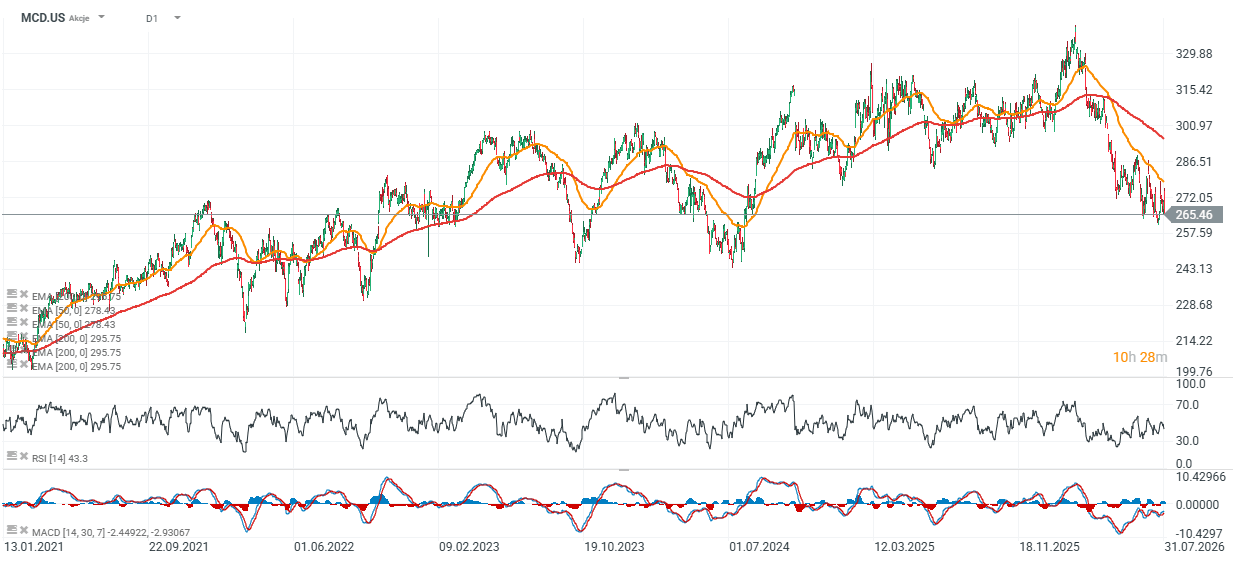
McDonald’s shares remain more than 25% below their all-time high of around $340 , a sizeable correction for a company of this size and quality. Importantly, most of the decline occurred while investors aggressively rotated capital toward AI-related and high-growth technology stocks. If momentum in the AI sector moderates while the global economy remains resilient, McDonald’s could benefit from a renewed investor preference for high-quality defensive businesses with stable cash flows. On the other hand, the company continues to face slowing organic growth and market saturation across many of its core geographies. Its most rapid expansion phase is likely behind it, although this does not imply limited upside from current valuation levels. McDonald’s still enjoys substantial competitive advantages, an iconic global brand, and growing popularity across many international markets. From a technical perspective, $260 represents a key support level, while the $295–300 area, coinciding with the 200-day EMA (red line) , is the nearest major resistance zone.
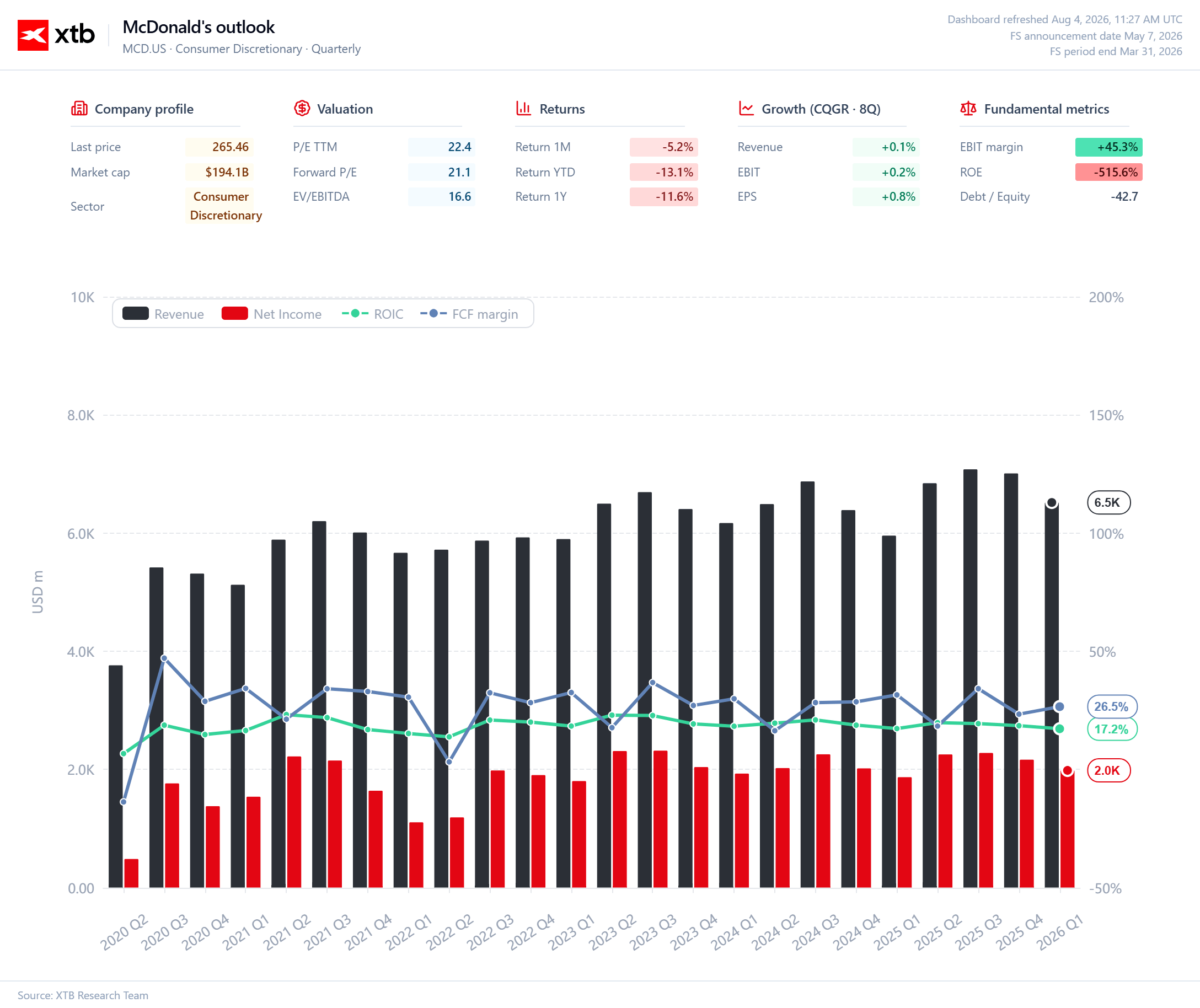
Source: xStation5 Over the past five years, McDonald’s has steadily increased both revenue and net income, although growth has remained moderate and considerably more stable than that of most large technology companies. One of the defining characteristics of the business is its ability to maintain exceptionally high profitability despite relatively modest revenue growth, reflecting the strength of its brand and the scalability of its franchise-based business model. The company’s ROIC remains at a very high level , indicating that every additional dollar of invested capital continues to generate above-average shareholder returns. At the same time, free cash flow margins have remained consistently strong , providing ample capacity to fund dividends, share buybacks, and ongoing investment without placing excessive pressure on the balance sheet. It is worth noting, however, that revenue growth has slowed in recent quarters, a common feature of mature global brands with already high market penetration. This suggests that future value creation will increasingly depend on operational efficiency, digital sales initiatives, and international expansion rather than rapid unit growth. From a fundamental perspective, McDonald’s remains a textbook example of a compounder —a company capable of creating long-term shareholder value through exceptional business quality, durable cash generation, and disciplined capital allocation despite relatively modest top-line growth. McDonald’s valuation also suggests that the market continues to view the company as a premium-quality business. The stock currently trades at a TTM P/E of approximately 22.4x , while forward P/E declines to around 21.1x , implying that investors expect further earnings growth over the next 12 months. Although this is not a low valuation in absolute terms, it remains justified by the company’s exceptional operating margins, highly predictable cash flows, and resilient business model. High-quality businesses like McDonald’s typically command a valuation premium relative to the broader equity market because investors are willing to pay more for durable competitive advantages and consistent long-term value creation.
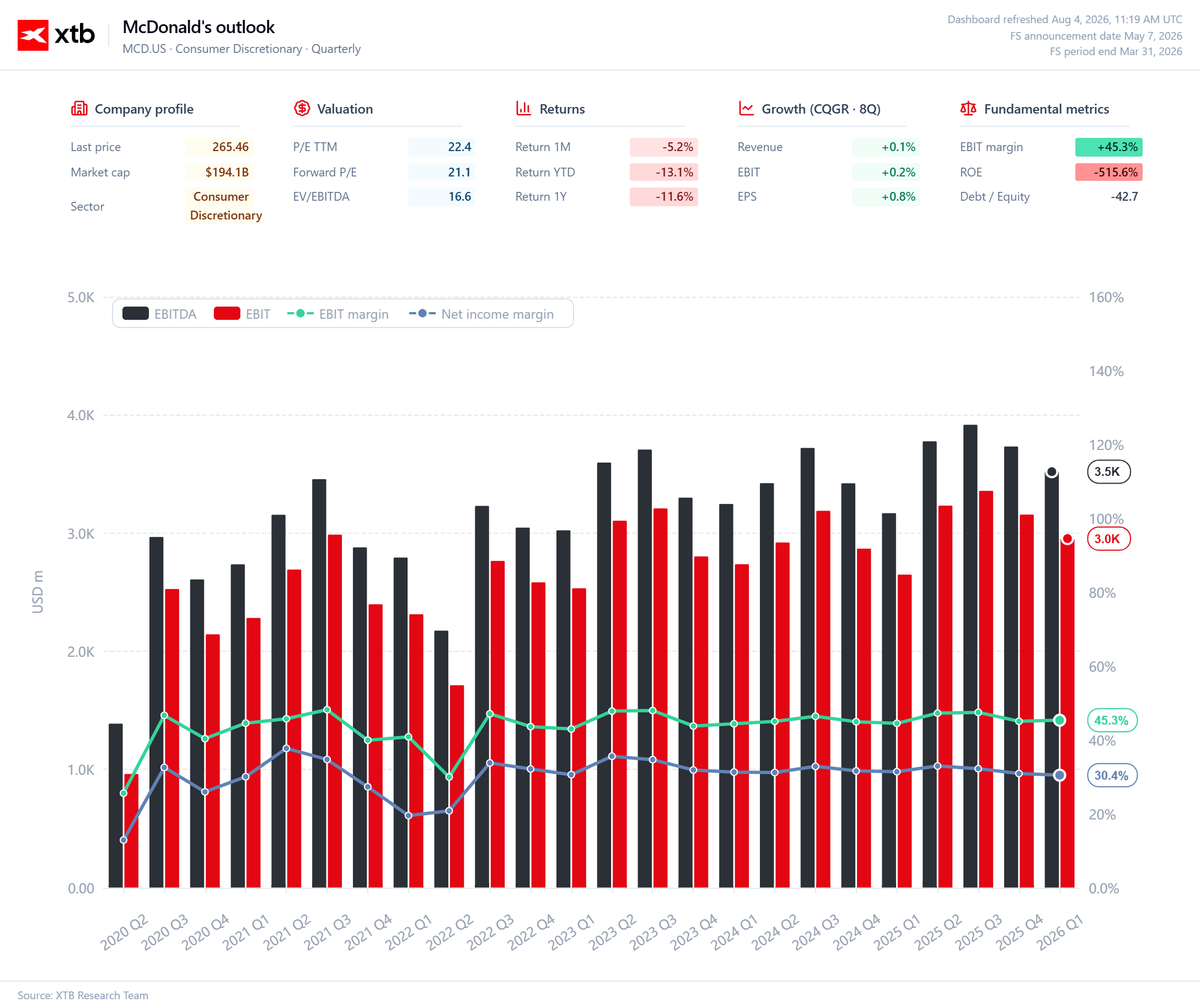
Source: XTB Research McDonald’s has maintained one of the highest operating profitability levels in the global restaurant industry for many years, largely thanks to its franchise-driven business model. The chart shows that both EBITDA and EBIT remain close to historical highs , despite slower revenue growth over recent quarters. EBIT margin currently stands at roughly 45% , meaning that nearly half of every dollar of revenue remains after operating expenses are covered. Such profitability reflects exceptional pricing power, strong brand equity, and outstanding operating efficiency, even in an environment of rising labor and food costs. At the same time, EBIT growth has recently lagged revenue growth, suggesting that the company has entered a more mature stage of its corporate lifecycle, where preserving margins has become a greater priority than aggressive expansion. For investors, the key takeaway is that McDonald’s continues to generate highly stable operating cash flows and industry-leading profitability despite modest sales growth. These characteristics make the company a classic example of a high-quality business whose intrinsic value is driven more by the predictability and durability of its earnings than by rapid revenue expansion.
Source: XTB Research