S&P 500 — US Large Cap Index
 FTSE 100 — UK Blue Chips
 Euro Stoxx 50 — Eurozone Leaders
 DAX 40 — German Equities
 CAC 40 — French Market Index
 Nikkei 225 — Japan Benchmark
 Hang Seng — Hong Kong Index
 Shanghai Composite — China Mainland
 ASX 200 — Australian Market
 TSX Composite — Canada Index
 Nifty 50 — India Large Cap
 STI Index — Singapore Market
 KOSPI — South Korea Index
 Bovespa — Brazil Equities
 JSE Top 40 — South Africa Index
 IPC Index — Mexico Market
Oil prices sharply up after Iran escalation


Brent crude tests $85 per barrel amid intensified attacks between the US and Iran Oil prices are rising for the second day in a row due to tensions in the Middle East. Brent crude is up over 2%, testing the vicinity of $85 per barrel. This is the highest level since the downward gap that occurred between June 12 and 15. Situation in the Strait of Hormuz and US plans: President Donald Trump reinstated the blockade of Iranian ships passing through the Strait of Hormuz. Although the United States indicates that it will act as a security guarantor on this key waterway, Trump announced plans to collect a 20% fee (compensation) from all other cargo benefiting from this protection.
Iran’s reaction and plans: Despite the American blockade imposed on Iranian merchant ships, Tehran is not backing down and firmly announces the continuation of exporting its raw materials to world markets. At the same time, it reports an attack on two supertankers passing through the Strait of Hormuz. Market background: Further exchange of blows between Washington and Tehran postpones the prospect of quickly unblocking the Strait of Hormuz. This situation raises renewed inflation concerns and increases the likelihood of further interest rate hikes by the US Fed.
It is worth noting that US crude oil inventories are already extremely low from the perspective of recent years, and reserves are the lowest since the 1980s. If vessel traffic is not resumed, oil prices could rise even to the level of $100 per barrel. If the situation is tense but the ship flow is continued to a limited extent, prices will likely reach an important supply zone in the vicinity of $88-$90 per barrel, where important technical levels are located. Zapasy i rezerwy strategiczne w USA
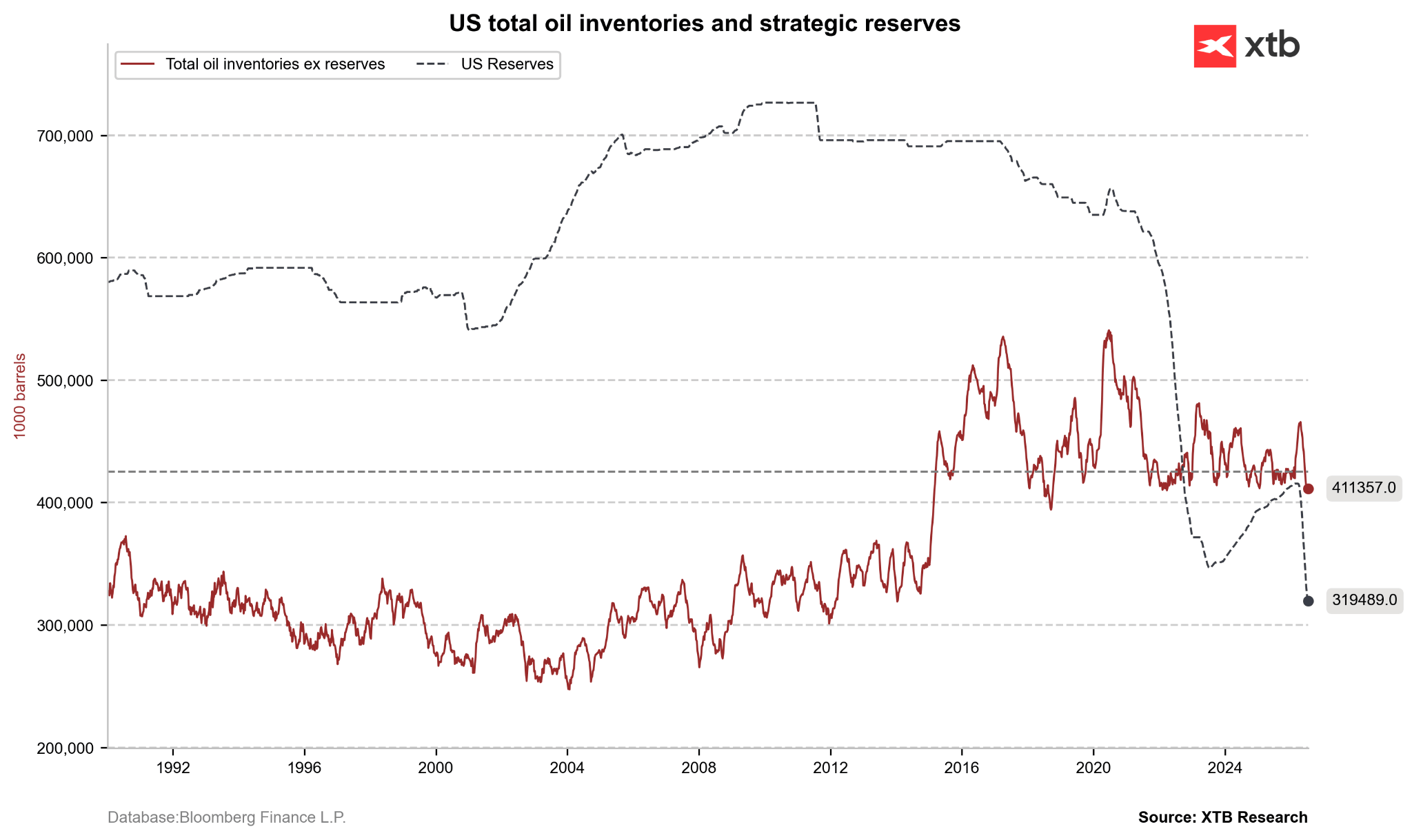
US commercial inventories are the lowest since 2018, while strategic reserves are at their lowest since the 1980s. A further decline in inventories and reserves could raise concerns about energy security in the US, despite near-total self-sufficiency. It is worth noting, however, that the United States has served as a buffer for supplies to Asian countries. Source: Bloomberg Finance LP, XTB Brent crude chart on the D1 interval
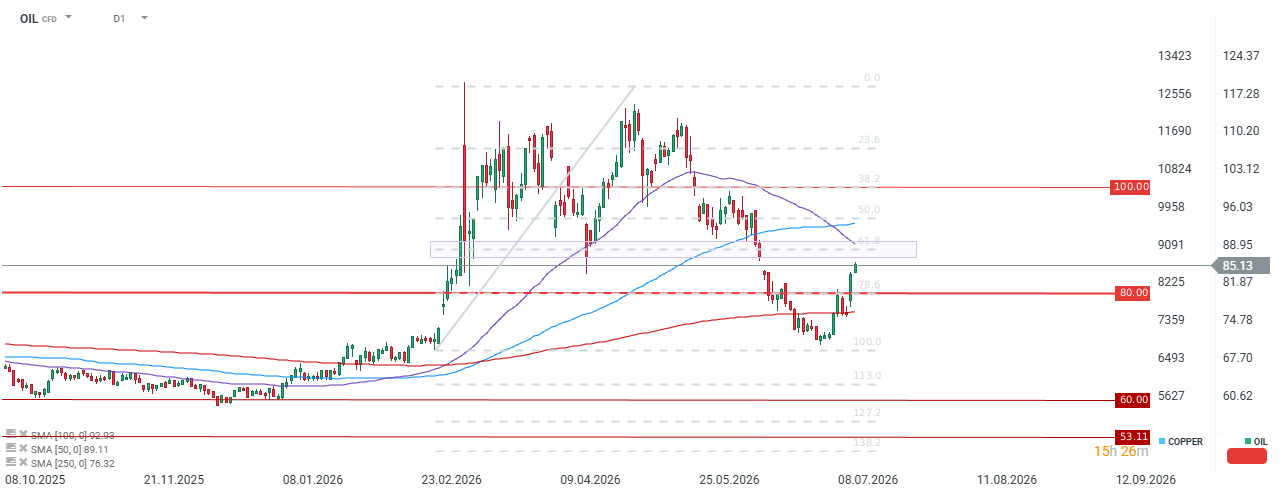
The price of crude oil has risen by over 20% from its last local low at the turn of the month and is approaching the 61.8 retracement of the upward wave associated with the Iranian conflict. The 88-90 USD zone is reinforced by local lows and the 50-period average. Source: xStation5