S&P 500 — US Large Cap Index
 FTSE 100 — UK Blue Chips
 Euro Stoxx 50 — Eurozone Leaders
 DAX 40 — German Equities
 CAC 40 — French Market Index
 Nikkei 225 — Japan Benchmark
 Hang Seng — Hong Kong Index
 Shanghai Composite — China Mainland
 ASX 200 — Australian Market
 TSX Composite — Canada Index
 Nifty 50 — India Large Cap
 STI Index — Singapore Market
 KOSPI — South Korea Index
 Bovespa — Brazil Equities
 JSE Top 40 — South Africa Index
 IPC Index — Mexico Market
Politics in Brazil more important than high rates. Why is the BRL weakening and what does it mean for commodities?

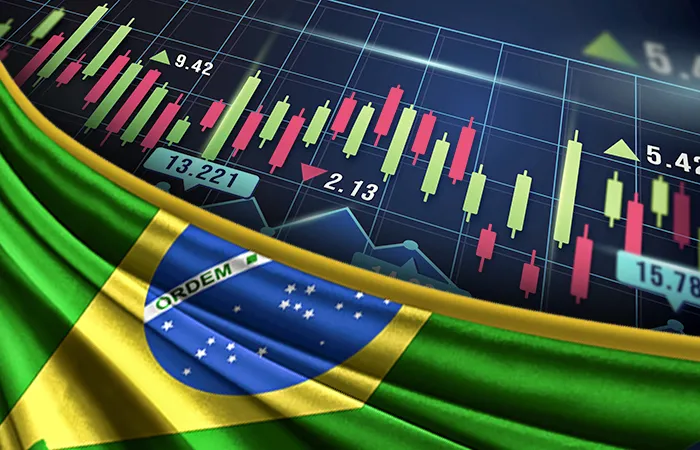
Anatomy of the BRL weakness: Politics eats into carry trade Although the Brazilian real offers an exceptionally attractive real interest rate reaching almost 10% (the Selic rate is 14% with inflation at 4.44%), the currency is under strong selling pressure, despite the generally positive sentiment for Latin American currencies. The main trigger is the growing political risk ahead of the October elections. Polls show a lead for Lula da Silva over Flávio Bolsonaro (47–48% to 39–44%), which is raising investors’ concerns about the country’s fiscal stability, despite the assurances of Lula’s campaign about keeping finances in check. As a result, the market risk premium is rising rapidly, neutralizing the advantages of high interest rates in carry trades.
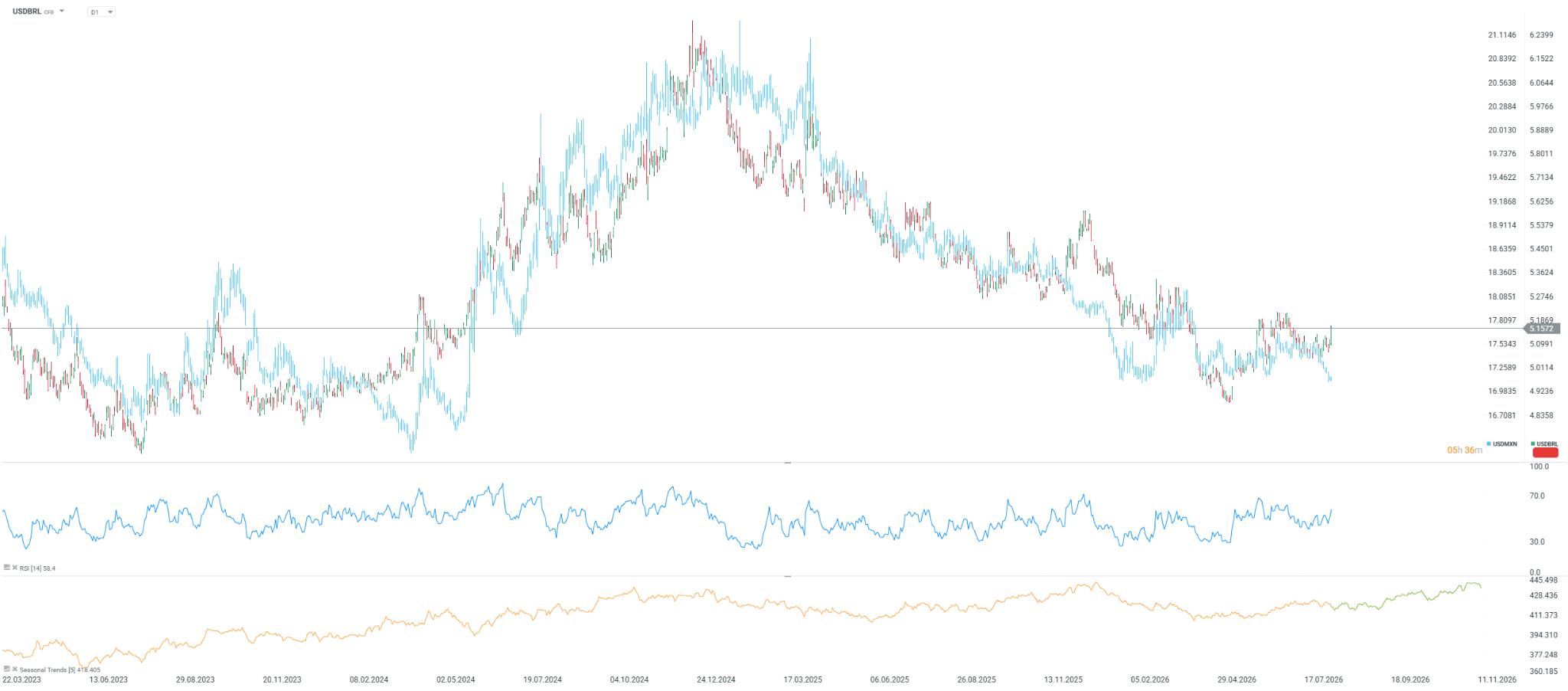
Real is losing value despite the positive sentiment for Latin American currencies. The USDMXN is clearly losing, remaining at its lowest levels since 2024. Source: xStation5
The Central Bank (BCB) Dilemma
The Central Bank of Brazil recently lowered the Selic rate by 25 bps to 14% (the fourth cut in a row).
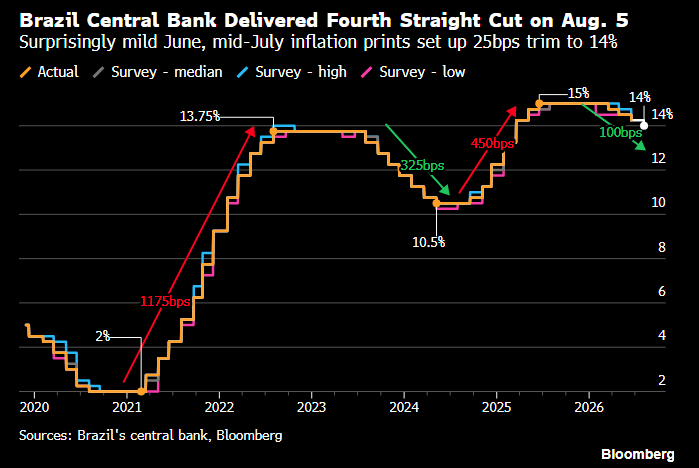
Brazil’s interest rate picture. Despite winning the fight against inflation, interest rates remain extremely high. Source: Bloomberg Finance LP Although rate cuts theoretically weaken a currency, in this case, the conclusions from the minutes of the monetary policy committee (Copom) meeting are key:
- Restrictiveness for longer: The Bank explicitly emphasizes that policy must remain strongly hawkish, as long-term inflation expectations for 2028 (3.8%) are still above the 3.0% target.
- Demand and fiscal pressure: Economic stimulus and social programs introduced by the Lula government are boosting domestic demand, making it difficult to control inflation.
- Higher inflation: The July CPI reading of 4.44% turned out to be higher than forecasts and is positioned dangerously close to the upper limit of the target (1.5%–4.5%).
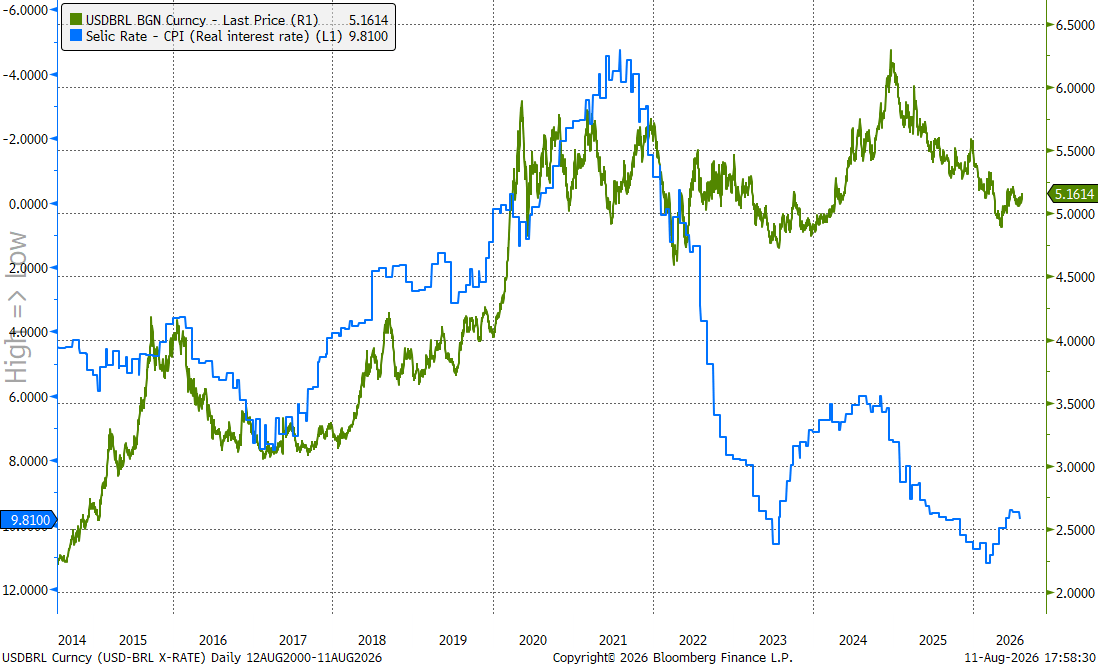
It is worth noting that the BCB has won the fight against inflation, although inflation itself is above the midpoint of the target range. The real interest rate remains extremely high. Source: Bloomberg Finance LP
Capital flight from the stock market (Ibovespa)
Political uncertainty is directly hitting the Brazilian stock market:
- The Ibovespa index is falling for the sixth consecutive session.
- The price-to-earnings (P/E) ratio has shrunk from over 10x at the beginning of the year to 8.2x.
- Stock market earnings yield is 243 basis points lower than the 10-year Treasury bond yield, which makes foreign capital choose safer debt or withdraw from Brazil entirely.
Impact on the agricultural commodities market (coffee, sugar, soybeans)
Brazil is the world’s largest exporter of coffee and sugar and a key supplier of soybeans. The weakening of the real translates directly into these markets:
- Higher export profitability: A weaker BRL means that goods priced in US dollars (USD) generate higher revenue in local currency for Brazilian farmers and trading corporations.
- Supply pressure and hedging: Currency weakening motivates local producers to sell stocks more intensively and hedge future harvests on the New York and Chicago exchanges.
- Global price decline: The increase in supply from Brazil historically generates downward pressure on the prices of futures contracts for coffee (Arabica), sugar, and soybeans.
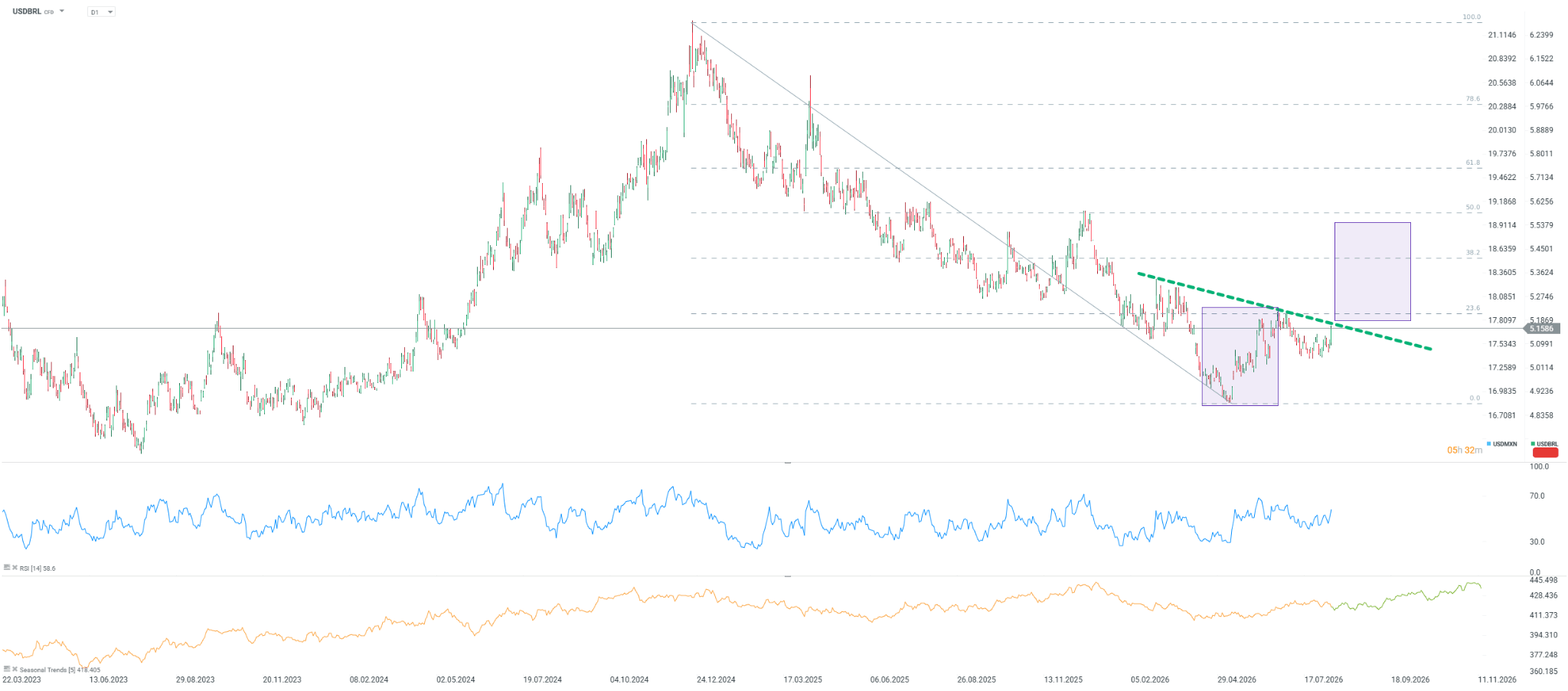
Even very high interest rates will not protect the real from volatility as long as uncertainty around the election outcome and Brazil’s future fiscal path dominates. The real is weakening today against the dollar, even though sentiment regarding LATAM currencies remains positive. Technically, the key resistance for USD/BRL will be the 5.20 level, where we can also draw the 23.6 Fibo level of the last major downward wave. Potentially, USD/BRL is currently testing the neckline of the inverse head-and-shoulders (iH&S) pattern. If this line, along with the aforementioned retracement, is broken, the scope of the pattern points even to the area around 5.55, where the 50.0 retracement and local highs from December 2025 are located.