S&P 500 — US Large Cap Index
 FTSE 100 — UK Blue Chips
 Euro Stoxx 50 — Eurozone Leaders
 DAX 40 — German Equities
 CAC 40 — French Market Index
 Nikkei 225 — Japan Benchmark
 Hang Seng — Hong Kong Index
 Shanghai Composite — China Mainland
 ASX 200 — Australian Market
 TSX Composite — Canada Index
 Nifty 50 — India Large Cap
 STI Index — Singapore Market
 KOSPI — South Korea Index
 Bovespa — Brazil Equities
 JSE Top 40 — South Africa Index
 IPC Index — Mexico Market
Stock of the Week – Arista Networks—A Second-Tier Technology with Top-Tier Results


The larger data centers become, the less important a single processor becomes, while the network connecting thousands of computing units into one efficient system gains increasing importance. Without this infrastructure, even the most powerful hardware cannot reach its full potential. This is the foundation on which Arista Networks has built its position for nearly two decades. The company does not compete with chip manufacturers and does not develop its own artificial intelligence models. Instead, it provides the technology responsible for communication inside the world’s largest data centers. Its solutions are used by companies such as Microsoft, Meta and Oracle, all of which are among the biggest investors in AI infrastructure development. In recent years, the importance of networking infrastructure has increased significantly. The reason is straightforward. Each new generation of AI models requires more data, greater computing power and an increasing number of processors working simultaneously. As a result, the ability to exchange information quickly and efficiently between these systems has become just as important as the performance of the computing units themselves. The recently published second quarter 2026 results show that Arista continues to benefit from this trend. The company maintains strong growth momentum, expands its business scale and remains one of the key beneficiaries of record investment in data centers. The question is no longer whether Arista benefits from the AI expansion, but whether its current valuation still leaves room for further upside.
Chapter 1. The biggest challenge for data centers is no longer only computing power
For many years, the development of data centers was relatively simple to describe. The most important element was computing power. The more advanced the processors became, the greater the capabilities of the entire infrastructure. Today, this model is no longer sufficient. The most demanding computational tasks increasingly require thousands of chips working together simultaneously. A modern data center is no longer a collection of independent servers, but a massive interconnected system where individual components constantly exchange information.
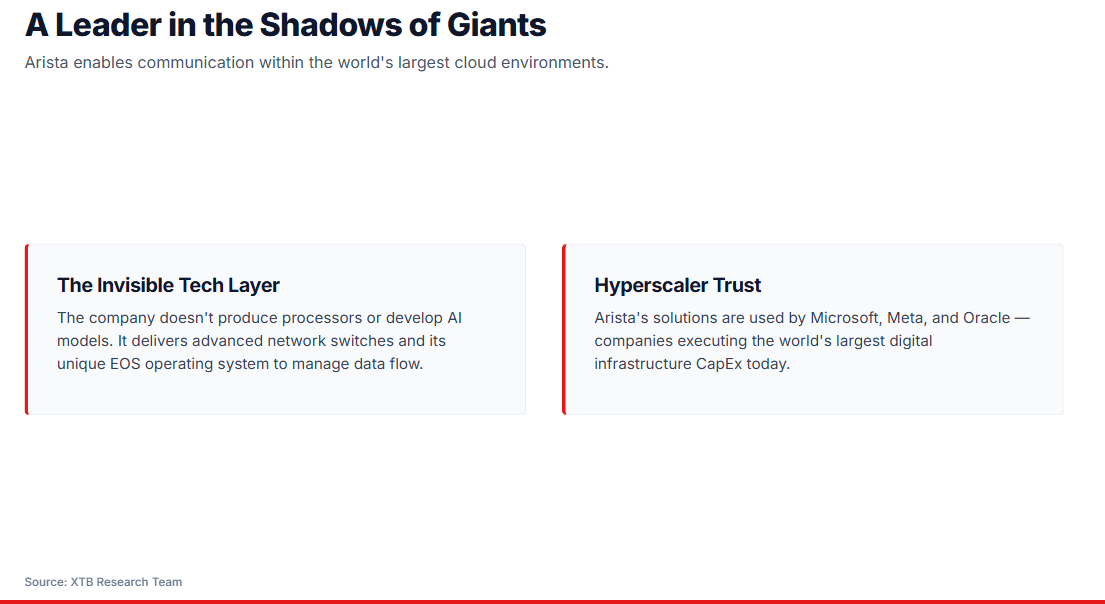
In this environment, raw computing power is no longer the only limitation. Equally important is how quickly and efficiently individual components can communicate with each other. This shift has significantly increased the importance of networking infrastructure. Until recently, networks were often viewed as a supporting element responsible mainly for transferring data between devices. Today, in the largest data centers, networking has become one of the core components of the entire architecture. The reason is simple. When thousands of processors are working together on a single task, even small communication delays can reduce the efficiency of the entire system. This transformation has major implications for infrastructure providers. The market is no longer focused solely on who produces the most advanced processors. Increasingly, investors are looking at companies responsible for connecting these components into one integrated and efficient system. Arista Networks is one of the companies benefiting from this structural change. The company operates in an area that for years remained in the shadow of the biggest technology names, but as data centers have grown in scale, it has become one of the most important parts of the entire ecosystem. The story is no longer only about increasing the number of processors. It is about building infrastructure that allows those processors to work together effectively.
Chapter 2. Arista Networks: the company powering communication inside the world’s largest data centers
Arista Networks is not a company that attracts attention from everyday technology users. It does not manufacture processors, create consumer applications or provide services visible on a typical computer screen. Its business operates behind the scenes. The company provides network switches and software used in the largest data centers worldwide. Its solutions enable efficient communication between servers, processors and other critical infrastructure components. This invisible layer of technology has become one of the most important areas of investment for the largest technology companies. Arista has built its position primarily through focusing on the most demanding customers. Its clients include Microsoft, Meta and Oracle, companies operating some of the largest computing environments in the world. A key element of Arista’s competitive advantage is not only its hardware, but also its proprietary network management software. The EOS operating system allows customers to efficiently manage complex infrastructure and automate network operations. This approach differentiates Arista from traditional networking equipment manufacturers. The company does not compete purely on hardware pricing. Instead, it provides solutions designed for organizations where reliability, scalability and performance are critical. For the largest data center operators, switching suppliers is not a simple decision. Network modernization requires time, testing and integration with existing systems. As a result, companies that earn the trust of major operators can build long-term competitive advantages. Arista’s history shows that the biggest investment opportunities are not always found in the most visible areas of the market. Sometimes the greatest beneficiaries of technological change are companies providing the essential infrastructure that allows the entire system to function. For Arista, that essential element is communication between devices, which becomes increasingly important as data centers continue to expand.
Chapter 3. Artificial intelligence has changed the importance of networking infrastructure
Until recently, data center development was mainly associated with increasing computing power. Companies invested in faster processors and more servers because these components determined the capabilities of the entire infrastructure. Today, the situation is changing. The most demanding AI workloads are no longer handled by individual chips, but by thousands of processors operating together. In such an environment, communication speed between components becomes just as important as computing capability itself. This is why networking infrastructure has gained strategic importance. Modern data centers increasingly resemble one enormous computing system where multiple devices must operate together seamlessly. If communication between these components is not fast enough, even the most advanced hardware cannot achieve its full potential. This structural shift directly benefits Arista Networks. The company provides solutions responsible for communication inside the largest data centers. Its growth does not depend on one specific processor manufacturer or a single computing technology. Its products remain essential regardless of which companies dominate future generations of AI hardware. This is the central investment argument behind Arista. The expansion of artificial intelligence does not only increase demand for processors and servers. It also creates demand for increasingly advanced networks capable of allowing thousands of computing units to function as one integrated system. The largest data center operators, including Microsoft, Meta and Oracle, are significantly increasing capital expenditure. Every new generation of infrastructure requires not only more computing equipment but also solutions enabling efficient communication between those systems. This places Arista in one of the most strategically important positions in the technology ecosystem. The company does not sell a product that attracts consumer attention. Its value comes from solving a problem that becomes increasingly important as data centers grow in complexity and scale.
Chapter 4. Financial results confirm the strength of demand for AI infrastructure
Arista Networks once again delivered results significantly above market expectations. The company continues to benefit from a powerful investment cycle in data centers, where growing demand for AI-related technologies requires increasingly advanced networking infrastructure. Key second quarter 2026 figures:
- Revenue reached approximately $3.04 billion, representing 38% year-over-year growth.
- Adjusted earnings per share came in at $1.02, compared with market expectations of approximately $0.89.
- Non-GAAP operating margin increased to 49.9%, highlighting the exceptional profitability of the business model.
- The company generated strong cash flow, maintaining high-quality growth.
- Third quarter revenue guidance was raised to approximately $3.3 billion.
- Management also increased full-year revenue growth expectations, pointing to stronger demand than previously anticipated.
These results show that Arista’s growth is not simply a result of short-term enthusiasm surrounding artificial intelligence. The company is benefiting from a fundamental transformation in infrastructure spending among the largest cloud providers, which are expanding data centers and investing heavily in networks capable of supporting increasingly demanding workloads. The most important element for investors was the improved outlook for future quarters. The market had been concerned that after several years of exceptional growth, expansion could begin to slow. However, Arista demonstrated that demand remains extremely strong. Higher guidance suggests that investments from major customers such as Microsoft and Meta are likely to continue supporting growth. The key conclusion for investors is that Arista remains one of the major beneficiaries of the AI infrastructure boom. However, as expectations rise, the company faces an increasingly demanding standard. Future performance must not only remain strong but also prove that current AI infrastructure spending represents the beginning of a long-term investment cycle.
Chapter 5. Financial analysis: a business of exceptional quality
Arista Networks stands out among technology companies not only because of its growth rate, but above all because of the quality and consistency of its financial performance. Over the years, the company has built a business model that combines scalable revenue growth with profitability levels more typical of technology companies with strong competitive advantages rather than traditional networking equipment manufacturers. The foundation of Arista’s success is the combination of specialized networking infrastructure, proprietary software and a strong position among the largest cloud operators. The company does not compete solely on the price of its products. Instead, it provides mission critical solutions for modern data centers. This allows Arista to maintain strong pricing power and stable margins that remain significantly above the average for the broader IT infrastructure sector.
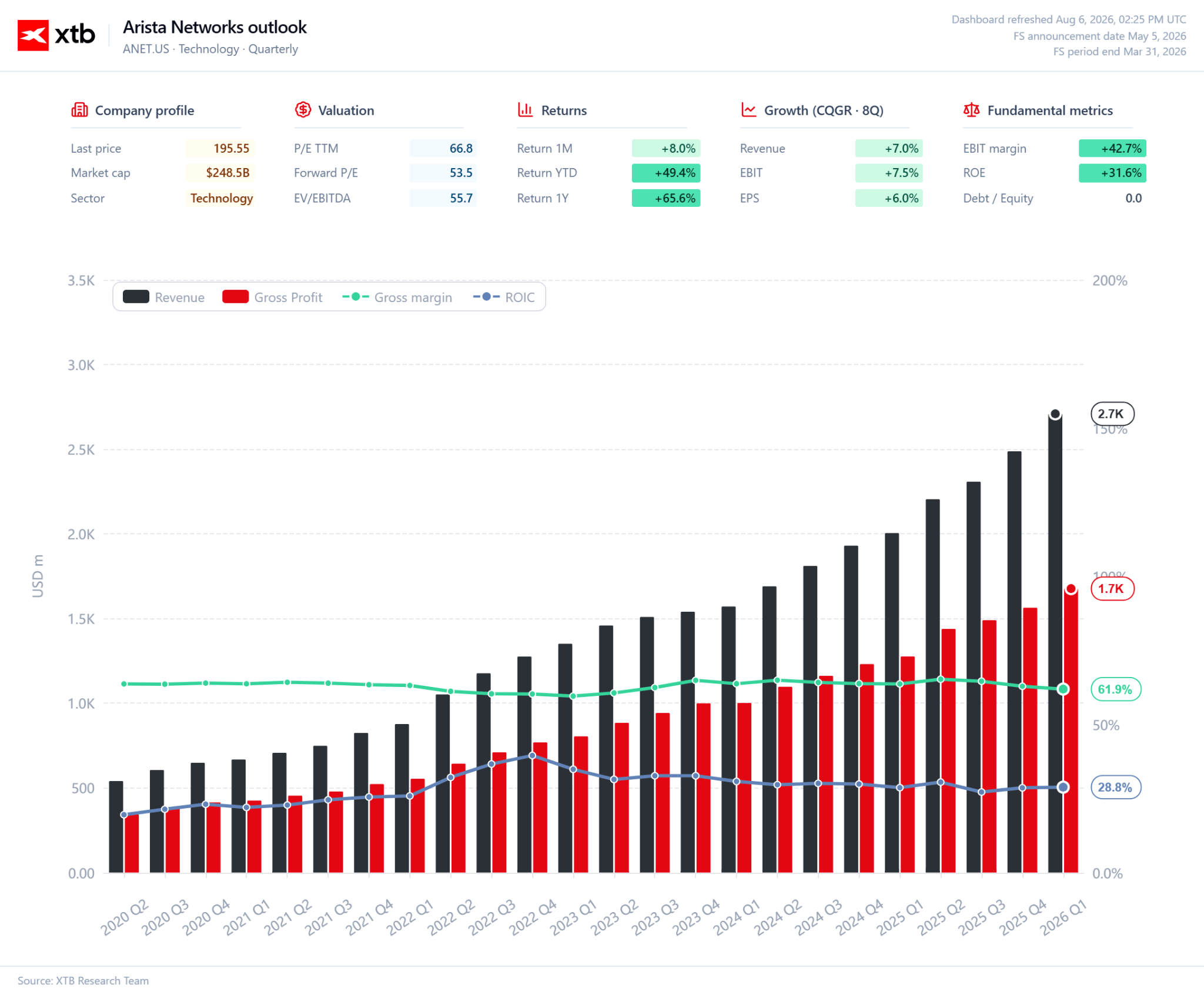
The most important element of Arista’s financial profile is its ability to consistently expand the scale of its business. The company has steadily increased revenue, benefiting from long term trends such as cloud computing growth, enterprise digital transformation and rising demand for AI infrastructure. Importantly, this growth has not come at the expense of profitability. Gross margins have remained around 60 to 62% for years, demonstrating the durability of the company’s competitive advantage and the high value of its technology.
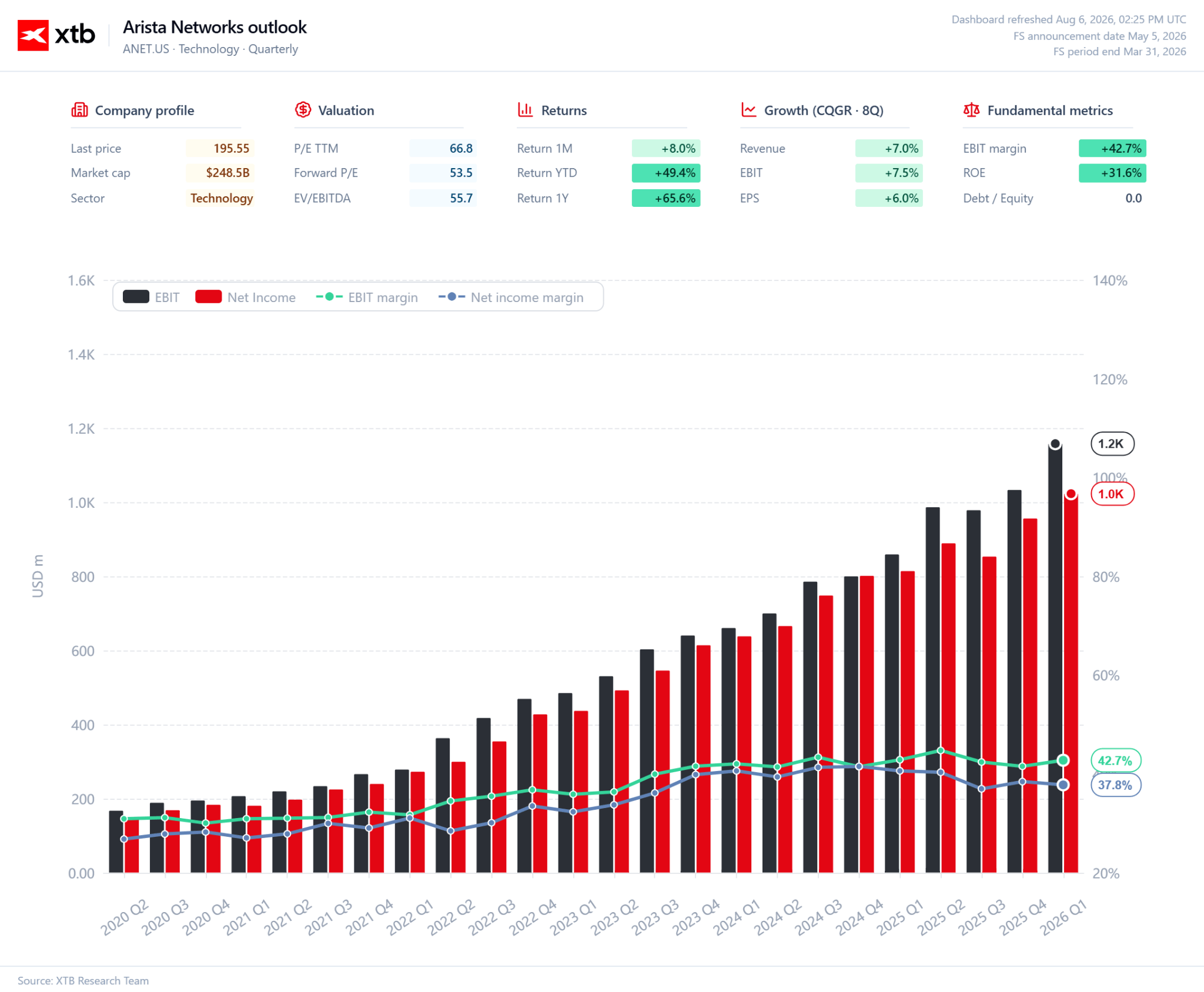
Another important factor is improving operational efficiency. Arista operates a highly scalable business model, where revenue growth does not require a proportional increase in fixed costs. As the company expands, an increasing portion of additional sales flows directly into operating profit. This is reflected in consistently high operating margins and strong capital efficiency metrics. Return on equity of approximately 31% and return on invested capital above 28% demonstrate that Arista is capable of generating exceptional returns on the capital used to grow its business.
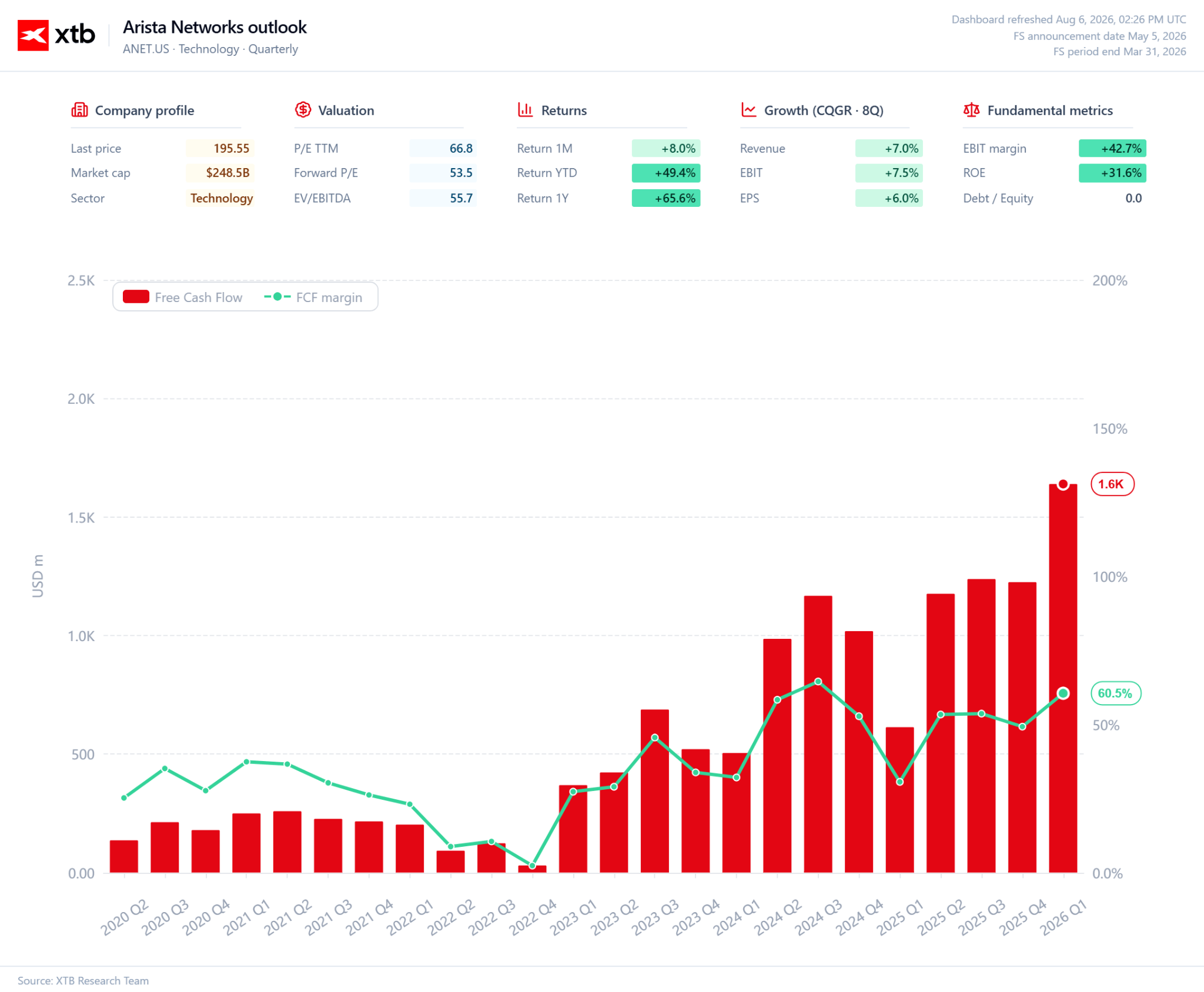
One of Arista’s biggest strengths remains its ability to generate significant amounts of cash. Unlike many companies involved in the AI infrastructure boom, Arista operates a relatively asset light business model. The company does not need to finance the construction of massive data centers or invest billions of dollars into manufacturing its own processors. Its role is to provide the critical communication layer that allows these systems to operate faster and more efficiently. As a result, a significant portion of earnings is converted into real cash flow. Strong cash generation also translates into an exceptionally healthy balance sheet. Arista maintains a net cash position and does not rely on debt financing. This provides significant financial flexibility during weaker economic periods, allows continued investment in technology development and enables shareholder value creation without pressure from interest expenses.
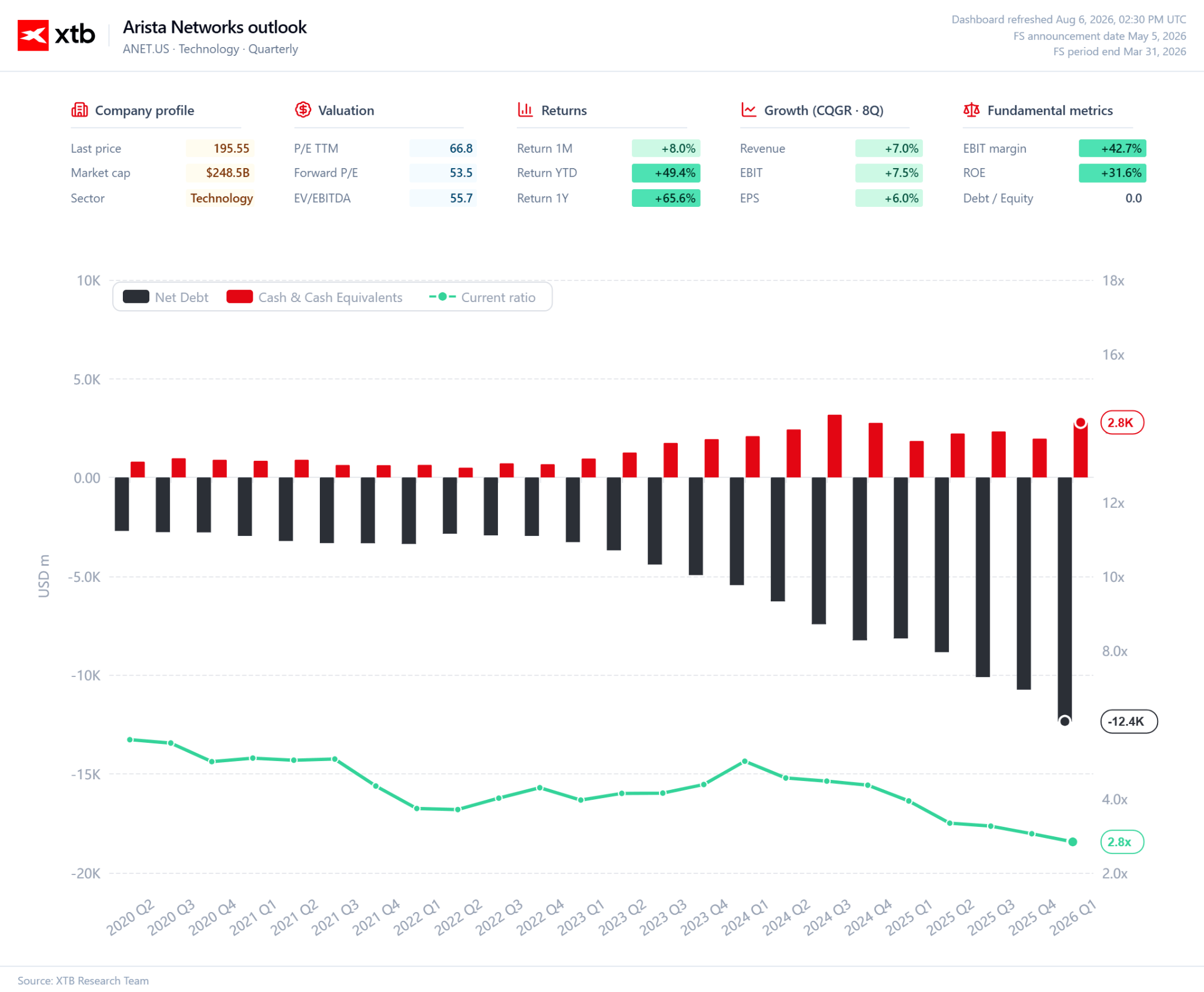
From a market perspective, the biggest challenge is not the quality of the business itself, but its valuation. Investors have recognized Arista’s exceptional position for years, and the company trades at a premium compared with many technology peers. High P/E multiples indicate that the market expects continued rapid growth and further benefits from global expansion of AI infrastructure. This means future results must not only remain strong, but also continue to justify the elevated expectations already reflected in the share price. Looking at Arista Networks from a broader perspective, the company represents a rare combination of characteristics: a growing end market, high margins, a fortress balance sheet and strong free cash flow generation.
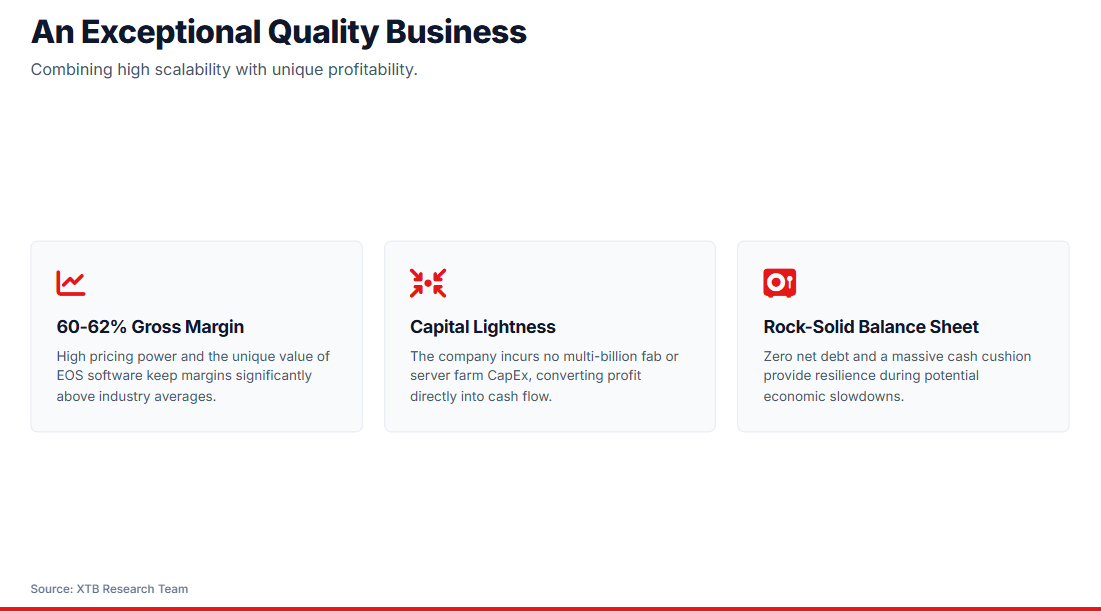
This combination places Arista among the most attractive long term beneficiaries of digital infrastructure expansion and artificial intelligence development.
Chapter 6. Risks
Despite its strong fundamentals, Arista Networks is not an investment without risks. The company’s current valuation reflects expectations of continued strong growth and further expansion of the AI infrastructure market. This means that any slowdown in data center investment or weaker than expected financial results could trigger a negative market reaction. The biggest risk remains elevated investor expectations. In recent years, Arista has become one of the major beneficiaries of the artificial intelligence boom, which has been reflected in both its share price performance and valuation. At such a high level of market confidence, investors are no longer looking only for solid results, but for continued positive surprises. For highly valued technology companies, even strong growth may not be enough if it falls short of already elevated market expectations.
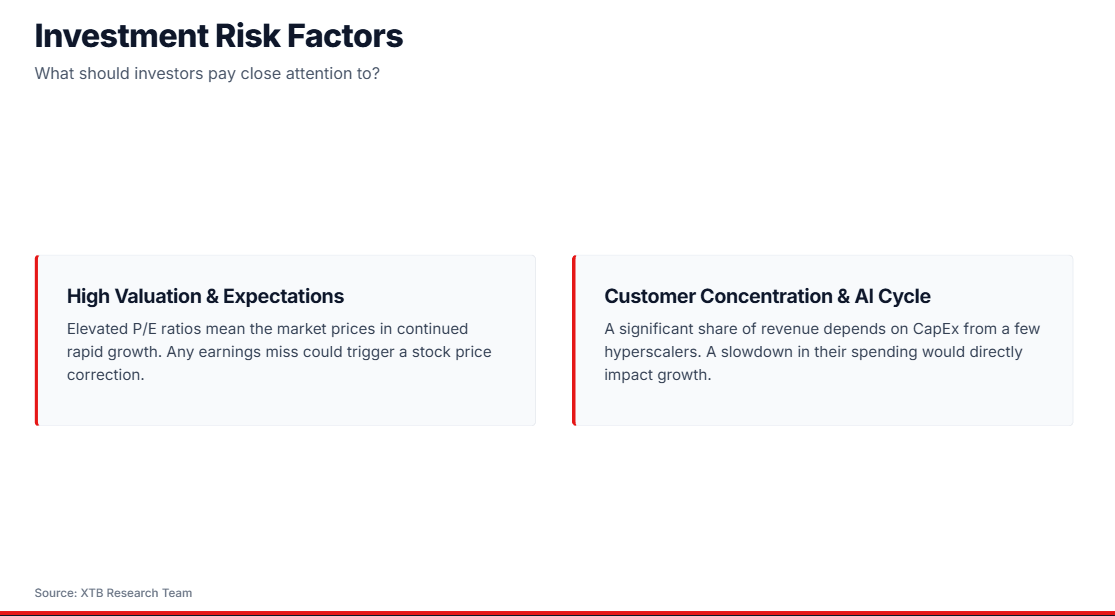
Another important risk is customer concentration. Arista’s growth is closely linked to spending from the largest technology companies building massive data center networks, including Microsoft, Meta and other cloud service providers. Currently, these companies are increasing capital expenditure to support rising demand for AI computing capacity. However, if investment growth slows, it could directly impact Arista’s future expansion rate. Competitive pressure is another factor that cannot be ignored. The networking infrastructure market remains highly competitive, and the largest technology companies continuously develop internal solutions while maintaining relationships with multiple suppliers. Arista has a strong market position and significant technological advantages, but maintaining current margins will require continuous investment in product development and ongoing innovation. The biggest long term question concerns the sustainability of the current AI investment cycle. The market assumes that artificial intelligence development will require years of massive spending on infrastructure. If this scenario plays out, Arista should remain one of the key beneficiaries of this trend. However, if current investment levels represent a temporary acceleration rather than the beginning of a long lasting transformation, the company’s valuation could become increasingly difficult to justify.
Summary
Arista Networks remains one of the most interesting infrastructure companies benefiting from the expansion of artificial intelligence. The company does not receive the same level of public attention as chip manufacturers or AI model developers, but it provides a critical component without which the continued growth of this market would be significantly more difficult. The networks responsible for communication between thousands of computing units are becoming increasingly important in modern data centers, and Arista has established itself as one of the leaders in this segment. The latest financial results confirmed that the company continues to successfully benefit from the current investment cycle. Strong revenue growth, exceptional profitability and improved guidance demonstrate that demand for Arista’s solutions remains extremely strong. Importantly, the company is not simply benefiting from short term AI enthusiasm. It is positioned within a long term transformation in how global technology infrastructure is built. At the same time, the current valuation shows that the market has already recognized Arista’s potential. Further share price appreciation will require not only strong results but also the continuation of exceptional growth rates over the coming years. For Arista, the key question is no longer whether the company benefits from the AI revolution. The question is whether the scale and duration of this growth will be sufficient to justify investor expectations. At present, Arista remains a company with outstanding fundamentals, a high quality business model and strategic importance for the entire artificial intelligence ecosystem. The main investment risk does not come from operational weakness, but from the very high expectations already embedded in the valuation. If the AI infrastructure boom continues, Arista has strong arguments to remain one of the major long term winners of this technological transformation.