S&P 500 — US Large Cap Index
 FTSE 100 — UK Blue Chips
 Euro Stoxx 50 — Eurozone Leaders
 DAX 40 — German Equities
 CAC 40 — French Market Index
 Nikkei 225 — Japan Benchmark
 Hang Seng — Hong Kong Index
 Shanghai Composite — China Mainland
 ASX 200 — Australian Market
 TSX Composite — Canada Index
 Nifty 50 — India Large Cap
 STI Index — Singapore Market
 KOSPI — South Korea Index
 Bovespa — Brazil Equities
 JSE Top 40 — South Africa Index
 IPC Index — Mexico Market
Last week was dominated by debt market events. On Wednesday, US Treasury Secretary Scott Bessent announced an expansion of the bond buyback programme, known as the liquidity support buyback.
- The programme primarily concerns the long end of the curve, i.e., Treasury bonds with longer maturities.
- The maximum threshold for individual buyback operations will be increased at least twofold (from 2 to 4 billion USD).
- The intervention occurred as 30-year bond yields rose to 19-year highs (5.33%).
The market reaction was swift: 30-year bond yields fell immediately by 10 bps, and the dollar weakened by 0.9% against the reference euro. Figure 1: G10 FX Dashboard [vs. USD] (14.08.2026 – 21.08.2026)
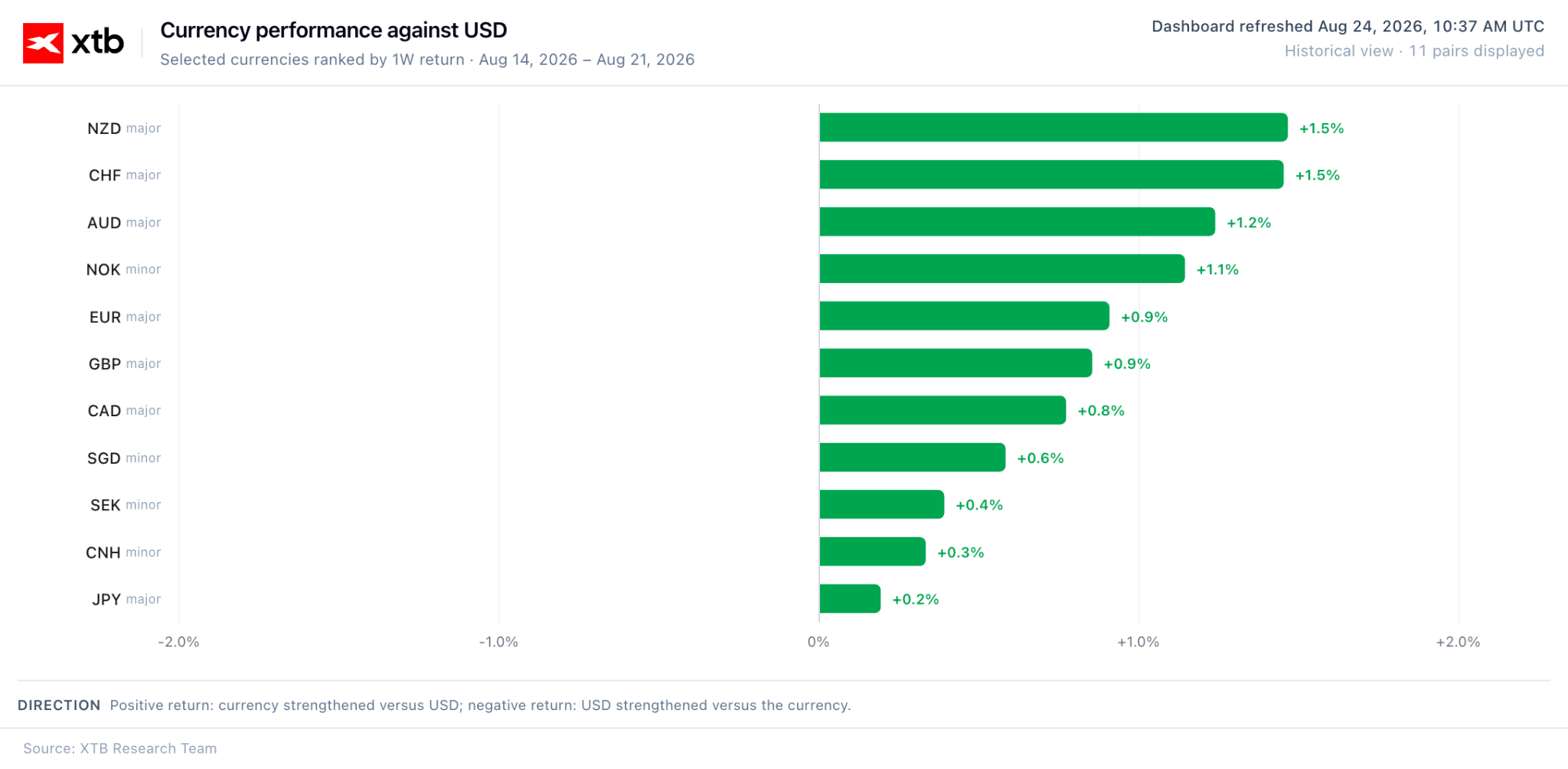
Source: XTB Research, 24.08.2026 In the following days, the market erased over half of Wednesday’s move in the debt market. The dollar, which remains under pressure from fiscal and institutional concerns, was unable to recoup most of the losses. The modest appreciation of the US currency that we observed today and on Friday seems to be mainly the result of a slight increase in market pricing for an interest rate hike in the autumn. Such action could be treated as a balancing tool. The market-implied probability of an upward move in September is currently around 40%. In October, it is slightly more than 60%.
US Dollar (USD)
Investors will be watching all actions aimed at stabilising the debt market situation very closely in the coming days. We are convinced that this topic will be extensively discussed at one of the most important central banker conferences of the year: the symposium in Jackson Hole. On Friday in the early afternoon, Kevin Warsh will be able to address the entire situation; for him, this event is of critical importance. Why? When Donald Trump nominated Warsh for the position of Federal Reserve Chair in March, the market labelled him as someone susceptible to influence, ready to opportunistically change his approach to monetary policy to satisfy the US President who was demanding interest rate cuts. While Warsh managed to some extent to detach this label with the June conference, presenting relatively hawkish rhetoric, the repetition of the same messages in July did not meet with enthusiasm. He stuck to his then-decision regarding the lack of forward guidance. He avoided answering questions regarding the legitimacy of a pause, as well as those concerning the current economic situation. That will not be possible this Friday. Warsh has recently been favoured by macroeconomic data that suggested no need for immediate monetary policy tightening. Investors, however, still want to ensure that he has a solid action plan and is independent in his actions. If his statements prove unconvincing again, the dollar may continue the sell-off initiated after the last meeting. Two days before the speech, which is crucial for the further outlook of the dollar, we await the publication of PCE inflation data. The measure, although delayed, has historically been preferred by FOMC policymakers when making monetary policy decisions. The consensus assumes a 0.2% increase on a monthly basis, which is unlikely to raise major concerns. On the same day, after the US market closes, Nvidia’s quarterly report will be released. This is a test for the durability of the entire bull market driven by artificial intelligence development. Results worse than the very high expectations would likely lead to a deterioration in risk sentiment, weighing on risky assets, not just in the equity market. In such a situation, the winner, paradoxically, could be the dollar.
Euro (EUR)
Less is happening on the other side. Stability serves the single currency. An interest rate hike at the September (10.09) meeting remains almost fully priced in, and incoming macroeconomic data continues to generally surprise on the upside. In recent days, we have received the August PMI indicators. The composite index reached its highest level in 9 months, driven by excellent industrial performance (51-month high). A significant improvement in the situation in Germany is noteworthy, aided by growing demand for technology equipment related to artificial intelligence and higher defence spending. In our opinion, the fiscal stimulus programme amounting to 500 billion euros, presented in March 2025 by Friedrich Merz, is of considerable importance in this context.
Canadian Dollar (CAD)
Figure 2: G10 FX Dashboard [vs. USD] (24.08.2026)
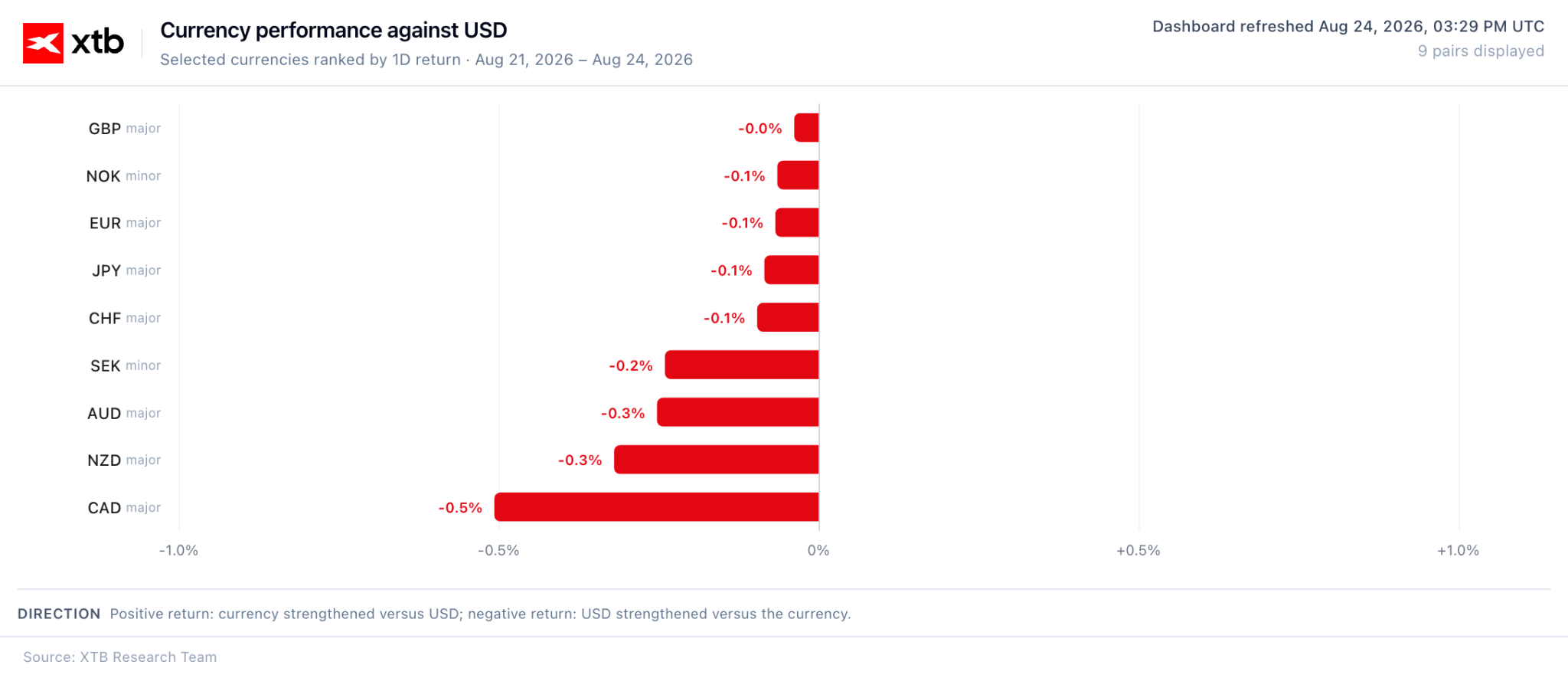
Source: XTB Research, 24.08.2026 The Canadian currency is experiencing a relatively significant weakening today. Why? Talks regarding a new trade agreement between Washington and Ottawa unexpectedly ended in failure. Negotiations were broken off on Friday, which meant the entry into force of 50% tariffs on Canadian products exported to the US. These will cover goods with a total value of approximately 20-28 billion dollars (5-7% of total Canadian exports to the US). The tariff list includes, among others, timber, cement, furniture, selected dairy products, wine, electrical equipment, and hockey equipment. President Donald Trump firmly defends the decision. On social media, he accused Canada of wanting to reap the benefits of being a state without being one. Canadian Prime Minister, Mark Carney, accuses the US of introducing unfair and economically harmful demands at the last minute, including attempts to limit Canada’s ability to conclude trade agreements with other countries. The US side (represented by Jamieson Greer) rejects these accusations, claiming that it was the Canadian negotiators who broke the previously developed compromise with new demands. According to Carney’s announcements, Canadian tariffs aimed at US exports of similar value (dollar for dollar, as the Prime Minister himself says) are to come into force on September 8th. They will hit sectors such as steel, agricultural machinery, household appliances, electronics, and dairy products. Incidentally, the selection is not accidental; they are intended to be felt quickly in politically key US states, which may be of particular importance in the face of the fast-approaching midterm elections.