S&P 500 — US Large Cap Index
 FTSE 100 — UK Blue Chips
 Euro Stoxx 50 — Eurozone Leaders
 DAX 40 — German Equities
 CAC 40 — French Market Index
 Nikkei 225 — Japan Benchmark
 Hang Seng — Hong Kong Index
 Shanghai Composite — China Mainland
 ASX 200 — Australian Market
 TSX Composite — Canada Index
 Nifty 50 — India Large Cap
 STI Index — Singapore Market
 KOSPI — South Korea Index
 Bovespa — Brazil Equities
 JSE Top 40 — South Africa Index
 IPC Index — Mexico Market

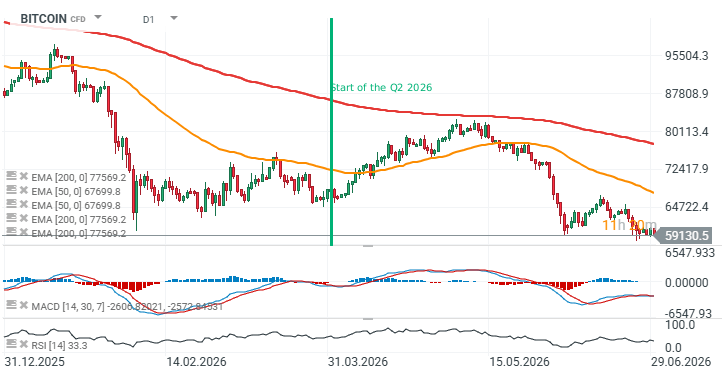
Bitcoin had a disastrous start to the year and an equally weak second quarter, during which the rally toward $81,000 completely faded. As a result, the cryptocurrency plunged to its lowest levels of 2026, while spot demand remains subdued, profit-taking continues to dominate, and derivatives positioning points to persistent caution among investors.
Key developments
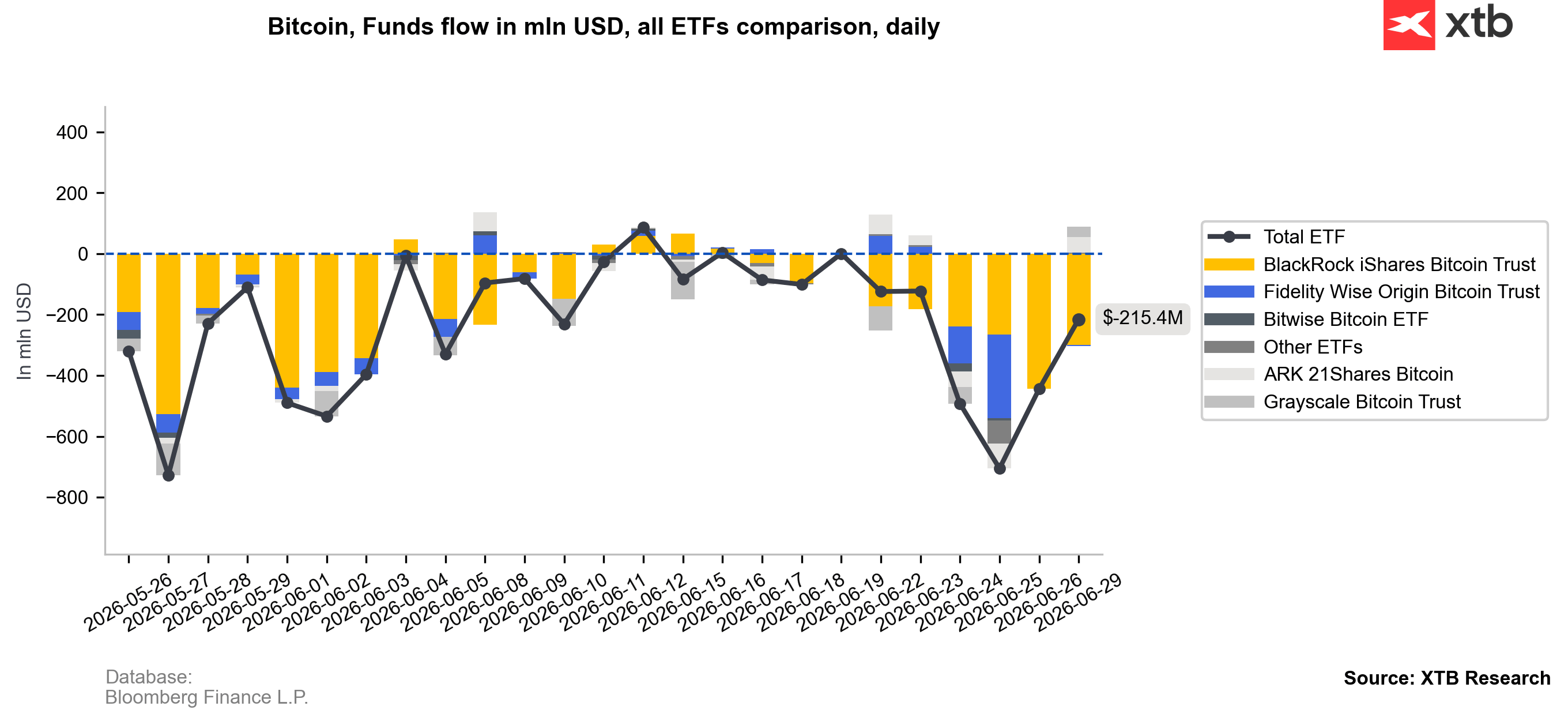
- In June, Bitcoin fell below $60,000 for the first time since 2024. The main drag has been persistent outflows from U.S. spot Bitcoin ETFs, which totaled an estimated $4.5–6 billion during the final weeks of the first half of the year.
- The weakness began early. In January, Bitcoin and Ethereum ETFs recorded nearly $1 billion in outflows in a single day , setting a negative tone for the year. Despite a strong rebound in March, when ETFs attracted $1.32 billion of inflows, spot Bitcoin ETFs still finished the first quarter with roughly $500 million in net outflows .
- Selling pressure intensified again in May and June. A six-day streak of more than $1.5 billion in ETF outflows reduced net inflows for 2026 to just around $536 million . At the same time, the ETF market became increasingly concentrated around BlackRock and Fidelity , which had previously attracted most of the inflows but also turned into net sellers in recent weeks.
- In June, Strategy sold a small portion of its Bitcoin holdings for the first time since 2022, weighing on sentiment surrounding the world’s largest corporate Bitcoin holder.
- The decline in Bitcoin prices also hit the mining industry. For some miners, production costs exceeded the market price of Bitcoin , while the network’s hashrate fell by around 5.8% at the beginning of 2026, highlighting mounting pressure across the mining sector.
- The narrative of Bitcoin as a hedge against U.S. dollar weakness lost momentum as markets priced in a more hawkish Federal Reserve, higher interest rates, and a rotation of capital away from cryptocurrencies toward AI and semiconductor stocks, as well as the highly anticipated SpaceX IPO .
- On the regulatory front, investors are still waiting for a breakthrough. Progress on the Clarity Act in the United States remains slow, limiting institutional appetite despite continued expansion of cryptocurrency services by major financial firms.
Bitcoin chart (D1 timeframe)
Source: xStation5
Source: XTB Research, Bloomberg Finance L.P.
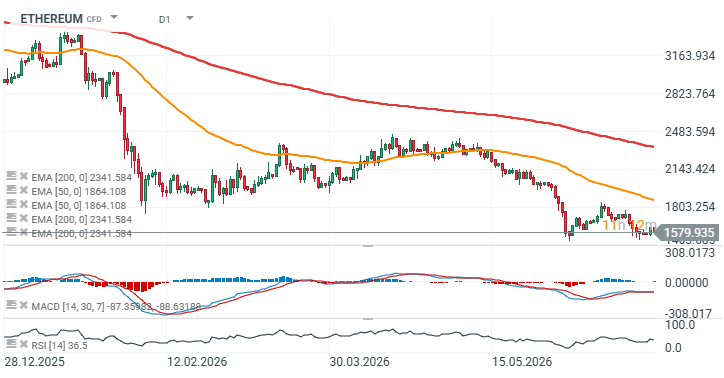
- Ethereum significantly underperformed Bitcoin during the first half of 2026, as investors favored Bitcoin ETFs while demand for ETH remained considerably weaker.
- Spot Ethereum ETFs continued to attract only modest institutional interest , with inflows remaining well below those seen in Bitcoin products despite periods of improving market sentiment.
- Ethereum staking reached another record high , with more than one-third of the total ETH supply locked in staking, reducing the amount of freely circulating coins.
- Layer-2 networks continued gaining traction , processing an increasing share of Ethereum transactions and helping lower fees on the main network.
- Decentralized finance (DeFi) activity remained resilient , although total value locked (TVL) stayed below previous cycle highs as investors remained cautious.
- Stablecoin usage on Ethereum continued to expand , reinforcing the network’s position as the leading settlement layer for tokenized dollar transactions.
- Ethereum developers continued work on the Pectra upgrade , one of the network’s most important upcoming protocol improvements, aimed at enhancing scalability, validator efficiency, and user experience.
- Despite improving on-chain fundamentals, ETH remained under pressure as higher U.S. interest rates and strong performance of AI-related equities continued to divert capital away from the broader cryptocurrency market.
Ethereum charts (D1 timeframe)
Source: xStation5