S&P 500 — US Large Cap Index
 FTSE 100 — UK Blue Chips
 Euro Stoxx 50 — Eurozone Leaders
 DAX 40 — German Equities
 CAC 40 — French Market Index
 Nikkei 225 — Japan Benchmark
 Hang Seng — Hong Kong Index
 Shanghai Composite — China Mainland
 ASX 200 — Australian Market
 TSX Composite — Canada Index
 Nifty 50 — India Large Cap
 STI Index — Singapore Market
 KOSPI — South Korea Index
 Bovespa — Brazil Equities
 JSE Top 40 — South Africa Index
 IPC Index — Mexico Market
Chevron preview: Has the market underestimated profit?

On Friday, before trading begins on Wall Street, oil major Chevron will publish its results. Across the entire energy sector, it stands out for the diversity and complexity of its price drivers, even in the context of ongoing market tensions linked to the changing situation in Russia, Iran, and Venezuela. The market currently expects EPS to rise to around 5.25 USD per share and revenue to increase to about 63.2 billion USD. This matters because expectations at this level imply earnings per share growth of roughly 70% year over year and more than 300% quarter over quarter. At the same time, it should not be forgotten that in Q1 Chevron already beat profit expectations by about 40% (1.41 USD EPS vs. roughly 0.97 expected).
Where is this growth coming from?
The source of the market’s stretched expectations for the company’s results seems fairly obvious, but it does not fully cover the topic. It is, of course, not only the huge rise in oil prices, but above all, something many forget: an even bigger increase in fuel prices. This stems from a shortage of refining capacity, which is far less flexible than crude supply itself. Fuels of all kinds are a higher-margin product than crude oil; fuel price increases can persist longer than oil price increases. In addition, fuel is less susceptible to interventions such as releasing stockpiles from strategic reserves. Valero and HF Sinclair have already shown that companies with the right exposure can capture more margin than markets had suspected. Chevron may be the next surprise on this list, but on a much larger scale. However, for the market to believe that Chevron is leveraging its biggest advantages, downstream revenue above 4 billion USD will be key; otherwise, the market may question the quality of the earnings growth. Chevron should become a beneficiary of a range of investments, facilities, and agreements developed by the company over recent years, precisely at the moment when oil prices are at their highest.
These include (but are not limited to):
- TCO (Kazakhstan)
- Hess (Guyana)
- Permian Basin
- Gulf of Mexico
- Venezuela
Profit is not everything
In addition to record profit from oil and fuels, cash management and cash flow will also be crucial.
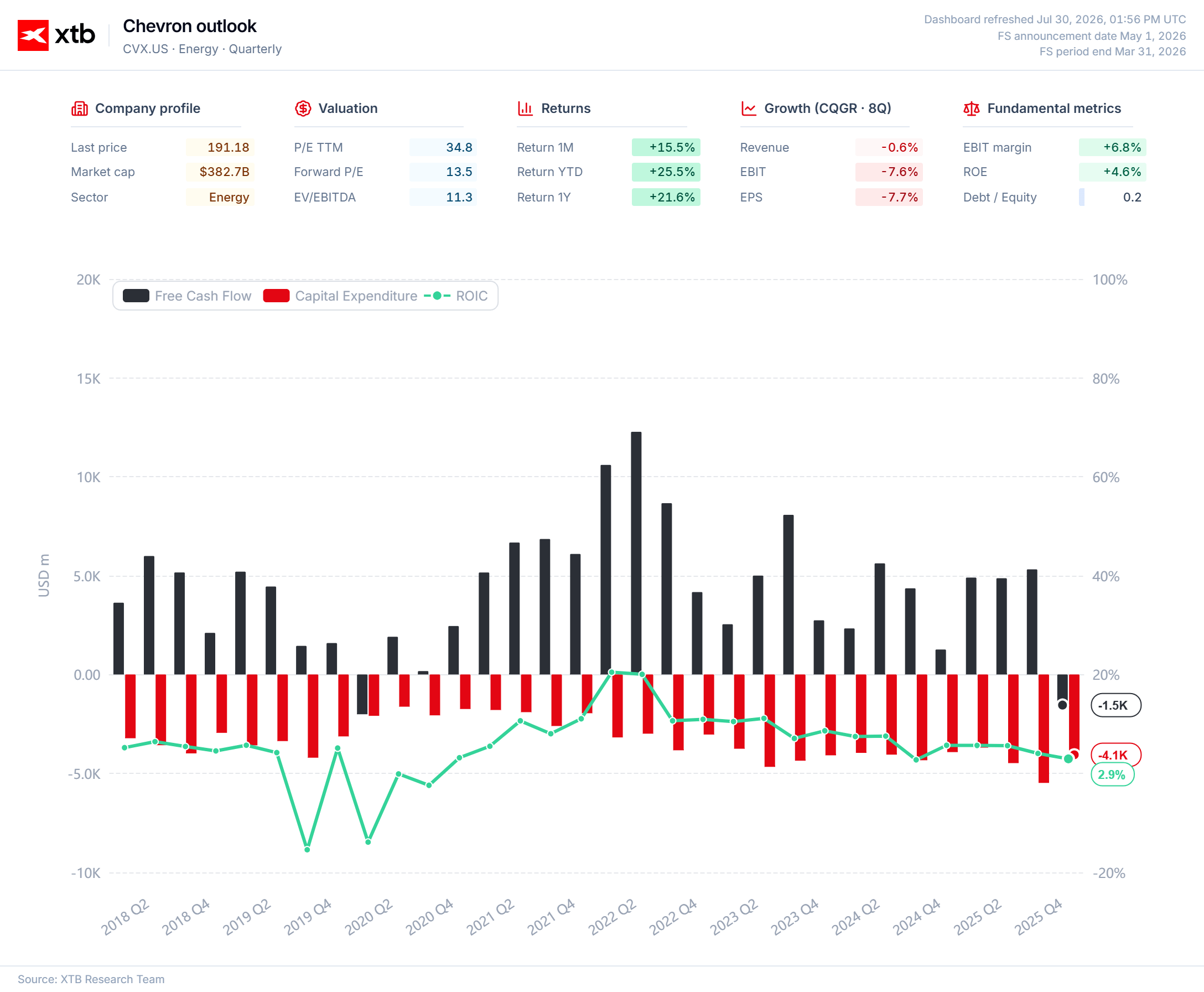
Investors will watch closely whether net profit translates into CFFO and how depreciation and amortization of infrastructure look in that context. Even record EPS will not be enough for the stock to rise if it does not translate into CFFO.
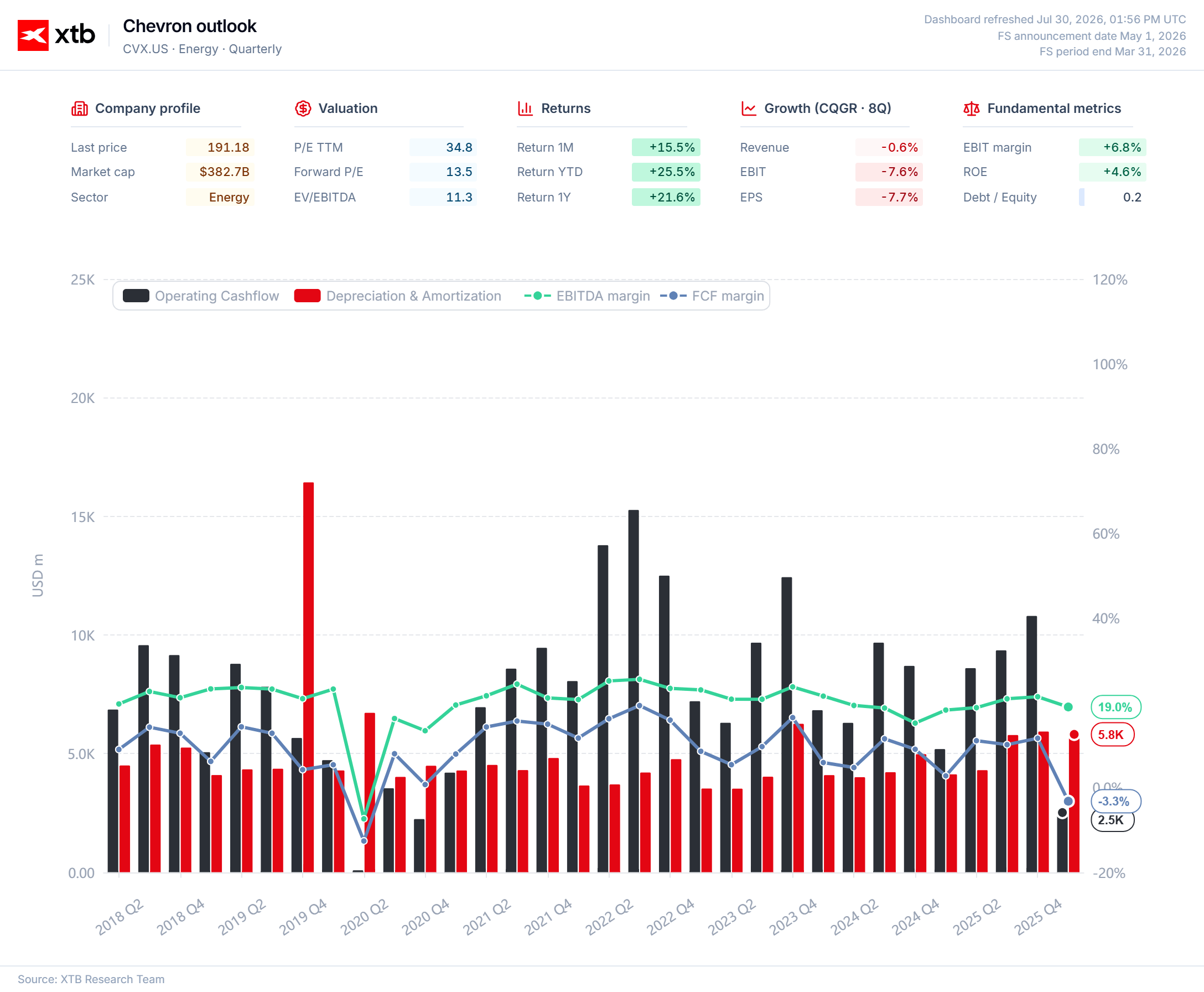
CFFO determines whether the record profit driven by oil and fuel prices will be transferred to shareholders. In summary, for all the elements of the bullish puzzle to fall into place and truly shock the market, which is possible:
- EPS must come in above about 5.3 USD
- Downstream must be at least 4 billion USD
- Management must declare some form of cash transfer to shareholders
- In the current context, it should be at least 2.5 billion USD (derived from the CFFO/DD&A relationship)
Chevron technical analysis (D1)
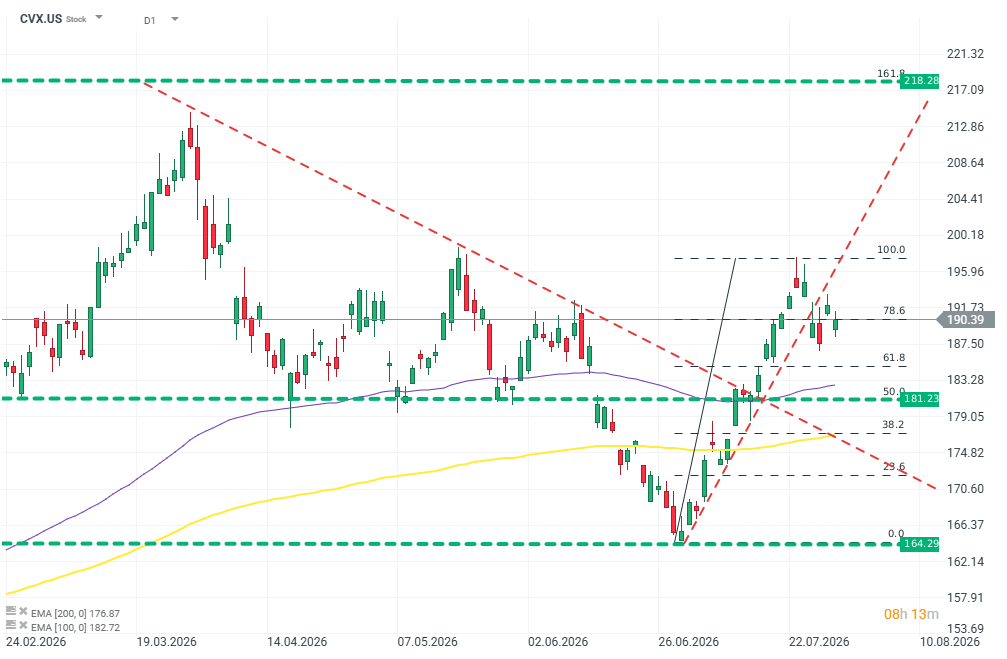
The price is currently trapped between strong resistance zones around 195 USD and 180 USD. Demand will need a fairly strong impulse to break out of the broad consolidation channel, but the reward could be significant, as Fibonacci levels point to a potential level around 220 USD. Buyers are still supported by long-term trends on the chart (including EMA momentum). Source: xStation5