S&P 500 — US Large Cap Index
 FTSE 100 — UK Blue Chips
 Euro Stoxx 50 — Eurozone Leaders
 DAX 40 — German Equities
 CAC 40 — French Market Index
 Nikkei 225 — Japan Benchmark
 Hang Seng — Hong Kong Index
 Shanghai Composite — China Mainland
 ASX 200 — Australian Market
 TSX Composite — Canada Index
 Nifty 50 — India Large Cap
 STI Index — Singapore Market
 KOSPI — South Korea Index
 Bovespa — Brazil Equities
 JSE Top 40 — South Africa Index
 IPC Index — Mexico Market

Key takeaways
- ICE cocoa futures are down around 4% today, while COCOBOD’s new financing model is easing concerns that liquidity problems in Ghana could disrupt cocoa purchases and exports.
- COCOBOD plans to raise around GHS 16 billion annually on the domestic market, including through 270-day commercial paper, moving away from the foreign syndicated-loan model used for more than three decades.
- Ghana is the world’s second-largest cocoa producer and, together with Côte d’Ivoire, accounts for around 60% of global production, making greater stability in the region’s supply chain highly relevant for cocoa prices.
ICE cocoa futures have come under pressure today, falling 4% following new developments from Ghana, as the market sees scope for improved financing of bean purchases in the world’s second-largest cocoa-producing country. COCOBOD plans to begin issuing debt on the domestic market later in August, moving away from the foreign syndicated-loan model that had underpinned the sector’s financing for more than three decades. For the market, this could be a meaningful shift: better access to capital may reduce the risk that liquidity constraints disrupt purchases from farmers and the subsequent flow of cocoa into the export supply chain. Recent COCOBOD announcements concerning the sector’s outlook have already triggered profit-taking in cocoa futures, with US contracts ending last week around 4.3% below their local three-week high. In my view, the market is therefore beginning to remove part of Ghana’s financial risk premium, although this does not mean that the fundamental challenges on the production side have been resolved.
COCOBOD Turns to Domestic Capital
Ghana is preparing one of the most significant changes to the way its cocoa sector is financed in decades. COCOBOD plans to begin issuing Ghanaian cedi-denominated debt instruments later this month, including 270-day commercial paper, under a new funding programme expected to operate for five years.
- COCOBOD expects to raise around GHS 16 billion annually on the domestic financial market, primarily to finance ongoing operations and cocoa purchases.
- The 270-day maturity is designed to match the cocoa purchasing cycle, as around 70% of the crop is purchased by COCOBOD between September and January.
- The potential domestic capital base is substantial. Ghanaian pension funds manage more than GHS 100 billion in assets, meaning local institutional investors could become a key pillar of the new funding model.
- Part of the proceeds will be used to service COCOBOD’s existing debt, meaning not all of the newly raised capital will be available to finance future cocoa purchases.
From the cocoa market’s perspective, the key issue is the potential reduction in financial risk across the supply chain. If COCOBOD gains more stable access to working capital, liquidity constraints should be less likely to disrupt purchases of beans from farmers. However, this does not solve all of the sector’s problems. Financing operations through short-term debt that must be rolled over regularly still leaves COCOBOD dependent on financial-market conditions. Ghana is therefore largely replacing the risk of access to foreign financing with refinancing risk in its domestic market.
The End of a Financing Model That Lasted More Than Three Decades?
For more than 30 years, Ghana financed seasonal cocoa purchases primarily through annual syndicated loans provided by international banks. The country’s debt crisis exposed the weaknesses of this model, with difficulties in securing financing eventually beginning to affect the functioning of the cocoa sector itself. Financing for 2023 was delayed, while ahead of the 2024/25 crop season the traditional syndicated-loan model ultimately ceased to function. COCOBOD consequently began shifting towards domestic and alternative sources of capital, with the planned commercial paper programme representing the next stage of that transition. The regulator still has to deal with substantial legacy obligations. In 2023, around GHS 7.93 billion of short-term Cocoa Bills were restructured into longer-dated instruments maturing between 2024 and 2028. As a result, COCOBOD continues to face significant debt-servicing costs. For a commodity trader, this is an important part of the equation. Cocoa markets naturally focus heavily on weather, crop size, tree diseases and inventories, but in West Africa the financial infrastructure connecting farmers with the global market can be equally important. Beans may physically exist on farms, but without an efficient system for financing purchases, that does not necessarily mean they will quickly reach ports and enter the global supply chain.
Why Are Cocoa Prices Falling?
From a futures-market perspective, the key factor is the change in perceived risk surrounding future supply. If COCOBOD can finance purchases from farmers more efficiently, the probability that the regulator’s financial difficulties become an additional constraint on physical cocoa availability declines. This is why an improvement in the funding model can be interpreted as bearish for prices in the short term. It does not imply a sudden increase in production, but it raises the probability that existing beans will move more efficiently through the purchasing system and onto the market. It is important, however, to distinguish liquidity from actual production. The new financing system will not put more cocoa pods on trees , improve weather conditions or eliminate crop diseases. Weather risks remain significant, with developing El Niño conditions raising concerns about West African production, while heavy rainfall in Ghana is creating favourable conditions for the spread of black pod disease. In my view, this is currently the key fundamental tension in the cocoa market: the financial infrastructure supporting supply may improve, while the production outlook itself remains vulnerable to significant weather-related risks.
Ghana Remains a Pillar of Global Cocoa Supply
The significance of COCOBOD’s reforms largely reflects Ghana’s position in the global cocoa market. Ghana remains the world’s second-largest cocoa producer after Côte d’Ivoire, with the two countries together accounting for around 60% of global production.
- Cocoa accounted for around 1.9% of Ghana’s GDP in Q1 2026.
- According to COCOBOD estimates, cocoa farming supports around 850,000 farming families.
- The sector generates approximately $2 billion in foreign-exchange revenues for Ghana each year.
- Major processors operating locally include Cargill, Barry Callebaut, Olam Group-owned ofi and Ghana’s Cocoa Processing Company.
This high geographical concentration of supply is one reason why cocoa prices can react much more aggressively to developments in Ghana and Côte d’Ivoire than many other major agricultural commodities. The market has relatively little margin for error when problems emerge simultaneously in its two most important producing countries.
Ghana Wants to Capture More Value from Cocoa
The change in financing is part of a broader reform of the sector. The government also wants to increase domestic processing, with a target of processing at least 50% of Ghana’s cocoa beans locally from the 2026/27 crop season. From an economic perspective, the rationale is clear. Ghana wants to capture a larger share of the cocoa value chain rather than remaining predominantly an exporter of raw beans. Greater domestic processing could mean that a growing share of exports eventually leaves the country as semi-finished cocoa products rather than unprocessed beans. However, I would not view the 50% target as a direct bullish argument for cocoa prices. For the global balance, the most important variables remain the size of the crop and worldwide demand for cocoa beans – where the beans are ultimately processed primarily changes the structure of trade flows.
What Comes Next for Cocoa Prices?
In my view, COCOBOD’s new financing model is positive for the stability of the physical market but could remain a negative factor for futures prices in the short term. The lower the risk of disruptions to cocoa purchasing and export financing, the less justification there is for futures to carry a large premium for potential supply problems in Ghana. That does not mean the fundamental supply problem has disappeared. Cocoa remains exceptionally sensitive to weather conditions. History shows that during strong El Niño episodes, global cocoa production can decline significantly , while the market, following previous weak harvests, remains vulnerable even to relatively modest supply disruptions. Three factors are therefore likely to be crucial for the direction of prices: Ghana’s actual crop size, the effectiveness of COCOBOD’s new financing system and the production outlook across West Africa. If purchasing is financed smoothly while Ghana and Côte d’Ivoire deliver larger crops, the scarcity premium could continue to decline. If improved financing coincides with weak production caused by adverse weather or crop diseases, however, cocoa could quickly return to gains as the market refocuses on the risk of a physical deficit – even if demand remains subdued.
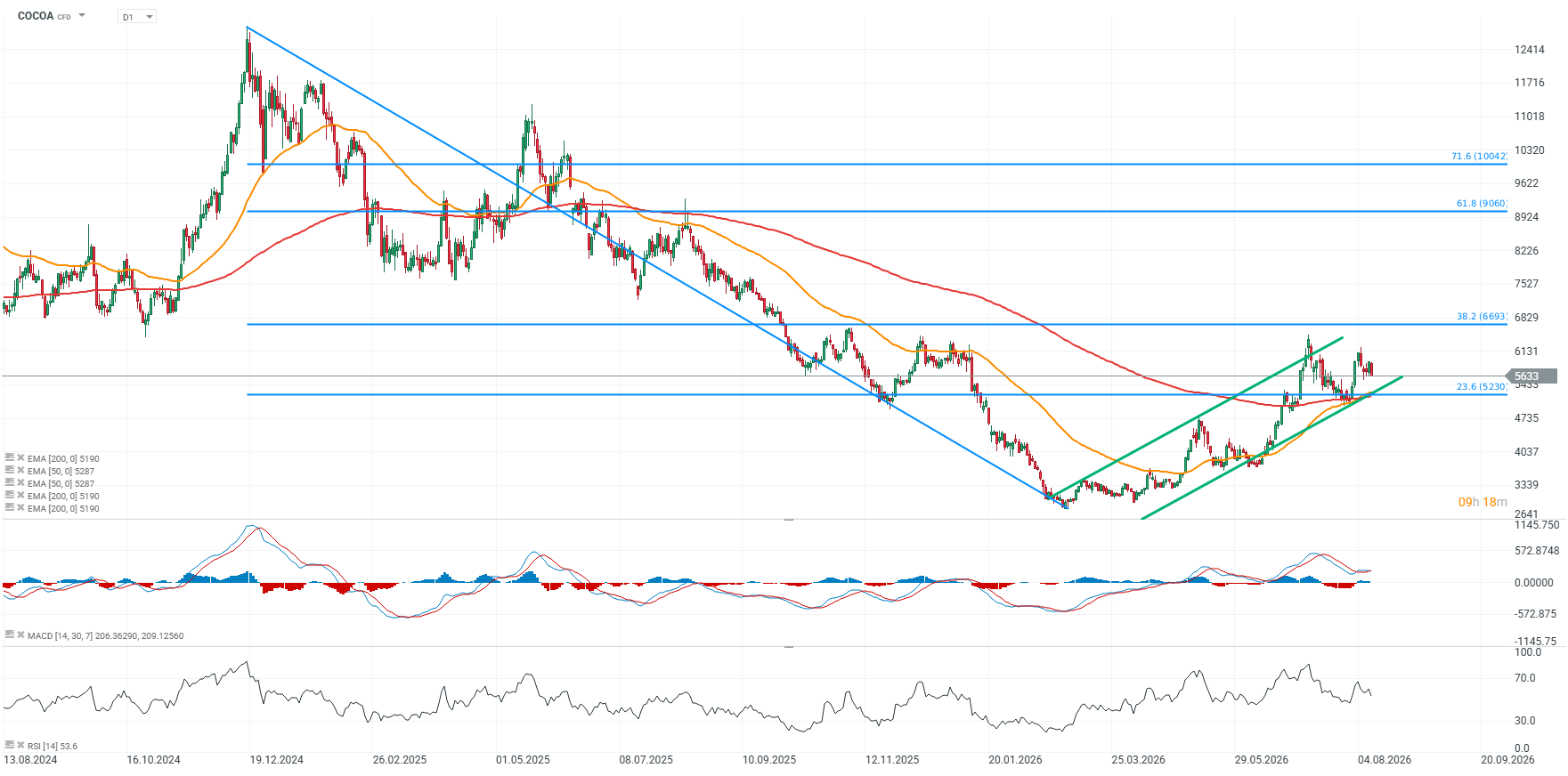
COCOA Chart (D1 Interval)
Cocoa futures have recently approached the 38.2% Fibonacci retracement of the strong 2025 downward move and are now trading increasingly close to the lower boundary of the rising price channel. An important support zone remains around $5,300–5,400 per tonne, while key resistance based on price-action methodology is located near $6,150. The new financing model is reducing the risk premium and weighing on prices in the short term, but it does not resolve issues related to crop size, weather conditions and plant diseases, which remain key risks to supply.
Source: xStation5