S&P 500 — US Large Cap Index
 FTSE 100 — UK Blue Chips
 Euro Stoxx 50 — Eurozone Leaders
 DAX 40 — German Equities
 CAC 40 — French Market Index
 Nikkei 225 — Japan Benchmark
 Hang Seng — Hong Kong Index
 Shanghai Composite — China Mainland
 ASX 200 — Australian Market
 TSX Composite — Canada Index
 Nifty 50 — India Large Cap
 STI Index — Singapore Market
 KOSPI — South Korea Index
 Bovespa — Brazil Equities
 JSE Top 40 — South Africa Index
 IPC Index — Mexico Market
Economic Calendar – Hawkish Fed, Middle East tensions set the pace for markets


The start of the week brought an increase in risk aversion across global markets. Investors are reacting to the hawkish tone of the speech by Federal Reserve Chairman Kevin Warsh during the Jackson Hole symposium, who maintained the priority of fighting inflation and fueled expectations for a longer period of high interest rates in the US. Additionally, renewed geopolitical tensions in the Middle East and the Strait of Hormuz are causing concern, which has triggered a rise in oil prices and exerted downward pressure on Asian stock indices. In the latter part of the day, market attention will focus primarily on the publication of preliminary CPI inflation estimates for August from Germany and Poland, as well as GDP dynamics readings for the second quarter from Poland and Turkey. In the afternoon, the Chicago PMI indicator will be key for US investors. Instruments with increased volatility will remain oil, the Polish zloty (PLN), currency pairs with USD, and major stock indices.
Key publications from the Asian session
- China: The official manufacturing PMI for August rose to 49.8 points (forecast: 49.5 points, previous: 49.2 points), signaling a slower pace of contraction in the sector. The Composite PMI stood at 49.5 points.
- Japan: Industrial production month-on-month for July rose by 0.1% (forecast: -0.7%, previous: 1.9%), while retail sales year-on-year accelerated to 4.0% (forecast: 3.2%).
- South Korea: Industrial production in July rose by 3.6% y/y (below expectations of 6.0%), with retail sales falling by 2.4% m/m.
- Australia: Corporate operating profits in Q2 rose by 1.8% q/q (forecast: 2.0%, previous: -1.5%).
Macroeconomic calendar (CET)
- 12:00 Portugal – GDP growth y/y (Q2). Consensus: 2.5%. Previous reading: 2.4%.
- 12:30 India – GDP growth y/y (Q1). Consensus: 7.1%. Previous reading: 7.8%.
- 14:00 Germany – CPI inflation y/y (August). Consensus: 2.9%. Previous reading: 2.8%.
- 14:00 Germany – CPI inflation m/m (August). Consensus: 0.3%. Previous reading: 0.8%.
- 14:00 Germany – HICP inflation y/y (August). Consensus: 3.0%. Previous reading: 2.8%.
- 15:45 USA – Chicago PMI Index (August). Consensus: 57.8. Previous reading: 57.6.
- 16:30 USA – Dallas Fed Manufacturing Index (August). Consensus: none. Previous reading: 1.3.
Markets to watch
- EURUSD – due to hawkish signals from the Fed after Jackson Hole and the publication of CPI inflation data from Germany, which will influence expectations regarding European Central Bank policy.
- USDPLN – reaction to the simultaneous publication of preliminary CPI inflation readings and data on economic growth dynamics (GDP) in Q2 in Poland.
- Crude oil (OIL.WTI) – under the influence of returning geopolitical risk premium in the Middle East and verification of demand from the Chinese economy after the publication of PMI indicators.
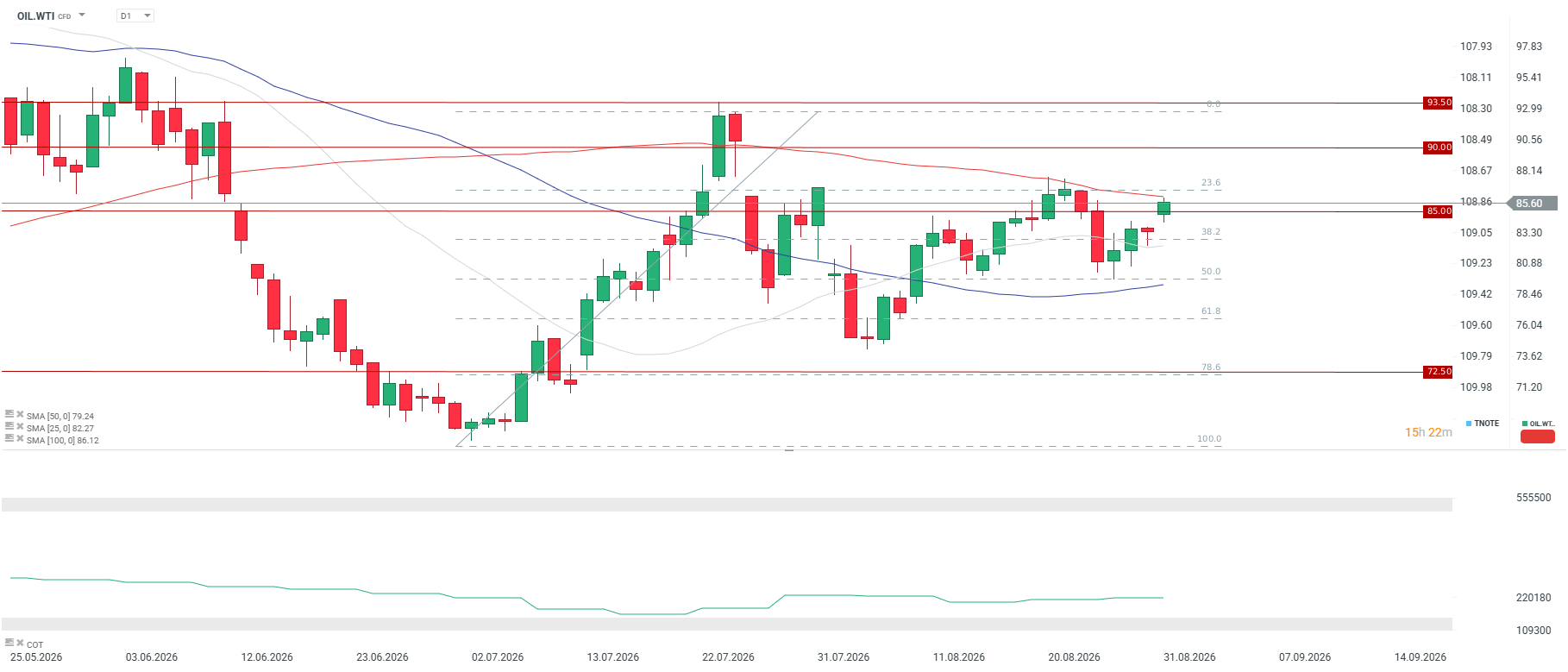
WTI oil is rising significantly this morning due to the escalation of the situation in the Middle East. It is worth noting the test of the 100-period moving average, which has recently acted as strong resistance. Source: xStation5