S&P 500 — US Large Cap Index
 FTSE 100 — UK Blue Chips
 Euro Stoxx 50 — Eurozone Leaders
 DAX 40 — German Equities
 CAC 40 — French Market Index
 Nikkei 225 — Japan Benchmark
 Hang Seng — Hong Kong Index
 Shanghai Composite — China Mainland
 ASX 200 — Australian Market
 TSX Composite — Canada Index
 Nifty 50 — India Large Cap
 STI Index — Singapore Market
 KOSPI — South Korea Index
 Bovespa — Brazil Equities
 JSE Top 40 — South Africa Index
 IPC Index — Mexico Market
🗽 Federal Reserve will decide on interest rates at 6 PM GMT; precious metals slide, USD gains
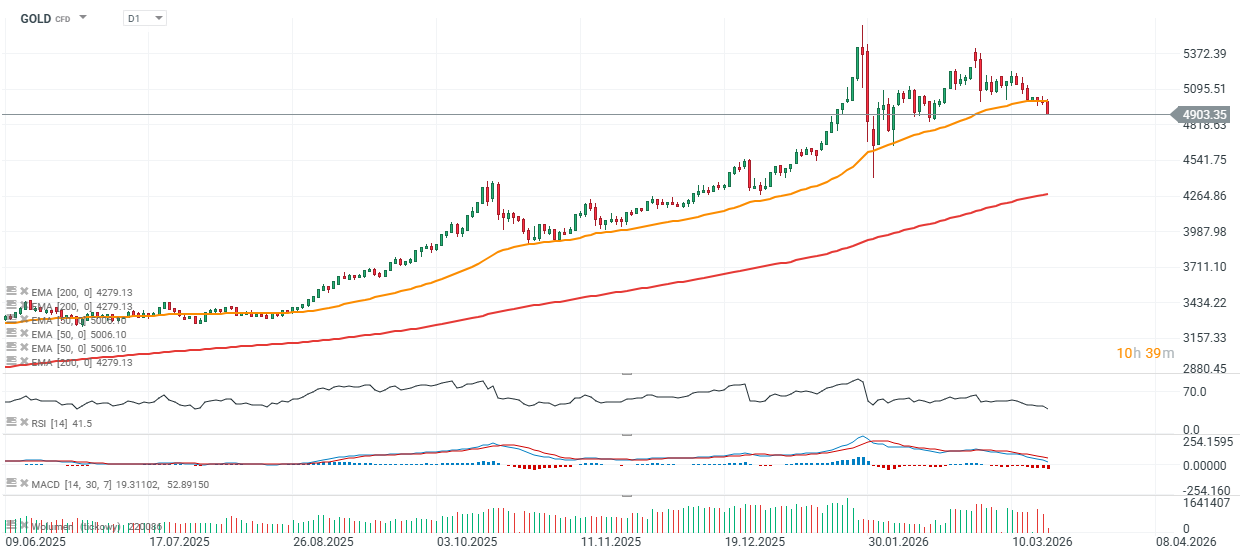
The Federal Reserve is widely expected to leave interest rates unchanged, while signaling an extended pause in its monetary policy cycle. However, the backdrop is becoming increasingly complex: an oil market shock is pushing inflation higher, while early signs of weakening economic activity and a softening labor market are beginning to emerge. Markets will closely watch Fed Chair Jerome Powell’s press conference at 19:30, as well as the updated economic projections. Ahead of the decision, yields are edging lower, while gold is down nearly 2%, falling to around $4,900 per ounce.
- 6 PM GMT, Fed interest rate decision (US): Forecast: 3.75% | Previous: 3.75% (FOMC statement + projections)
- Median Fed rate projections (current level): Forecast: 3.375% | Previous: 3.625%
- Median Fed rate projections (next year): Forecast: 3.125% | Previous: 3.375%
- Median Fed rate projections (next 2 years): Forecast: 3.125% | Previous: 3.125%
- Median Fed rate projections (long term): Forecast: 3.125% | Previous: 3.0%
- 6:30 PM GMT, Speech by Fed Chair Jerome Powell
The baseline scenario from Bloomberg Economics assumes rates will remain in the 3.50% – 3.75% range. However, the decision may not be unanimous. Some FOMC members could dissent in favor of a cut, particularly Stephen Miran and potentially Christopher Waller, for whom the decision remains finely balanced. Back in February, Waller outlined conditions that would justify a pause: inflation close to 2% (after tariff adjustments) and a weakening labor market. Recent data partially meet these criteria—core inflation is stabilizing and the February payrolls report was weak although the strong January print continues to complicate the picture.
A new factor: oil and war
The March meeting takes place under a new risk regime. The conflict involving Iran has pushed oil prices into the $80–$100 per barrel range, directly impacting the inflation outlook.
The Fed is likely to update its statement to emphasize “two-sided risks,” meaning simultaneous threats of:
- higher inflation (energy-driven),
- weaker growth and employment.
This shift in narrative is significant, as it marks a move away from the clear easing bias seen earlier this year.
Projections: inflation up, growth down
The most visible changes will appear in the Summary of Economic Projections (SEP). PCE inflation is expected to be revised higher to around 3.0% (from 2.4%), with core PCE rising to 2.7%.
At the same time, the Fed is likely to lower its GDP growth forecast (to around 2.0% from 2.3%) and raise the unemployment rate projection to 4.5%. The mechanism behind these revisions is consistent: higher energy prices reduce household disposable income, dampen consumption, and weaken labor demand. A stagflationary scenario remains a key risk this year—for both the US dollar and bond yields.
Dot plot: slightly more hawkish
The upward revisions to inflation should be reflected in the dot plot, with the expected rate path shifting modestly higher relative to December. However, not enough to change the median outlook for 2026.
The central scenario still points to one 25 bp rate cut, and no participant is expected to project rate hikes. Even the most hawkish member, Beth Hammack, is likely to maintain a stable path, viewing current policy as broadly neutral.
Statement: a subtle shift in tone
The most likely adjustment to forward guidance will be evolutionary rather than dramatic. The Fed may replace “additional adjustments” with the more neutral “future adjustments,” while removing the implicit easing bias.
This is a small linguistic change, but an important signal—it suggests greater optionality and readiness to act in either direction, including, at least theoretically, the possibility of hikes.
Labor market starting to crack?
One of the most surprising data points since the previous meeting was the 92k drop in February nonfarm payrolls. Analysis presented at a recent FOMC conference suggests the actual weakening could be larger—potentially revised down to -112k.
This matters because:
- private-sector indicators have historically been effective in anticipating revisions,
- some policymakers may conclude the labor market is not stabilizing but deteriorating.
Additional signals from the Beige Book point to stagnant hiring across most regions and slowing economic activity between January and mid-February.
A divide within the Fed
There is a clear divergence within the Fed on how to interpret the current supply shock. From a model-based perspective (FRB/US), higher oil prices and tariffs should be treated as transitory, provided inflation expectations remain anchored. In that framework, optimal policy would maintain an easing bias, as higher energy prices ultimately cool demand and reduce core inflation.
However, the dominant stance within the FOMC is currently more cautious. The hawkish camp is focused on near-term inflation risks, which is likely to keep rate cuts on hold at least through the first half of the year.
Scenario: delayed cuts
According to Bloomberg Economics, inflation will continue rising in March and April, peaking in May. Only afterward will the effects of weaker demand and a cooling labor market begin to dominate. In this setup, the Fed is likely to remain on hold in the first half of the year, before being forced to cut more aggressively in the second half to catch up with the economic cycle. The March FOMC meeting is likely to carry a more hawkish tone, both in the statement and in updated projections. At the same time, macroeconomic data are increasingly pointing to rising downside risks. As a result, the Fed may find itself in a classic policy trap: reacting to short-term inflation pressures by delaying easing, only to be forced into faster rate cuts later as economic conditions weaken.
GOLD (D1 chart)
Source: xStation5
The material on this page does not constitute financial advice and does not take into account your level of understanding, investment objectives, financial situation or any other specific needs. All information provided, including opinions, market research, mathematical results and technical analyzes published on the Website or transmitted To you by other means, it is provided for information purposes only and should in no way be construed as an offer or solicitation for a transaction in any financial instrument, nor should the information provided be construed as advice of a legal or financial nature on which any investment decisions you make should be based exclusively To your level of understanding, investment objectives, financial situation, or other specific needs, any decision to act on the information published on the Website or sent to you by other means is entirely at your own risk if you In doubt or unsure about your understanding of a particular product, instrument, service or transaction, you should seek professional or legal advice before trading. Investing in CFDs carries a high level of risk, as they are leveraged products and have small movements Often the market can result in much larger movements in the value of your investment, and this can work against you or in your favor. Please ensure you fully understand the risks involved, taking into account investments objectives and level of experience, before trading and, if necessary, seek independent advice.