S&P 500 — US Large Cap Index
 FTSE 100 — UK Blue Chips
 Euro Stoxx 50 — Eurozone Leaders
 DAX 40 — German Equities
 CAC 40 — French Market Index
 Nikkei 225 — Japan Benchmark
 Hang Seng — Hong Kong Index
 Shanghai Composite — China Mainland
 ASX 200 — Australian Market
 TSX Composite — Canada Index
 Nifty 50 — India Large Cap
 STI Index — Singapore Market
 KOSPI — South Korea Index
 Bovespa — Brazil Equities
 JSE Top 40 — South Africa Index
 IPC Index — Mexico Market
- The Japanese Yen strengthens further amid intervention fears and BoJ rate hike bets.
- Dovish Fed expectations keep the USD depressed and also weigh on the USD/JPY pair.
- Traders keenly await the FOMC decision ahead of the BoJ policy update on Thursday.
The Japanese Yen (JPY) attracts strong follow-through buyers for the second straight day and climbs to a one-week high against a softer US Dollar (USD) during the Asian session on Wednesday. Comments from Japan’s Economics Minister Minoru Kiuchi on Tuesday fueled speculations about a possible government intervention to stem further JPY weakness. Moreover, the outcome of a high-profile meeting between Japan’s new Prime Minister Sanae Takaichi and US President Donald Trump also contributes to the JPY’s relative outperformance.
Meanwhile, supportive remarks from US Treasury Secretary Scott Bessent, along with bets for an imminent interest rate hike by the Bank of Japan (BoJ), provide an additional boost to the JPY. The USD, on the other hand, struggles to attract buyers amid dovish Federal Reserve (Fed) expectations and drags the USD/JPY pair closer to mid-151.00s in the last hour. The BoJ, however, could resist early tightening amid Takaichi’s aggressive fiscal spending plans. This might cap the JPY ahead of the crucial Fed rate decision and the BoJ policy meeting.
Japanese Yen benefits from intervention fears and BoJ-Fed policy divergence
- On Wednesday, US Treasury Secretary Scott Bessent urged Japan’s government to allow the Bank of Japan policy space to keep inflation expectations anchored and avoid excess exchange rate volatility. The remarks revived market expectations that the US may continue to press Japan to tighten monetary policy more quickly.
- This follows a verbal intervention from Japan’s Economics Minister Minoru Kiuchi on Tuesday, emphasizing the importance of stable FX moves that reflect economic fundamentals. Kiuchi added that he plans to assess the impact of FX changes on Japan’s economy and that it is important to avoid rapid, short-term fluctuations.
- Furthermore, US President Donald Trump and Japan’s new Prime Minister Sanae Takaichi signed an agreement laying out a framework to secure mining and processing of rare earths and other critical minerals. This contributes to the Japanese Yen’s relative outperformance against its G-10 peers for the second straight day.
- Meanwhile, Takaichi’s pro-stimulus stance to revitalize the economy could further delay the BoJ’s tightening plan. Traders, however, seem convinced that the central bank will eventually hike interest rates in December or early next year. This marks a significant divergence in comparison to dovish Federal Reserve expectations.
- The US central bank is universally anticipated to lower borrowing costs by 25-basis-points at the end of a two-day meeting later today. Moreover, traders have been pricing in a greater chance of another rate cut in December, which keeps the US Dollar depressed and contributes to the USD/JPY pair’s ongoing corrective fall.
- Apart from the crucial Fed rate decision, market participants will closely scrutinize the latest BoJ policy update on Thursday. A further hawkish signal would be enough to further boost the JPY. However, a surprisingly dovish tilt, though unlikely, would negate any positive outlook for the JPY and prompt aggressive selling.
USD/JPY could find decent support and attract buyers near 151.10-151.00
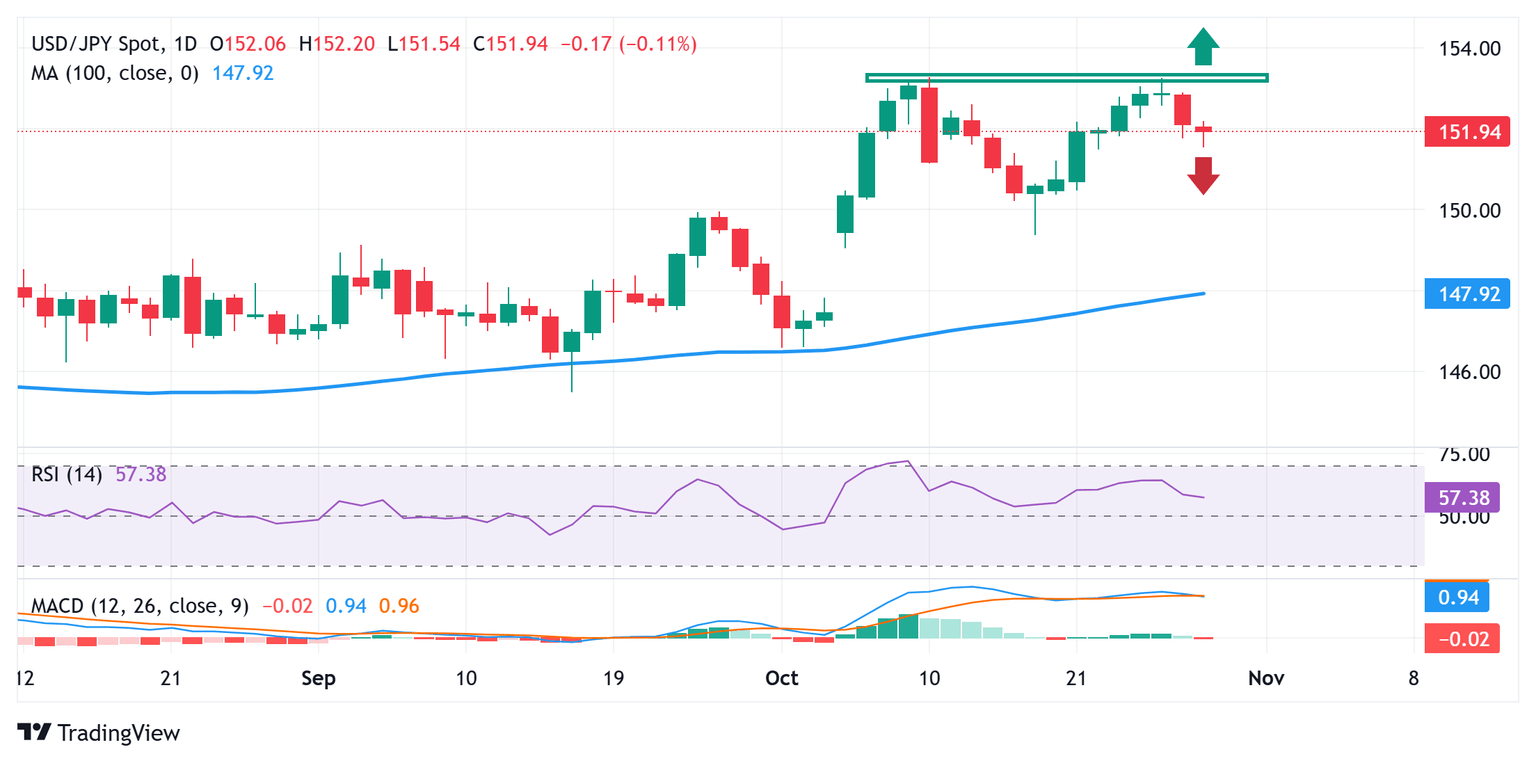
This week’s failure near the 153.25-153.30 hurdle, or the monthly swing high, constitutes the formation of a bearish double-top pattern on the daily chart and backs the case for a further depreciating move for the USD/JPY pair. That said, oscillators on the said chart are holding in positive territory, suggesting that any further slide could find some support near the 151.10-151.00 region. A convincing break below the latter, however, should pave the way for deeper losses towards the 150.00 psychological mark with some intermediate support near the 150.45 zone.
On the flip side, any meaningful recovery beyond the Asian session peak, around the 152.20 area, is more likely to attract fresh sellers and remain capped near the 152.90-153.00 region. Some follow-through buying, leading to a further strength beyond the 153.25-153.30 zone, will be seen as a fresh breakout and allow the USD/JPY pair to reclaim the 154.00 mark. The momentum could extend further towards the next relevant resistance near mid-154.00s en route to the 154.75-154.80 region and the 155.00 psychological mark.