S&P 500 — US Large Cap Index
 FTSE 100 — UK Blue Chips
 Euro Stoxx 50 — Eurozone Leaders
 DAX 40 — German Equities
 CAC 40 — French Market Index
 Nikkei 225 — Japan Benchmark
 Hang Seng — Hong Kong Index
 Shanghai Composite — China Mainland
 ASX 200 — Australian Market
 TSX Composite — Canada Index
 Nifty 50 — India Large Cap
 STI Index — Singapore Market
 KOSPI — South Korea Index
 Bovespa — Brazil Equities
 JSE Top 40 — South Africa Index
 IPC Index — Mexico Market

Nvidia Shares Slide as Jensen Huang Leadership Uncertainty Triggers Wider AI Market Sell-Off


Nvidia is facing renewed selling pressure as investors await an official announcement following a crucial board meeting concerning the future of CEO Jensen Huang. The uncertainty surrounding the company’s leadership has disrupted technology market sentiment, with investors reassessing their exposure to the world’s most valuable semiconductor business and the wider artificial intelligence sector.
The potential departure of Huang, Nvidia’s only CEO, has introduced an unexpected governance risk into a market that has largely been driven by confidence in AI investment, infrastructure expansion and long-term revenue growth.
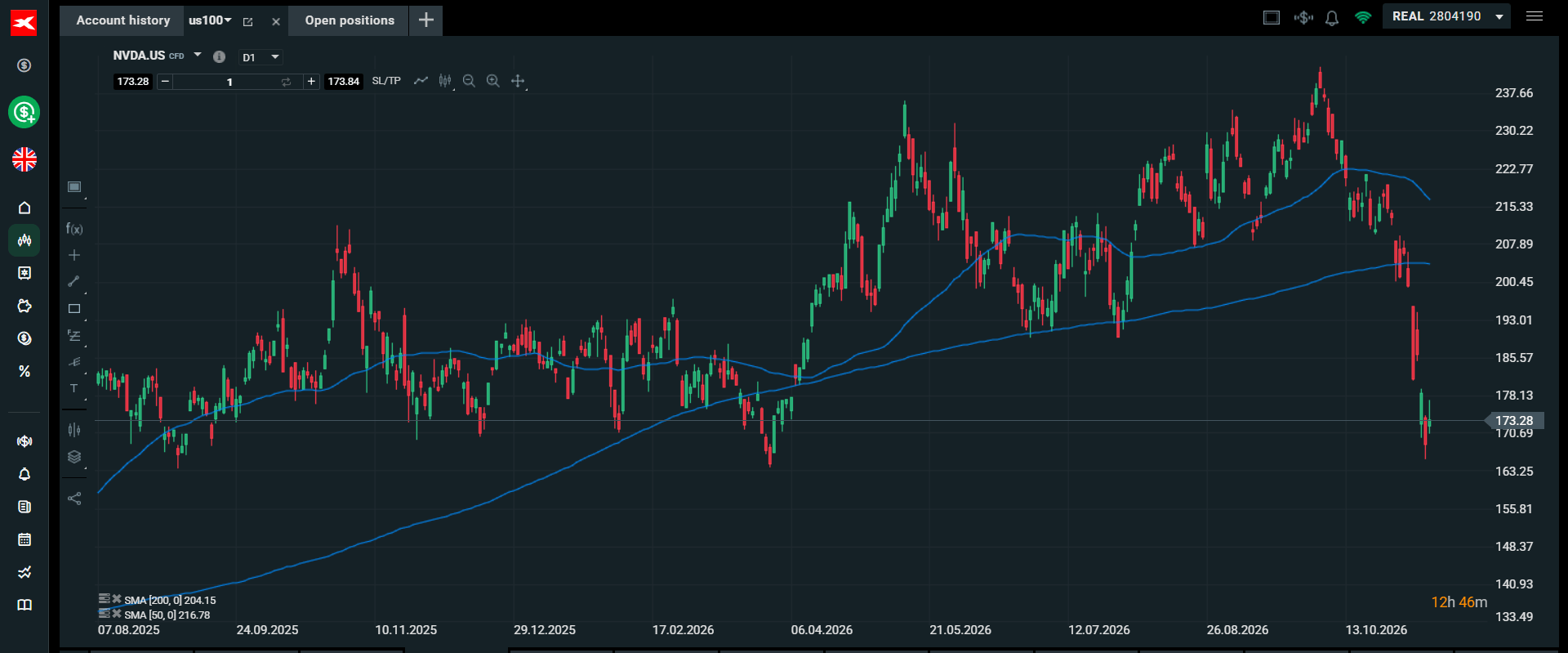
Nvidia shares are reportedly heading towards another 7% decline at the next market open, adding to losses that have already reduced the stock’s value by approximately a quarter over the past month. The pressure is also weighing on the Nasdaq and S&P 500, while investors are increasingly rotating towards European equities and alternative semiconductor companies.
The situation raises a broader question for financial markets: how dependent has the AI investment cycle become on Nvidia, its leadership and its financial relationships across the technology industry?
Market Snapshot
| Market Indicator | Latest Reported Position |
|---|---|
| Nvidia Expected Share Move | -7% at next open |
| Nvidia One-Month Performance | Approximately -25% |
| Nvidia Market Capitalisation | Above $4 trillion |
| Nvidia Nasdaq Weighting | Approximately 8% |
| Nvidia S&P 500 Weighting | Approximately 7% |
| Nvidia Forward P/E | Approximately 11x |
| Expected Quarterly Revenue | $108 billion |
| AMD Share Performance | Nearly +4% |
| Nvidia 2028 Revenue Forecast | $1 trillion |
| European Equity Markets | Outperforming US technology indices |
Current Market Action: Nvidia Leadership Uncertainty Weighs on Technology Stocks
Nvidia is at the centre of the latest technology market sell-off as investors wait for confirmation of the outcome of Wednesday’s board meeting.
The meeting reportedly addressed the future of Jensen Huang, whose position as CEO has been central to Nvidia’s development and its rise to become one of the world’s most influential technology companies.
No official announcement had been made at the time of the latest update.
The uncertainty is particularly significant because Huang has been the company’s only CEO. Investors are therefore facing the possibility of a leadership transition without a publicly identified successor.
Nvidia is expected to open approximately 7% lower, extending a decline that has already seen its share price fall by around 25% over the past month.
The market reaction demonstrates how quickly confidence can deteriorate when corporate governance concerns emerge at a company that occupies such an important position in global equity markets.
Why Investors Are Avoiding Nvidia Despite Its Valuation
One of the more unusual aspects of the sell-off is that investors are not rushing to buy the decline, despite what appears to be a significantly reduced valuation.
Nvidia’s 12-month forward price-to-earnings ratio is approximately 11 times expected future earnings, while the company is forecast to report quarterly revenue of $108 billion.
Under normal circumstances, these figures might attract bargain hunters looking for exposure to a dominant AI infrastructure business.
However, governance uncertainty is difficult to quantify.
Investors are not simply assessing revenue growth, earnings potential or semiconductor demand. They are also considering the possibility of executive departures, leadership instability, regulatory scrutiny and changes to the company’s strategic direction.
Until greater clarity emerges, valuation alone may not be sufficient to restore confidence.
Nvidia’s Influence on the Nasdaq and S&P 500
The scale of Nvidia’s market capitalisation means that its share price movement has consequences well beyond the semiconductor industry.
The company represents approximately 8% of the Nasdaq and 7% of the S&P 500, making it one of the most influential constituents in both indices.
Its market capitalisation remains above $4 trillion, meaning that even relatively modest percentage movements can have a substantial impact on broader equity performance.
The latest decline is therefore creating additional pressure on US indices, particularly the technology-heavy Nasdaq.
If Nvidia continues falling and loses further ground among the world’s largest publicly traded companies, the implications could extend into index positioning, institutional portfolios and technology sector sentiment.
The situation highlights the concentration risk that has developed within US equity markets as a relatively small number of mega-cap technology companies have come to dominate index performance.
AMD Rallies as Investors Rotate Away From Nvidia
The latest developments are producing clear winners and losers across the semiconductor sector.
Advanced Micro Devices (AMD), Nvidia’s biggest rival, has gained nearly 4% as investors consider the possibility of a shift in market share and demand towards alternative chipmakers.
Alphabet and Broadcom are also gaining, with their semiconductor businesses potentially benefiting from changing investor allocations.
One concern highlighted by the market narrative is the possibility that regulatory scrutiny surrounding Nvidia could increase, particularly in relation to export restrictions and its international commercial relationships.
If additional restrictions were introduced, Nvidia could face greater challenges in certain markets, potentially creating opportunities for competing semiconductor suppliers.
However, these remain potential scenarios rather than confirmed regulatory decisions.
Nvidia-Backed AI Companies Face Additional Pressure
The consequences of Nvidia’s difficulties are extending into the wider AI infrastructure ecosystem.
CoreWeave, SpaceX, Intel, Nebius and Synopsys are among the companies reportedly struggling as investors reassess their exposure to businesses connected to Nvidia.
Nvidia has played an important role in supporting the expansion of the AI industry, not only through its semiconductor technology but also through its financial and commercial relationships with other businesses.
This has contributed to concerns about circular financing within the AI ecosystem, where major companies invest in or support businesses that are also customers, infrastructure partners or commercial counterparties.
If Huang were to leave, investors may question whether the same level of financial and commercial support would continue.
The potential loss of this informal financing and confidence mechanism could be particularly challenging for smaller AI infrastructure companies that rely on continued investment to expand their operations.
Long-Term Implications for the AI Trade
The potential departure of Jensen Huang would not automatically undermine the long-term development of artificial intelligence.
Demand for AI computing, cloud infrastructure, data centres and advanced semiconductor technology could remain substantial regardless of Nvidia’s leadership structure.
However, the investment dynamics of the sector could change considerably.
Huang has become one of the most influential figures in the AI industry, providing investors with a recognisable leadership figure associated with Nvidia’s growth strategy and the wider expansion of AI infrastructure.
His departure could introduce several longer-term uncertainties:
- Leadership confidence: Investors would need to assess whether a successor could maintain Nvidia’s strategic direction and execution.
- AI infrastructure financing: Smaller AI companies could face greater uncertainty if Nvidia reduces or changes its financial support for industry partners.
- Semiconductor competition: AMD, Broadcom and other chip developers could benefit if customers diversify their reliance on Nvidia.
- Regulatory scrutiny: Greater examination of international sales and commercial relationships could affect Nvidia’s growth opportunities.
- AI valuation reassessment: Investors may begin distinguishing between companies with sustainable revenue and those whose valuations depend heavily on continued external financing.
- Market concentration: Institutional investors could reduce exposure to highly concentrated technology positions and diversify into other sectors and regions.
The important distinction is that the AI technology trend and the investment performance of individual AI companies are not necessarily the same thing.
Is Nvidia’s $1 Trillion Revenue Forecast Under Threat?
One of the most significant longer-term questions concerns Nvidia’s reported ambition to generate $1 trillion in revenue by 2028.
The forecast is an important part of the investment narrative surrounding the company’s future growth.
However, the latest developments could introduce uncertainty around its assumptions.
The reported forecast does not include direct data centre revenue from China, but it does include indirect sales through commercial conduits such as Singapore.
These indirect sales could attract additional scrutiny if regulators increase their examination of international semiconductor exports and the final destinations of advanced computing products.
Any additional restrictions could affect future sales opportunities and complicate the company’s ability to achieve its long-term revenue ambitions.
The integrity of the $1 trillion forecast is therefore likely to become an important subject during Nvidia’s next earnings call.
Investors will want greater clarity on demand, international sales exposure, regulatory risks and the assumptions underpinning future revenue growth.
Chart 1: Nvidia, nothing good happens below the 200-day sma
European Equities Outperform as Investors Reduce Concentration Risk
The weakness in Nvidia and other major US technology companies is contributing to a broader rotation towards European equity markets.
European indices, including the Euro Stoxx, DAX, CAC 40 and FTSE 100, have been outperforming technology-heavy US and Asian markets during the week.
Both the Euro Stoxx and DAX recently reached record highs, highlighting the relative strength of European equities during a period of heightened technology market volatility.
This rotation reflects an important consideration for investors: the concentration of capital in a small number of AI-related stocks has created opportunities elsewhere that may have been overlooked.
European markets traditionally have lower technology concentration than major US indices, offering investors exposure to different sectors and economic drivers.
If uncertainty surrounding Nvidia persists, the appeal of diversification could strengthen further.
This does not necessarily mean that European equities will outperform US markets over the long term, but the latest developments demonstrate how quickly capital allocation can change when a major market leader encounters difficulties.
UK Economy and Currency Markets
Elsewhere, stronger UK economic data has provided some support to the domestic economic outlook, although the reaction in financial markets remains mixed.
Recent GDP figures showed that UK growth was driven by services, including activity linked to business investment in AI.
The British pound has stabilised, although GBP/USD remains under pressure after declining approximately 1.5% during the week.
The US dollar has regained momentum following stronger October inflation data, reinforcing expectations of further Federal Reserve tightening.
The latest currency performance suggests that investors are still balancing technology market uncertainty against interest-rate expectations and broader macroeconomic developments.
Bullish Sentiment
- AI demand remains substantial: The wider demand for computing infrastructure, advanced semiconductors and AI services has not disappeared because of Nvidia’s leadership uncertainty.
- AMD gains market attention: A nearly 4% advance suggests investors are considering alternative semiconductor suppliers.
- Diversification supports European equities: European indices are benefiting from capital rotation away from concentrated US technology exposure.
- Nvidia retains significant revenue potential: The reported $108 billion quarterly revenue forecast highlights the scale of its existing business.
- Alternative chipmakers could benefit: Alphabet and Broadcom may attract additional investment if customers and investors diversify semiconductor exposure.
Bearish Sentiment
- Leadership uncertainty: The absence of an official announcement concerning Jensen Huang’s future is creating significant governance risk.
- Nvidia share price weakness: An expected further decline of approximately 7% follows a reported 25% fall over the past month.
- Index concentration risk: Nvidia’s substantial weightings in the Nasdaq and S&P 500 amplify the impact of its share price movements.
- AI financing concerns: A potential reduction in Nvidia’s financial support could expose vulnerabilities among connected infrastructure companies.
- Regulatory uncertainty: Greater scrutiny of export controls and international commercial relationships could affect future sales.
- Revenue forecast vulnerability: The $1 trillion 2028 target could face renewed scrutiny if regulatory restrictions or leadership changes affect growth assumptions.
- Technology sector volatility: Continued uncertainty could weigh on the Nasdaq and broader US equity market sentiment.
Market Outlook – What Traders Are Watching
The immediate focus remains on the outcome of Nvidia’s board discussions and whether Jensen Huang will remain in the CEO position.
The absence of an official announcement is creating uncertainty, and markets appear to be pricing in the possibility of a leadership change.
If Huang remains in position, Nvidia could experience a relief rally, although the abrupt nature of the recent developments means volatility may continue.
If he departs, investors will need to assess the proposed succession arrangements, the company’s future strategic direction and whether its commercial relationships with other AI businesses remain unchanged.
The next earnings call will also be particularly important. Investors will want clarity on the $1 trillion revenue ambition, international sales exposure, regulatory risks and the sustainability of AI infrastructure demand.
Market Outlook for the Coming Sessions
The Nvidia situation has exposed a significant vulnerability within the technology market: even the strongest corporate growth narratives remain dependent on leadership, governance and investor confidence.
The broader AI industry is unlikely to lose its long-term relevance, but the investment landscape could become more selective.
Companies with strong balance sheets, sustainable revenue streams and less dependence on circular financing may become increasingly attractive as investors reassess risk.
AMD and other semiconductor competitors could benefit from any shift in customer demand, while European equities may continue attracting capital as investors seek to reduce exposure to concentrated US technology positions.
For the coming sessions, the direction of the Nasdaq and S&P 500 will remain heavily influenced by Nvidia’s leadership outcome. A confirmed transition could introduce further volatility, while a resolution that reassures investors may help stabilise technology shares.
The wider lesson is that the AI investment cycle is entering a more demanding phase. Revenue growth and technological leadership remain important, but corporate governance, financing structures and regulatory exposure are becoming equally significant in determining which companies ultimately emerge as long-term winners.
Currency Hedger – Contributor
Currency Hedger provides international payment, foreign exchange and currency risk management solutions, helping businesses manage cross-border transactions and exchange-rate exposure.
Disclaimer: This article is for informational and educational purposes only and does not constitute investment advice, trading recommendations or an offer to buy or sell financial instruments. Equity, technology and foreign exchange markets involve substantial risk and may not be suitable for all investors.