S&P 500 — US Large Cap Index
 FTSE 100 — UK Blue Chips
 Euro Stoxx 50 — Eurozone Leaders
 DAX 40 — German Equities
 CAC 40 — French Market Index
 Nikkei 225 — Japan Benchmark
 Hang Seng — Hong Kong Index
 Shanghai Composite — China Mainland
 ASX 200 — Australian Market
 TSX Composite — Canada Index
 Nifty 50 — India Large Cap
 STI Index — Singapore Market
 KOSPI — South Korea Index
 Bovespa — Brazil Equities
 JSE Top 40 — South Africa Index
 IPC Index — Mexico Market

Oracle bounces back on the wave of a broad AI offensive

Oracle returned to investors’ favour on Tuesday, with ORCL.US shares rising by around 4.8 per cent at the time of writing, to around US$132, on the back of a series of announcements showing that the company is aggressively building its position in AI infrastructure. This is an important day for the company, as the announcements covered virtually every key area, from expanding its partnership with Nvidia, through venturing into its rivals’ chips, to integration with leading AI models and data platforms. At the heart of this is a hardware push.
Oracle, in partnership with Nvidia, has announced that it will scale up its cloud to a capacity of several gigawatts, based on the latest generation of Vera Rubin AI servers, which are now generally available on Oracle Cloud Infrastructure. The scale is impressive, because, as Nvidia’s CEO Jensen Huang previously pointed out, the Vera Rubin systems are capable of generating up to US$40 billion in revenue per gigawatt of power for the chip manufacturer alone. What is most interesting, however, is that Oracle is no longer putting all its eggs in one basket. Even in Nvidia-based systems, the company intends to bypass some of that manufacturer’s networking chips in favour of its own Acceleron networking chips; and, most importantly, it is introducing Google’s TPUs into its portfolio for the first time, as well as inference chips from SambaNova and Cerebras. This is a strategic move that is well in line with the company’s own philosophy.
As Oracle emphasises, different AI tasks have different computational requirements, and diversifying suppliers gives customers the flexibility to choose the right infrastructure to optimise the performance and cost-effectiveness of a specific workload. In practice, Oracle is capitalising on a key market segmentation here. Nvidia still dominates the training of AI models, but the inference market – that is, responding to user queries – is far more competitive and fragmented, and this is precisely where Cerebras and SambaNova are entering the fray.
For these smaller players, this is a huge leap forward, as aptly captured by a comment from Cerebras CEO Andrew Feldman, who speaks of a massive expansion of its top-tier customer base and large-scale deployments in third-party data centres. It is no surprise that Cerebras’s shares rose by over 9 per cent that day. On top of that, there has been a whole wave of product announcements. Oracle is integrating OpenAI models, including ChatGPT and Codex, with its applications and infrastructure; it will make the Snowflake AI Data Cloud platform available natively; and it is expanding its own AI data platform and Fusion Data Intelligence with new agents and operational analytics. Most of these new features are set to be available within the next 12 months, whilst the Google and Cerebras chips are due in 2027. The company is holding an investor day this week, so the market is clearly beginning to price in further details of the strategy in advance.
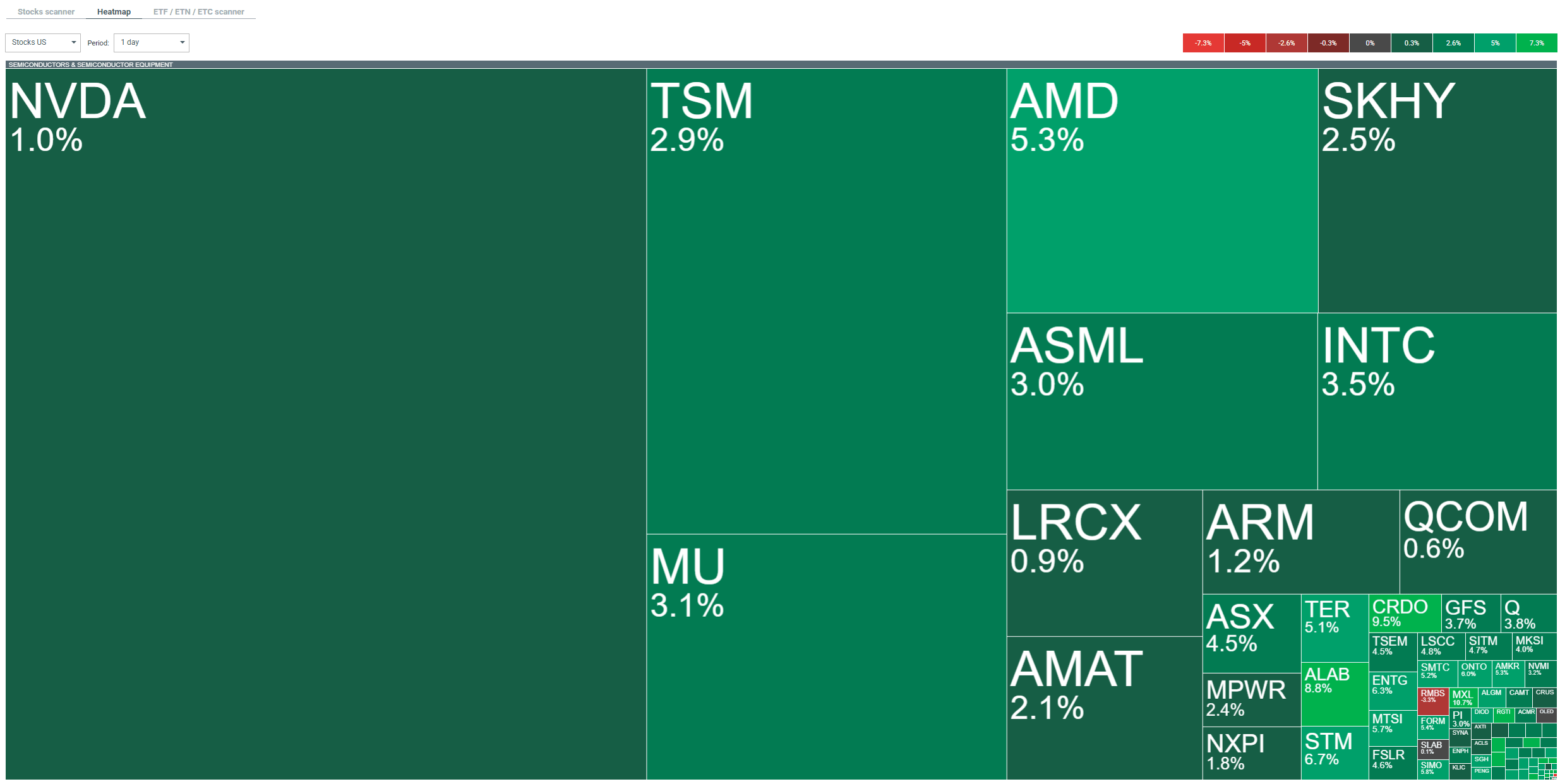
This optimism is not occurring in a vacuum, as the entire AI and semiconductor sector has enjoyed a strong trading session. The sector is dominated by gains, with AMD up by over 5 per cent, TSMC, Micron and ASML rising by around 3 per cent each, whilst among server manufacturers, Dell and Super Micro gained around 7.7 and 7.2 per cent respectively. The rally was fuelled by announcements of massive investments in computing power, including $63 billion in funding for Anthropic announced by Broadcom and Meta’s plans to raise capital. As analysts note, the AI cycle is clearly not over yet, and the market is once again banking on continued spending on infrastructure.
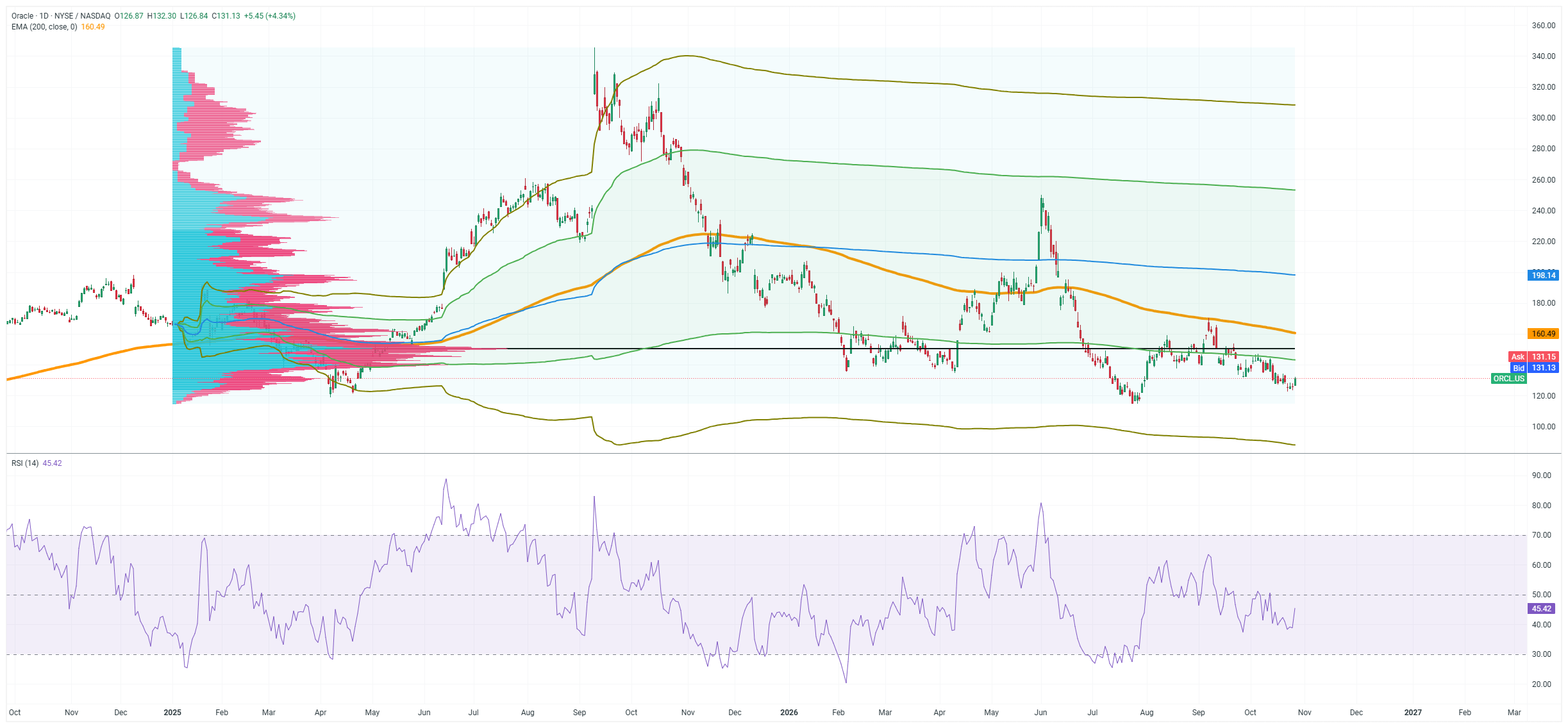
However, the technical picture for Oracle is far more subdued than today’s enthusiasm would suggest, and it is worth keeping a level head here. Despite today’s rebound, the shares are still down sharply by 32 per cent year-to-date. The share price, at around US$131, remains well below the 200-session exponential moving average, which stands at approximately 160, meaning that today’s rise is, for the time being, a move within the downtrend rather than a reversal of it. The company has fallen from its highs of around US$340 at the turn of 2025 and 2026, when the euphoria surrounding AI cloud contracts drove up its valuation. Since then, we have seen a steady erosion and a series of progressively lower highs.