S&P 500 — US Large Cap Index
 FTSE 100 — UK Blue Chips
 Euro Stoxx 50 — Eurozone Leaders
 DAX 40 — German Equities
 CAC 40 — French Market Index
 Nikkei 225 — Japan Benchmark
 Hang Seng — Hong Kong Index
 Shanghai Composite — China Mainland
 ASX 200 — Australian Market
 TSX Composite — Canada Index
 Nifty 50 — India Large Cap
 STI Index — Singapore Market
 KOSPI — South Korea Index
 Bovespa — Brazil Equities
 JSE Top 40 — South Africa Index
 IPC Index — Mexico Market
WTI Climbs Back Above $99 as Middle East Tensions Fuel Further Upside Risks


Today Markets Analysis: WTI crude oil has reclaimed the $99 per barrel level, extending its recent advance as escalating Middle East tensions raise concerns over regional supply and keep a geopolitical risk premium embedded in oil prices. With crude trading close to its highest levels since May, the market remains focused on the potential for further supply disruption and whether the latest geopolitical developments can push prices towards the $100–$107 region.
Middle East Tensions Keep Supply Risk Elevated
WTI has maintained a positive bias as renewed tensions in the Middle East increase concerns over energy infrastructure and regional supply routes.
Recent attacks involving Iran-backed Houthi forces in Yemen, alongside limited prospects for an immediate diplomatic breakthrough between the United States and Iran, have reinforced concerns that the conflict could remain prolonged.
For oil markets, the immediate issue is therefore not simply current production levels, but the possibility that the conflict could disrupt future supply, transportation routes and regional energy infrastructure.
This geopolitical premium is helping crude prices remain elevated even as broader demand concerns continue to influence the market.
Supply Disruption Risk Becomes the Key Driver
Oil markets are particularly sensitive to developments involving the Middle East because of the region’s importance to global energy supply and transportation.
A sustained escalation could increase the risk premium embedded in crude prices, particularly if tensions spread to major production or shipping infrastructure.
The current market therefore has two competing forces:
| Market Factor | Current Direction | Impact on WTI |
|---|---|---|
| Middle East tensions | Elevated | Bullish |
| Supply disruption risk | Increasing | Bullish |
| Geopolitical risk premium | Higher | Bullish |
| Oil prices | Near recent highs | Bullish |
| Global demand concerns | Persistent | Bearish |
| US Dollar | Firm | Bearish |
| Technical momentum | Positive | Bullish |
Technical Momentum Remains Constructive
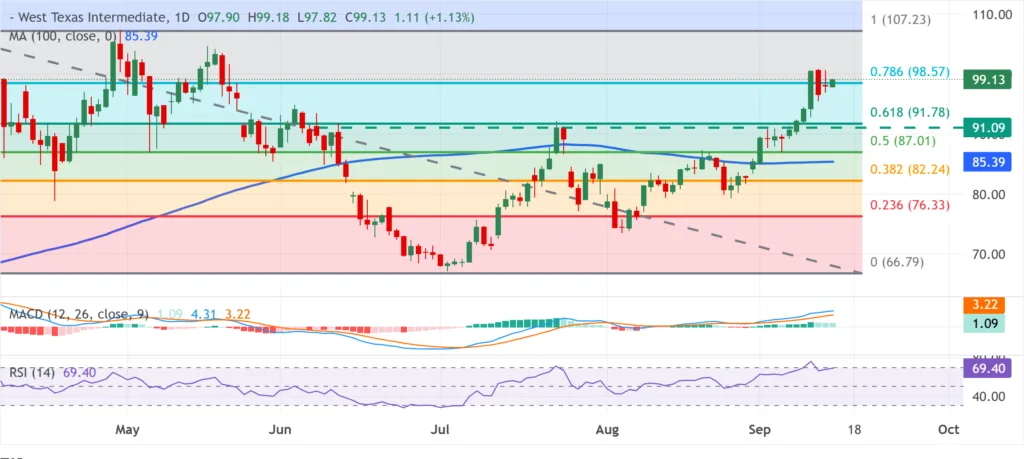
WTI’s move above the $91.00 area was an important technical development, as the level represented both a significant horizontal resistance zone and the 61.8% Fibonacci retracement of the previous May–July decline.
The subsequent move towards $99 has strengthened the technical picture.
Momentum indicators also remain supportive. The Relative Strength Index is approaching overbought territory, while the MACD remains positive.
This suggests that buyers continue to control the near-term trend, although increasingly stretched momentum means the market could become vulnerable to short-term profit-taking.
The key technical levels are now:
- $99.00 – important psychological level
- $98.57 – immediate technical support
- $91.78 – major Fibonacci support
- $87.01 – next downside level
- $85.39 – 100-day moving average
- $82.24 – deeper support
- $76.33 – further structural support
- $107.23 – major upside resistance
Could WTI Test $100?
The ability of WTI to remain above the high-$90s will be important.
A sustained move above $99–$100 would reinforce the bullish technical structure and potentially open the way towards the previous cycle high around $107.23.
However, the closer oil moves towards $100, the more important the distinction becomes between geopolitical risk and fundamental demand.
If tensions continue to escalate while physical supply becomes genuinely threatened, the market could sustain prices above $100.
If geopolitical concerns ease without an actual disruption to supply, some of the risk premium could unwind quickly.
What Traders Are Watching Next
The key factors for the oil market are:
- Developments involving Iran and the United States
- Houthi activity and regional shipping risks
- Any disruption to Middle Eastern production or infrastructure
- OPEC+ supply policy
- US crude inventories
- Global oil demand expectations
- WTI’s ability to hold above $98–$99
- Price action around the $100 psychological level
The most important distinction for traders will be whether geopolitical developments remain a risk premium or turn into an actual reduction in available supply.
Currency Hedger View
Higher oil prices also have important implications for corporate currency management.
For businesses that import energy or energy-intensive goods, a sustained move towards or above $100 per barrel can increase the underlying cost of imports.
The impact can be even more significant when combined with a stronger US Dollar.
For companies purchasing oil or other dollar-denominated commodities, this creates a potential double cost pressure: higher commodity prices and an unfavourable exchange-rate move.
Energy importers should therefore avoid looking at oil and FX exposure in isolation.
A company may have a relatively stable oil price budget but still experience a significant increase in its local-currency cost if the dollar strengthens at the same time.
For currency hedgers, this reinforces the value of monitoring both commodity exposure and USD exposure when setting forward hedge ratios.
Today Markets View
WTI’s recovery above $99 keeps the near-term outlook constructive as Middle East tensions continue to support the geopolitical risk premium.
The technical picture also favours further gains, with the $107.23 area representing the next major upside reference if crude can establish itself above $100.
However, the market is becoming increasingly dependent on geopolitical developments.
A further escalation or genuine supply disruption could accelerate the move higher, while any credible diplomatic breakthrough could trigger a rapid reduction in the risk premium.
For businesses exposed to energy costs, the combination of oil above $99 and a firm US Dollar deserves particular attention.
Bottom Line
WTI has reclaimed $99 per barrel as escalating Middle East tensions keep supply concerns at the forefront of the oil market.
The technical structure remains bullish, with $100 acting as the next psychological test and $107.23 the major upside resistance.
For corporate hedgers, the bigger concern is the potential combination of higher crude prices and a stronger US Dollar, which could materially increase local-currency energy costs.
Until geopolitical risks begin to ease, meaningful dips in WTI may continue to attract buyers.
Analysis by Louis Roche, Analyst, Today Markets
Market analysis contributed by Currency Hedger, an Octalas Group division specialising in foreign exchange, currency risk and hedging.