S&P 500 — US Large Cap Index
 FTSE 100 — UK Blue Chips
 Euro Stoxx 50 — Eurozone Leaders
 DAX 40 — German Equities
 CAC 40 — French Market Index
 Nikkei 225 — Japan Benchmark
 Hang Seng — Hong Kong Index
 Shanghai Composite — China Mainland
 ASX 200 — Australian Market
 TSX Composite — Canada Index
 Nifty 50 — India Large Cap
 STI Index — Singapore Market
 KOSPI — South Korea Index
 Bovespa — Brazil Equities
 JSE Top 40 — South Africa Index
 IPC Index — Mexico Market
WTI Price Forecast: Slides below $80 on US-Iran deal finalization


- The Oil price plummets to near $79.50 as US President Trump announces the reopening of the Strait of Hormuz.
- Iran said the Hormuz reopening would take place within 30 days under Iranian arrangements.
- The oil supply could remain limited as the war has damaged the Middle East’s energy infrastructure.
West Texas Intermediate (WTI), futures on NYMEX, trade over 4% down to near $79.50 in the European trading session on Monday. The Oil price faces intense selling pressure as United States (US) President Donald Trump announces the reopening of the Strait of Hormuz, a vital passage to almost 20% of global energy supply, after finalizing a memorandum of understanding (MoU) with Iran, which will be signed on June 19 in Switzerland.
On Sunday, US President Trump said in a post on Truth Social, “I hereby fully authorize the toll free opening of the Strait of Hormuz, and, simultaneously herewith, authorize the immediate removal of the United States Naval blockade.”
However, Iranian Mehr News Agency has reported that the reopening of the Strait would take place within 30 days “under Iranian arrangements”. Similarly, the US blockade of Iran would be lifted within 30 days, as per Seatrade Maritime News.
The oil price surged significantly when the war started as Iran closed the Hormuz, and demanded recognition of Tehran’s authority on the same.
While oil prices have recovered strongly, market experts doubt that the downfall will continue due to the damage to Middle East energy infrastructure in the exchange of attacks between the US-Israel and Iran.
“You may see (oil) break $80 on just, you know, happy days today…but then maybe the market will realize that, oh, wait a minute, maybe the terms of the deal may not be as lucrative. We also think that oil prices will remain a little bit on the higher side only because infrastructure has been damaged,” analysts at ANZ said, Reuters report.
WTI technical analysis
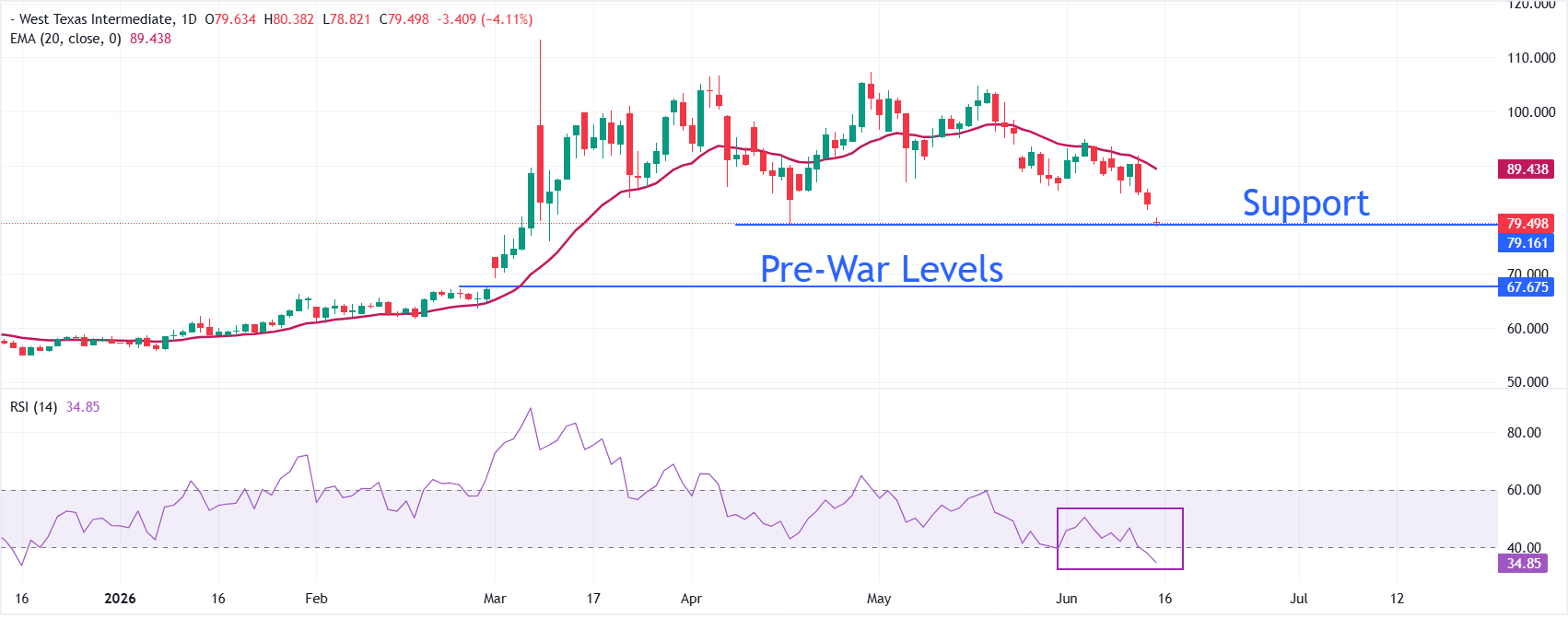
The WTI US Oil trades lower at around $79.50 at press time. The near-term bias is bearish as price holds well below the 20-day Exponential Moving Average (EMA) at $89.44, underscoring persistent overhead supply after the recent slide.
The Relative Strength Index (RSI) slides to 34.84, which suggests that the downside momentum remains in place and could intensify further.
On the topside, the 20-day EMA at $89.44 forms the first meaningful resistance, and a recovery above this dynamic cap would be needed to ease the immediate bearish tone and open the door to a deeper corrective bounce. Looking down, the oil price could slide to the March 10 low at $75.95 if it extends its decline below the April 17 low at $78.88. Further support levels are $70.00, and the February 27 high at $67.74, which is the pre-war level.