S&P 500 — US Large Cap Index
 FTSE 100 — UK Blue Chips
 Euro Stoxx 50 — Eurozone Leaders
 DAX 40 — German Equities
 CAC 40 — French Market Index
 Nikkei 225 — Japan Benchmark
 Hang Seng — Hong Kong Index
 Shanghai Composite — China Mainland
 ASX 200 — Australian Market
 TSX Composite — Canada Index
 Nifty 50 — India Large Cap
 STI Index — Singapore Market
 KOSPI — South Korea Index
 Bovespa — Brazil Equities
 JSE Top 40 — South Africa Index
 IPC Index — Mexico Market
Are Rheinmetall’s “outstanding” results not enough for investors


The financial results of the German defence group Rheinmetall (RHM.DE) for the first half of 2026 confirm the unprecedented growth in the European defence sector and the company’s operational strength. Consolidated revenue rose by 39% year-on-year to €5.23 billion, exceeding market estimates of €5.1 billion. This is a direct result of increased deliveries of military vehicles, ammunition and air defence systems. An exceptionally positive signal for the market is the sharp 74% rise in operating profit (EBIT) to €786 million. This result was significantly better than the consensus estimate of €697.2 million, pushing the operating margin up to 15.0%. This result stems from excellent operating leverage and a favourable product mix, which enabled the company to almost double its earnings per share (EPS) to €8.43.
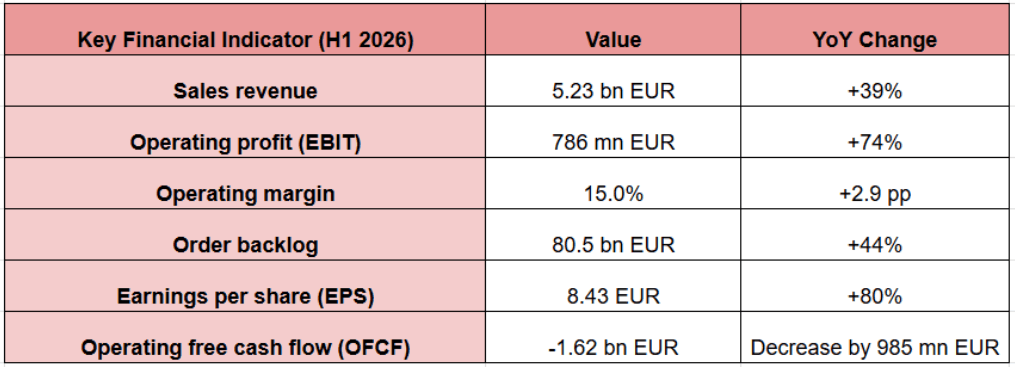
In terms of revenue stability, the order backlog reached a record high of 80.5 billion euros, whilst the book-to-bill ratio remained above 3, ensuring excellent financial visibility for the coming years.
The Dark Side of the Report: Loss of Contract and Burning Through Cash
Although the results for the first half of the year clearly exceeded analysts’ expectations, Rheinmetall’s shares reacted with increased volatility and a sharp fall of 3.28 per cent to €1,160.9 at the start of trading. This was due to the materialisation of key risks and slightly weaker forecasts for the rest of the year. & nbsp; Firstly, the company was forced to reduce its full-year revenue forecast by 300 million euros, and is now targeting a range of 13.7–14.2 billion euros. Although the market consensus had been for €14.08 billion (which falls within the new range), the reason for the cuts was the German government’s cancellation of the F126 frigate programme. This development made investors realise that even record-high order books are vulnerable to political decisions. At the same time, the company maintained its full-year operating margin forecast at around 19 per cent, which is slightly below market expectations of 19.1 per cent. Secondly, the deeply negative operating free cash flow (OFCF) of -1.62 billion euros has raised concerns amongst analysts about liquidity. This deficit is the result of massive stockpiling in anticipation of future orders, the deferral of advance payments, and the substantial capital expenditure (CAPEX) required to rapidly scale up production in the face of the European ammunition shortage.
The company’s valuation in recent times
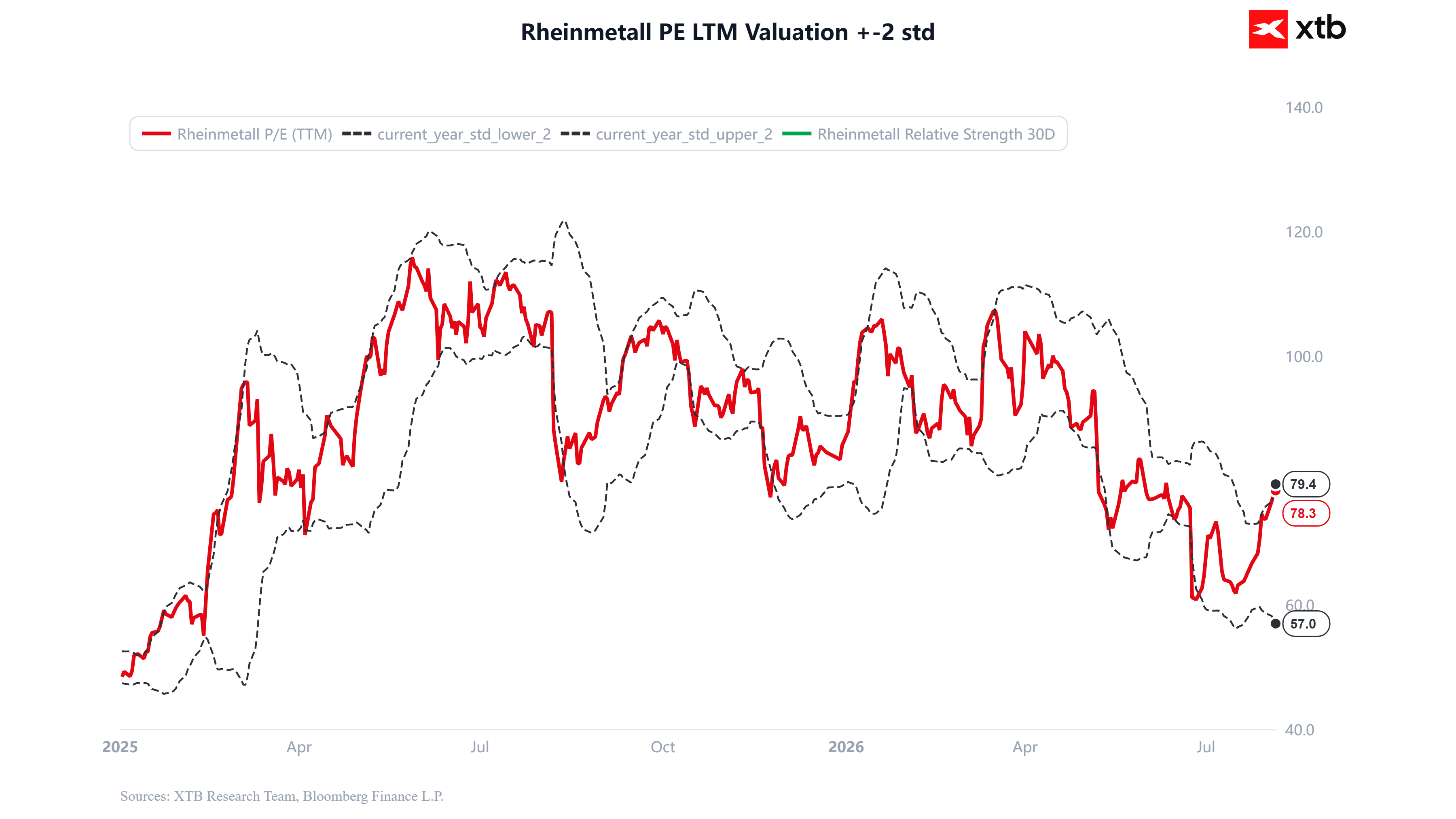
Around July 2026, the company’s price-to-earnings ratio fell to the lower boundary of the range (around 57.0 ). This was followed by a steep and sharp upward rebound. Currently, the indicator stands at 78.3 , very close to the upper dotted line, which points to a rapid shift in sentiment and a renewed rise in market expectations. For this reason, today’s report could be crucial in determining the future trajectory of a potential rise or fall in the ttm P/E ratio. Source: XTB
Conclusions for the Future and Prospects for Development
The implications for the future are clear. The structural boom in the defence sector remains intact due to rising NATO member states’ budgets and steady demand for armaments. Rheinmetall is also aggressively expanding its production capacity in international markets, as evidenced by plans to build factories in Lithuania, amongst other places, and the fulfilment of orders for Hungary and Romania, which strengthens the company’s position as a key player in Europe. However, given the current post-growth share valuations, the market does not forgive operational slip-ups, as today’s investor reaction has clearly shown. Despite sensational H1 results (exceeding estimates for both revenue and profit), the setback in the form of the loss of a maritime contract and the strain on cash flow provided a pretext for a sell-off. In the second half of the year, Rheinmetall must prove that it can convert its massive 80-billion order book not only into accounting revenue but also into positive operating cash flow (OFCF), whilst effectively managing execution risk. Investors should expect increased share price volatility, viewing it as a natural part of dynamic operational growth.
Chart
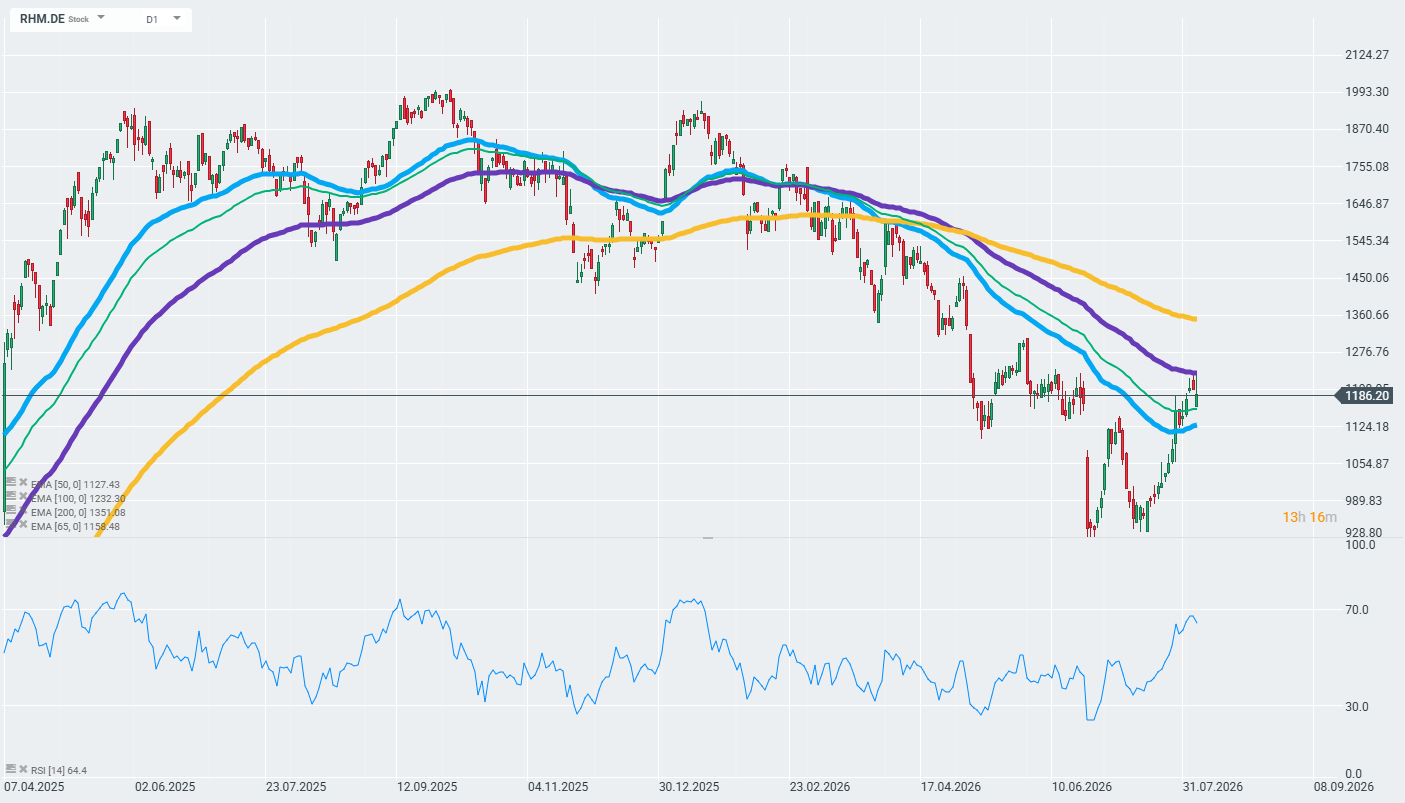
The company’s shares have recently tested the 100-day exponential moving average, but have failed to break consistently above this level. In the short term, this level may remain the main area limiting further gains. The 14-day RSI is rising to levels close to 70 points, its highest this year. Source: xStation