S&P 500 — US Large Cap Index
 FTSE 100 — UK Blue Chips
 Euro Stoxx 50 — Eurozone Leaders
 DAX 40 — German Equities
 CAC 40 — French Market Index
 Nikkei 225 — Japan Benchmark
 Hang Seng — Hong Kong Index
 Shanghai Composite — China Mainland
 ASX 200 — Australian Market
 TSX Composite — Canada Index
 Nifty 50 — India Large Cap
 STI Index — Singapore Market
 KOSPI — South Korea Index
 Bovespa — Brazil Equities
 JSE Top 40 — South Africa Index
 IPC Index — Mexico Market
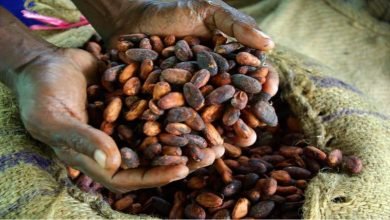
May ICE NY cocoa (CCK26) on Friday closed up +175 (+5.73%), and May ICE London cocoa #7 (CAK26) closed up +110 (+4.99%).
Cocoa prices rallied to 1.5-week highs on Friday and settled sharply higher. The ongoing war in Iran has sparked short covering in cocoa futures amid concern that the closure of the Strait of Hormuz will boost shipping costs, curb cocoa exports, and limit supplies. The closure of the strait has increased global shipping rates, insurance costs, and fuel prices, thereby raising cocoa importers’ costs.
An excessive short position by funds in London cocoa could add fuel to any short-covering rally. Friday’s weekly Commitment of Traders report (COT) showed funds boosted their short positions in London cocoa futures and options by 3,370 in the week ended March 3 to 29,049 net-short positions, the most in more than 4 years.
On Monday, May NY cocoa posted a contract low, and nearest-futures London cocoa (H26) fell to a 3-year low after the International Cocoa Organization (ICCO) raised its global 2024/25 cocoa surplus estimate to 75,000 MT from a November forecast of +49,000 MT, the first surplus in four years. The ICCO also forecasts global cocoa production in 2024/25 will climb by +8.4% y/y to 4.7 MMT.
Cocoa prices are in the midst of an eight-week-long downtrend, with NY cocoa falling to a 2.75-year low last Friday amid robust global supplies and slack demand. On January 29, StoneX forecasted a global cocoa surplus of 287,000 MT in the 2025/26 season and a 267,000 MT surplus for 2026/27. Also, the International Cocoa Organization (ICCO) reported on January 23 that global cocoa stocks rose +4.2% y/y to 1.1 MMT.
International cocoa buyers are reluctant to pay official farm-gate prices in the Ivory Coast and Ghana, which are well above current world prices. The lack of buyers is boosting supplies as ICE cocoa inventories rose to a 6.5-month high of 2,204,098 bags on Friday.
Last month, Ghana cut the official price it pays its cocoa farmers by nearly 30% for supplies for the 2025/26 growing season, and the Ivory Coast on Wednesday said it would cut cocoa farmer pay by 57% that would kick in for the mid-crop harvest that starts in March. The Ivory Coast and Ghana produce more than half of the world’s cocoa.
Favorable growing conditions in West Africa are also a negative factor for cocoa prices. Tropical General Investments Group recently said that favorable growing conditions in West Africa are expected to boost the February-March mid-crop cocoa harvest in the Ivory Coast and Ghana, as farmers report larger and healthier pods compared with the same period last year. The Ivory Coast mid-crop accounts for about 25% of annual production and is estimated at 400,000 to 450,000 MT this year.
Slowing cocoa deliveries to ports in the Ivory Coast is also supportive of prices. Monday’s cumulative data from the Ivory Coast shows that Ivory Coast farmers shipped 1.34 MMT of cocoa to ports in the current marketing year (October 1, 2025, through March 1, 2026), down -3.6% from 1.39 MMT in the same period a year ago.
Demand concerns have hammered cocoa prices as consumers continue to balk at the high price of chocolate. On January 28, Barry Callebaut AG, the world’s largest bulk chocolate maker, reported a -22% decline in sales volume in its cocoa division for the quarter ending November 30, citing “negative market demand and a prioritization of volume toward higher-return segments within cocoa.”
Grinding reports also showed weak demand. On January 15, the European Cocoa Association reported that Q4 European cocoa grindings fell -8.3% y/y to 304,470 MT, a bigger decline than expectations of -2.9% y/y and the lowest for a Q4 in 12 years. On December 16, the Cocoa Association of Asia reported that Q4 Asian cocoa grindings fell -4.8% y/y to 197,022 MT. Also, the National Confectioners Association reported Q4 North American cocoa grindings rose only +0.3% y/y to 103,117 MT.
Chocolate maker Mondelez recently said that the latest cocoa pod count in West Africa is 7% above the five-year average and “materially higher” than last year’s crop. Harvest of the Ivory Coast’s main crop has begun, and farmers are optimistic about its quality.
Also undercutting cocoa prices are higher exports from Nigeria, the world’s fifth-largest cocoa producer. On February 17, Bloomberg reported that Nigerian Dec cocoa exports rose +17% y/y to 54,799 MT. Nigeria’s Cocoa Association projects that Nigerian cocoa production in 2025/26 will fall by -11% y/y to 305,000 MT, from a projected 344,000 MT for the 2024/25 crop year.
On the bullish side, the Ivory Coast projects cocoa production in 2025/26 to fall -10.8% y/y to 1.65 MMT from 1.85 MMT in 2024/25. On February 10, Rabobank also cut its 2025/26 global cocoa surplus estimate to 250,000 MT from a November forecast of 328,000 MT.