S&P 500 — US Large Cap Index
 FTSE 100 — UK Blue Chips
 Euro Stoxx 50 — Eurozone Leaders
 DAX 40 — German Equities
 CAC 40 — French Market Index
 Nikkei 225 — Japan Benchmark
 Hang Seng — Hong Kong Index
 Shanghai Composite — China Mainland
 ASX 200 — Australian Market
 TSX Composite — Canada Index
 Nifty 50 — India Large Cap
 STI Index — Singapore Market
 KOSPI — South Korea Index
 Bovespa — Brazil Equities
 JSE Top 40 — South Africa Index
 IPC Index — Mexico Market
EUR/JPY Holds Near 178.50 as Yen Weakness Fails to Reverse the Bearish Trend


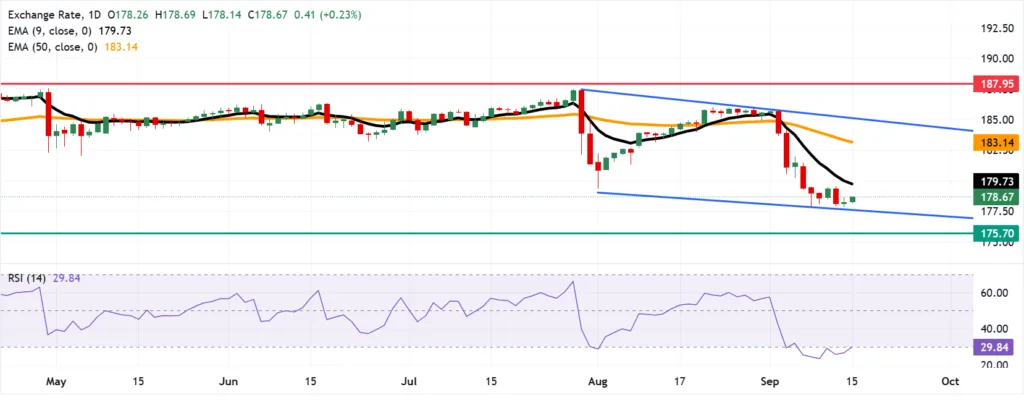
Today Markets Analysis: EUR/JPY is attempting to stabilise after two consecutive sessions of gains, trading around 178.70 during Asian hours. Despite the recent bounce, the broader technical structure remains bearish, with the cross trapped inside a descending channel and trading below its key short-term moving averages.
The interesting feature of the current market is the divergence between yen weakness and EUR/JPY’s technical structure. The yen has underperformed ahead of Friday’s widely anticipated Bank of Japan decision, yet EUR/JPY remains vulnerable because the euro itself has not generated enough momentum to break the prevailing downtrend.
EUR/JPY Remains Trapped in a Descending Channel
The daily chart continues to show a clear descending channel, keeping the near-term bias tilted lower.
EUR/JPY is currently trading below both the nine-day EMA at 179.73 and the 50-day EMA at 183.14.
That leaves 179.73 as the first important test for buyers.
A sustained move above the nine-day EMA would be an early indication that downside momentum is losing strength. However, the broader structure would not turn convincingly positive unless EUR/JPY can reclaim the 183.14 area.
Above that, the upper boundary of the descending channel sits near 185.30, while the April record high remains at 187.95.
RSI Signals an Oversold Market
Momentum indicators are warning that the decline may be becoming stretched.
The 14-day RSI is at 29.84, putting the indicator just inside traditionally oversold territory.
That does not automatically mean EUR/JPY must rebound.
An RSI below 30 can remain oversold during a strong downtrend, particularly when the underlying price structure continues to make lower highs and lower lows.
For traders, the distinction is important: oversold conditions increase the probability of a rebound, but they do not by themselves establish a bullish reversal.
177.60 Becomes the Critical Support
The lower boundary of the descending channel is currently positioned around 177.60.
This is the most important technical level on the downside.
A successful defence of 177.60 could encourage short-covering and push EUR/JPY back toward 179.73.
However, a decisive break below the channel would strengthen the bearish technical setup and expose the cross to the region around 175.70, the lowest level recorded in November 2025.
That would represent a significant deterioration in the technical picture.
| EUR/JPY level | Significance |
|---|---|
| 187.95 | April all-time high |
| 185.30 | Upper descending-channel boundary |
| 183.14 | 50-day EMA / major resistance |
| 179.73 | Nine-day EMA / first upside barrier |
| 178.70 | Current area |
| 177.60 | Descending-channel support |
| 175.70 | November 2025 low |
Why the Yen Is Weak Ahead of the BoJ
The yen’s recent underperformance against the dollar and other G10 currencies is particularly notable because markets are looking directly toward Friday’s Bank of Japan decision.
Scotiabank strategists argue that the yen’s relative performance appears to reflect more than simply changes in global risk sentiment, with investors positioning around the expected BoJ policy move and upcoming Japanese economic data.
The hike is widely anticipated and largely priced into markets.
That creates an unusual situation for EUR/JPY: the yen can weaken into an expected rate hike if traders have already positioned for the decision and are waiting for guidance on what comes next.
The market therefore needs to distinguish between the hike itself and the BoJ’s forward guidance.
A more hawkish message could eventually provide the yen with support. A cautious approach, however, could leave the currency vulnerable to further selling.
EUR/JPY Is Now a Policy-Divergence Trade
The cross is increasingly being driven by the relative policy outlook between Europe and Japan.
For EUR/JPY to recover sustainably, traders need either stronger expectations for European rates, weaker expectations for Japanese tightening, or a combination of both.
Conversely, a more hawkish BoJ alongside a less hawkish European Central Bank could reinforce the downside.
This makes Friday’s decision particularly important even though the initial rate move is already widely expected.
The real market reaction may come from the language surrounding future policy.
What Traders Are Watching Next
177.60 is the key level on the downside. A break could open the way toward 175.70.
On the upside, 179.73 is the first hurdle, followed by 183.14.
The RSI near 29.84 means traders should also be alert to a sharp technical rebound. If price climbs back above 179.73 while RSI recovers from oversold territory, the bearish momentum could begin to weaken.
But until EUR/JPY can reclaim the 50-day EMA, rallies remain vulnerable to renewed selling.
Currency Hedger View
EUR/JPY is particularly relevant for companies with commercial exposure to both the euro and Japanese yen.
The current environment demonstrates why businesses should not treat an FX cross simply as a directional trade. A company receiving euros while paying suppliers in yen, for example, can see its underlying margin change materially when EUR/JPY moves several percentage points.
The risk becomes more significant when central-bank expectations are driving the currency.
With the BoJ decision approaching, businesses exposed to EUR/JPY should consider whether they are comfortable leaving their future conversion rate entirely open to the market.
For companies with predictable euro or yen cash flows, forward contracts and structured hedging strategies can provide greater certainty around future exchange rates while allowing the business to manage its underlying commercial exposure rather than attempting to predict every central-bank move.
Today Markets View
EUR/JPY is currently caught between yen weakness and a technically bearish euro-yen structure.
The recent recovery toward 178.70 has not yet changed the underlying trend. Price remains below both the nine-day and 50-day EMAs, while the descending channel continues to dominate the daily chart.
The 29.84 RSI suggests the market is becoming stretched, meaning a rebound cannot be ignored. But the key distinction is whether that rebound can break through 179.73 and ultimately 183.14.
Until that happens, the path of least resistance remains lower.
Friday’s BoJ decision could therefore be the catalyst for the next major move. A break below 177.60 would strengthen the bearish case and bring 175.70 into focus, while a sustained recovery above 183.14 would materially weaken the current downside structure.
“The yen may be weak heading into the BoJ decision, but EUR/JPY has not yet produced the technical evidence needed to call the broader downtrend over.” — Louis Roche, Analyst, Today Markets
Bottom Line
EUR/JPY is hovering near 178.50–178.70, but the technical picture remains fragile.
177.60 is the critical support, while 179.73 represents the first meaningful resistance. A break below support could expose 175.70, while a sustained move above 183.14 would be needed to significantly improve the bullish outlook.
With the BoJ decision approaching, the next major move could come from the interaction between Japanese monetary-policy expectations and the euro’s own rate outlook.
Analysis by Louis Roche, Analyst, Today Markets
Market analysis contributed by Currency Hedger, an Octalas Group division specialising in foreign exchange, currency risk and hedging.