S&P 500 — US Large Cap Index
 FTSE 100 — UK Blue Chips
 Euro Stoxx 50 — Eurozone Leaders
 DAX 40 — German Equities
 CAC 40 — French Market Index
 Nikkei 225 — Japan Benchmark
 Hang Seng — Hong Kong Index
 Shanghai Composite — China Mainland
 ASX 200 — Australian Market
 TSX Composite — Canada Index
 Nifty 50 — India Large Cap
 STI Index — Singapore Market
 KOSPI — South Korea Index
 Bovespa — Brazil Equities
 JSE Top 40 — South Africa Index
 IPC Index — Mexico Market
- EUR/USD slides below 1.1100 as the US Dollar rallies after the US and China agreed to lower tariffs by 115% for 90 days.
- The US-China temporary trade truce is expected to tame elevated consumer inflation expectations.
- ECB Schnabel sees no need to lower interest rates further.
EUR/USD plunges below 1.1100 during European trading hours at the start of the week. The major currency pair faces an intense selling pressure as the US Dollar (USD) rallies after the United States (US) and China, in a joint statement, announced a higher-than-expected reduction in tariffs for 90 days imposed in April.
The US Dollar Index (DXY), which tracks the Greenback’s value against six major currencies, surges to near 101.60.
In a scheduled briefing during the European trading session on Monday, the US and China have agreed to lower tariffs by 115%. Tariffs on the US and China have dropped to 10% and 30%, respectively. Import duties on China still carry the burden of a 20% fentanyl levy, however, Washington has assured that it could be resolved soon. “Two sides are having constructive conversations on the issue of fentanyl,” US Trade Representative Jamieson Greer said.
Ahead of the US-China trade talks in Geneva over the weekend, US President Donald Trump stated on Friday that he could lower tariffs on China to 80% through a post on Truth. Social. “80% Tariff on China seems right! It’s up to Scott Bessent,” Trump said.
The next trigger for the US Dollar will be commentary from Federal Reserve (Fed) officials on the monetary policy outlook in the wake of de-escalation in the Sino-US trade war. Fed officials are expected to revise their outlook on interest rates as the averted tariff war would diminish elevated consumer inflation expectations.
Last week, Fed Chair Jerome Powell warned in the press conference after the central bank’s decision to keep interest rates unchanged that tariffs announced were “significantly bigger than expected” and we will see “higher inflation, and lower employment” if large increases in tariffs as announced are “sustained”.
Daily digest market movers: EUR/USD plunges as US Dollar strengthens
- EUR/USD is down over 1% on Monday as the US Dollar surges after the US and China lowered tariffs. The Euro (EUR) trades mixed against other currencies as investors seek cues on how the temporary US-China trade truce will influence the Eurozone economic outlook.
- Ahead of the Sino-US trade talks, financial market participants anticipated that the trade war between the two largest world economic countries would be unfavorable for the shared continent, assuming that Beijing would move to other markets to sell its products to offset the impact of a trade war with Washington. Given China’s low-cost competitive advantage, its products could be disruptive for the global economy.
- Meanwhile, firm expectations that the European Central Bank (ECB) could continue the monetary policy expansion cycle in the wake of easing inflationary pressures might restrict the upside in the Euro. A string of ECB officials has signaled that more interest rate cuts are needed amid trade tensions with the US, while remaining confident that the disinflation trend is intact.
- Contrary to several officials supporting more interest rate cuts, ECB board member Isabel Schnabel has signaled that there is no need to reduce interest rates further. “The appropriate course of action is to keep rates close to where they are today – that is, firmly in neutral territory,” Schnabel said in a conference at Stanford University on Friday. Schnabel warned of risks to inflation exceeding the central bank’s 2% target in the medium term amid global economic turmoil.
- On the economic front, the EUR/USD pair will be influenced by the US Consumer Price Index (CPI) data for April, which will be released on Tuesday. The inflation data is expected to show that the headline CPI rose steadily by 2.4% YoY.
Technical Analysis: EUR/USD weakens on 20-day range breakdown
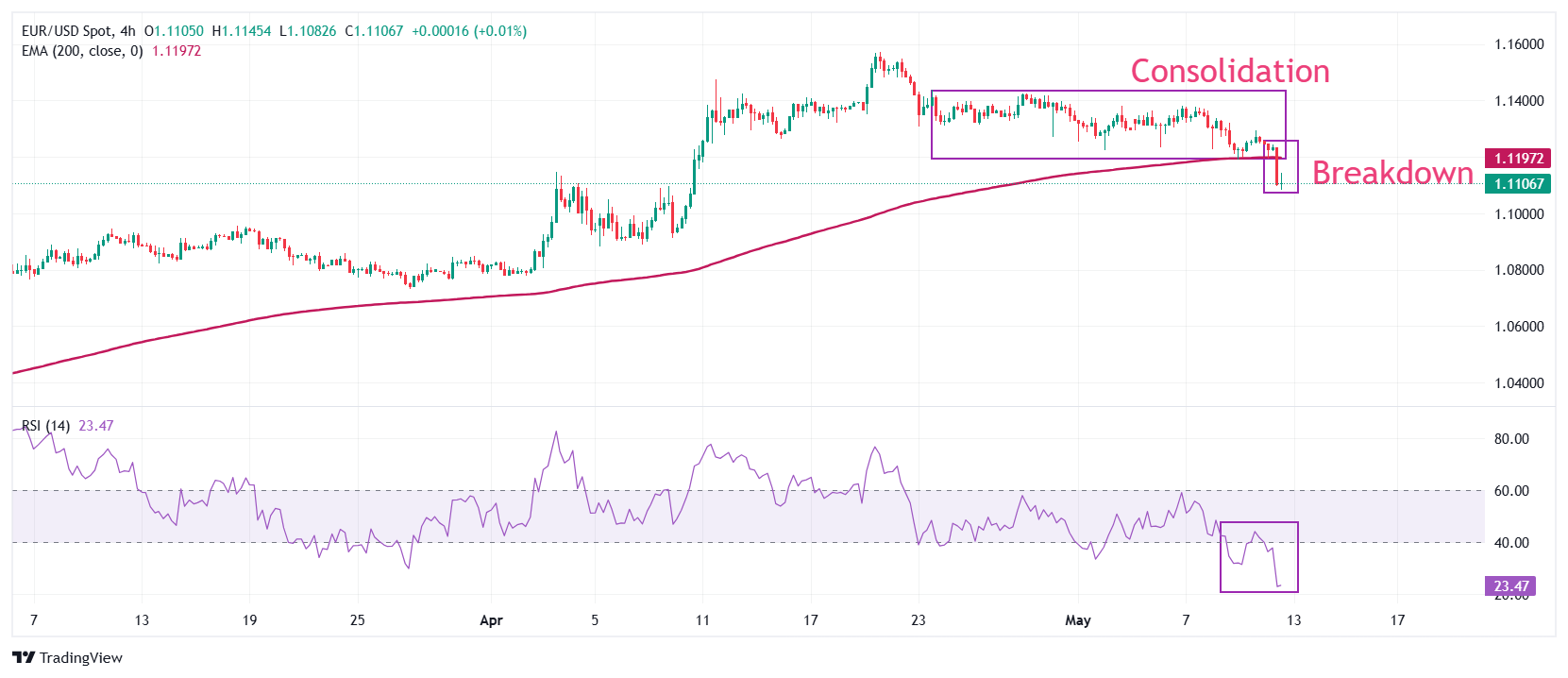
EUR/USD declines on Monday after a breakdown of the 1.1200-1.1440 range formed in the last 20 trading days. The major currency pair extends its downside move below the 200-period Exponential Moving Average (EMA), which is around 1.1200, indicating a bearish trend.
The 14-period Relative Strength Index (RSI) slides below 40.00, suggesting that a fresh bearish momentum has been triggered.
Looking up, the April 28 high of 1.1425 will be the major resistance for the pair. Conversely, the March 27 low of 1.0733 will be a key support for the Euro bulls.