S&P 500 — US Large Cap Index
 FTSE 100 — UK Blue Chips
 Euro Stoxx 50 — Eurozone Leaders
 DAX 40 — German Equities
 CAC 40 — French Market Index
 Nikkei 225 — Japan Benchmark
 Hang Seng — Hong Kong Index
 Shanghai Composite — China Mainland
 ASX 200 — Australian Market
 TSX Composite — Canada Index
 Nifty 50 — India Large Cap
 STI Index — Singapore Market
 KOSPI — South Korea Index
 Bovespa — Brazil Equities
 JSE Top 40 — South Africa Index
 IPC Index — Mexico Market

Riots across Paris and Milan trigger a slump in the luxury goods sector


The wave of “unbridled violence” that swept through France last weekend is spilling over into European stock markets. Today’s index map shows that contracts on the Italian and French stock exchanges are performing the worst. Leading the declines is the ITA40 (−0.90%) , followed closely by the FRA40 (−0.77%) , with the SPA35 (−0.76%) and DE40 (−0.71%) rounding out the list of decliners . The broader picture confirms that this is European—rather than global—risk aversion: across the Atlantic, the US100 is up 1.07%, and the JP225 is up as much as 1.79% , while the Old Continent is in the red.
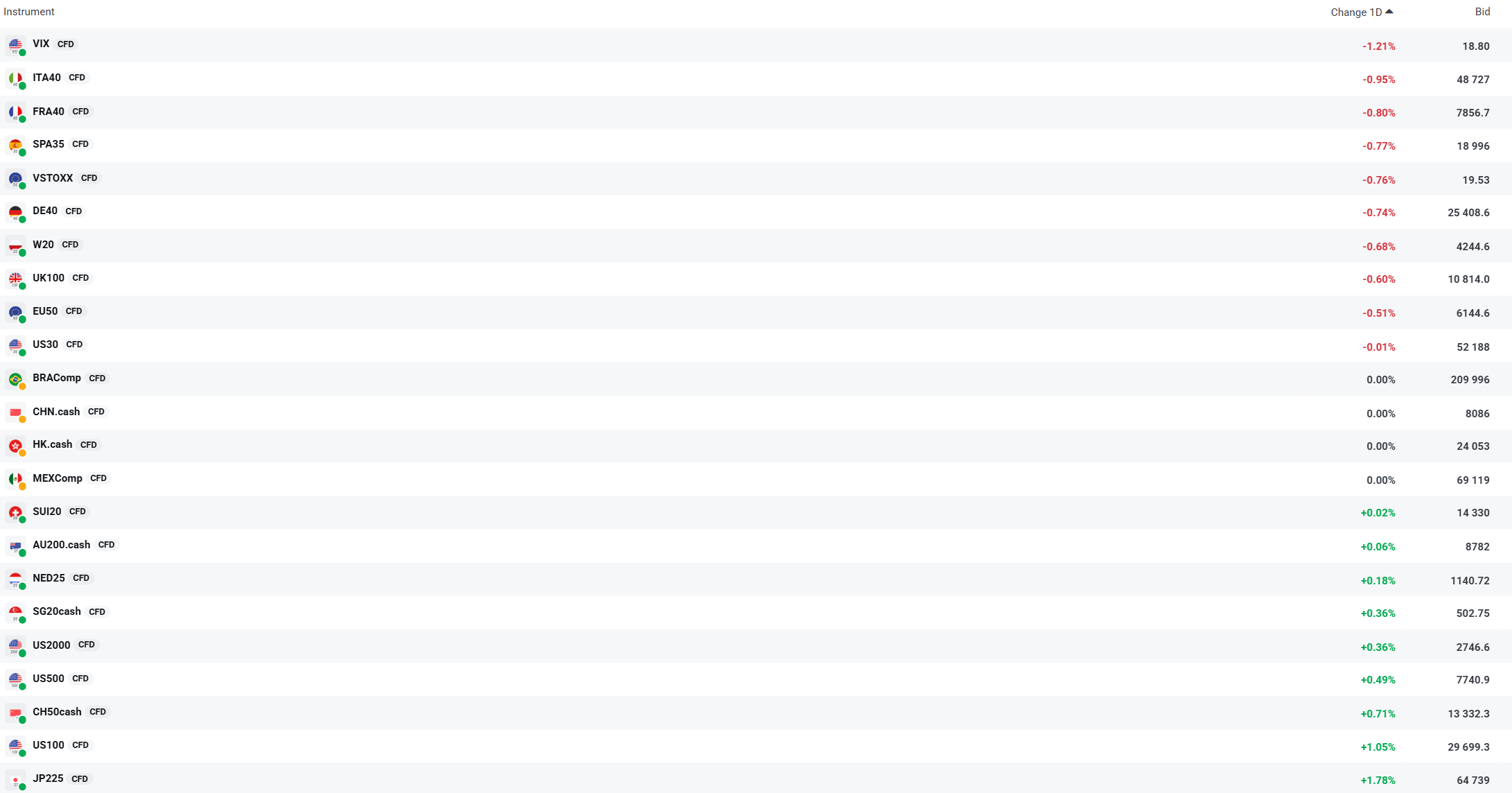
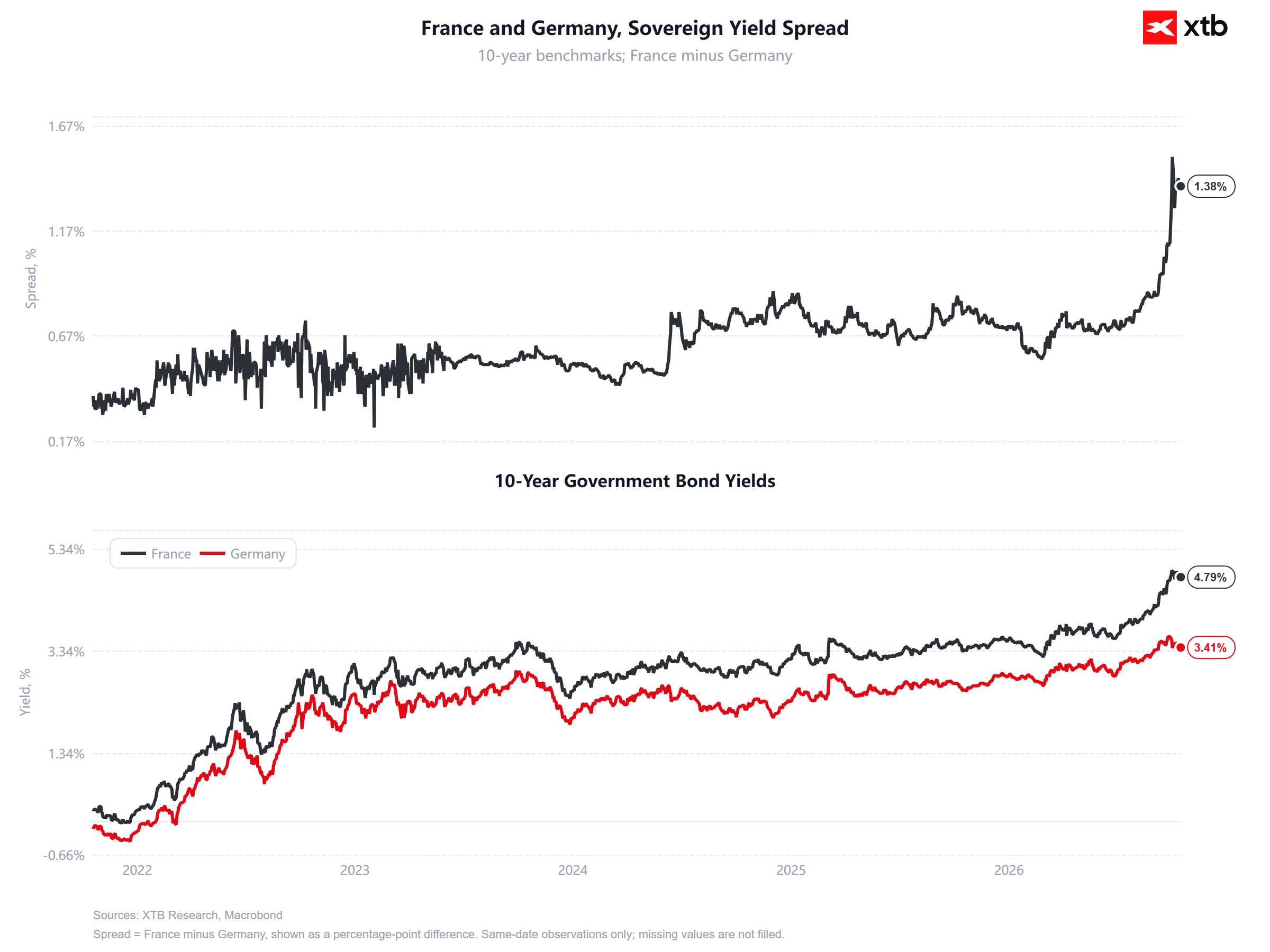
Following the weekend riots in Paris and Milan, among other places, FRA40 and ITA40 index futures are posting sharper declines, despite a clear rebound in Asia and the U.S. Source: XTB Why are Italy and France at the bottom of the list? France is portrayed in the media as the epicenter of unrest. It is there that the riots have reached an exceptionally large scale, with stores and city halls becoming targets, and it is French companies that are suffering direct losses. The sell-off of contracts in Italy also stems from the same phenomenon observed in Milan, where clashes with police and looting of stores occurred, and protests have also spread to Belgium and Portugal (with more expected in Spain in November). The market is thus beginning to price in the risk that the French “spark” is spreading throughout Western Europe. For investors, this is a signal that we are dealing not with a local incident, but with a broader wave of social unrest in the eurozone . The reaction is also evident outside the stock market. The spread between French and German 10-year bond yields widened to 138 basis points — investors are demanding a higher premium for French political and fiscal risk.
Source: XTB Luxury in the Crossfire
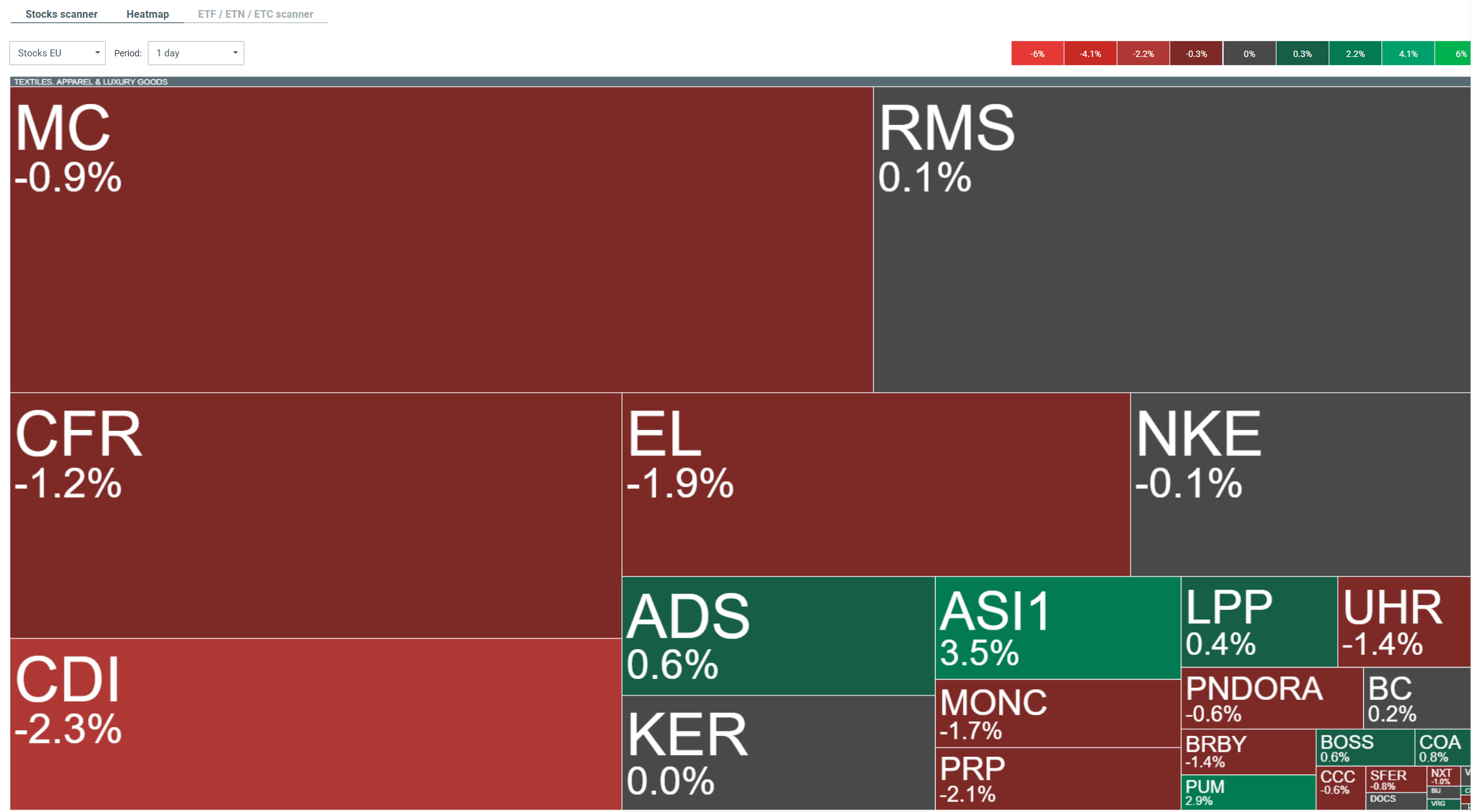
As a result of this situation, the luxury goods and apparel sectors found themselves at the epicenter of the losses—and for good reason. Louis Vuitton and Christian Dior boutiques in Marseille and Paris were looted, Rolex watches disappeared from the shelves, Lacoste stores were ransacked, and there were attempts to break into Galeries Lafayette. Red dominates today’s fashion landscape: Christian Dior (CDI) is down 2.3%, EssilorLuxottica (EL) 1.9%, Moncler is down 1.7%, Swatch (UHR) and Burberry (BRBY) are each down 1.4%, Richemont (CFR) is down 1.2%, and LVMH (MC) is down 0.9%. The only outlier is the sports segment, which is less exposed to French boutiques (Adidas +0.6%, Puma +2.9%, Asics +3.5%). For these companies, the riots represent several overlapping risks: direct property damage (smashed storefronts, stolen merchandise), lost sales during the crucial pre-holiday season in one of the most important luxury markets, and the impact on tourism — scenes of chaos in Paris, Marseille, and Lyon are deterring affluent tourists, who account for a significant portion of luxury sales in Europe. Alexandre Bompard, head of the French retail federation, estimates that approximately 1,500 stores and service outlets were damaged or looted, and total losses will reach hundreds of millions of euros. The industry is already on the defensive These concerns are hitting the sector at a terrible time. The luxury sector has been grappling with a slowdown for over three years; LVMH reported weak third-quarter results weighed down by sluggish Chinese demand, and its stock is down significantly this year. The unrest in France adds a second, domestic risk factor to the weakness in China—and this in a market that has so far been considered a stable pillar of sales. However, it’s important to keep things in perspective. Today’s declines are moderate (mostly below 2.5%), which suggests that the market is treating the unrest as a temporary shock for now. For global giants like LVMH and Richemont, French boutiques are just a small part of a geographically dispersed network. The greater risk is the unrest dragging on —five French labor unions have already called for another strike on November 5 , and with just over a dozen months remaining until the 2027 presidential election, social tensions, pressure on French public finances (work is underway on the 2027 budget, which calls for a deficit reduction of approximately 43 billion euros), and heightened uncertainty in the tourism sector are likely to persist. What to Watch Next The key will be whether Lecornu’s government quickly restores order and whether the wave of protests will indeed spread to Italy, Spain, and Belgium—because that is precisely the scenario currently priced in by Europe’s weakest contracts, the ITA40 and FRA40. If the unrest turns out to be a one-off event, today’s sell-off—especially given that luxury stock valuations are already heavily compressed—could be quickly reversed. However, if the chaos drags on and spreads across borders, Southern European indices and fashion companies may remain under pressure for longer.