S&P 500 — US Large Cap Index
 FTSE 100 — UK Blue Chips
 Euro Stoxx 50 — Eurozone Leaders
 DAX 40 — German Equities
 CAC 40 — French Market Index
 Nikkei 225 — Japan Benchmark
 Hang Seng — Hong Kong Index
 Shanghai Composite — China Mainland
 ASX 200 — Australian Market
 TSX Composite — Canada Index
 Nifty 50 — India Large Cap
 STI Index — Singapore Market
 KOSPI — South Korea Index
 Bovespa — Brazil Equities
 JSE Top 40 — South Africa Index
 IPC Index — Mexico Market

SK Hynix breaks records and lifts Wall Street. Memory sold out through 2029

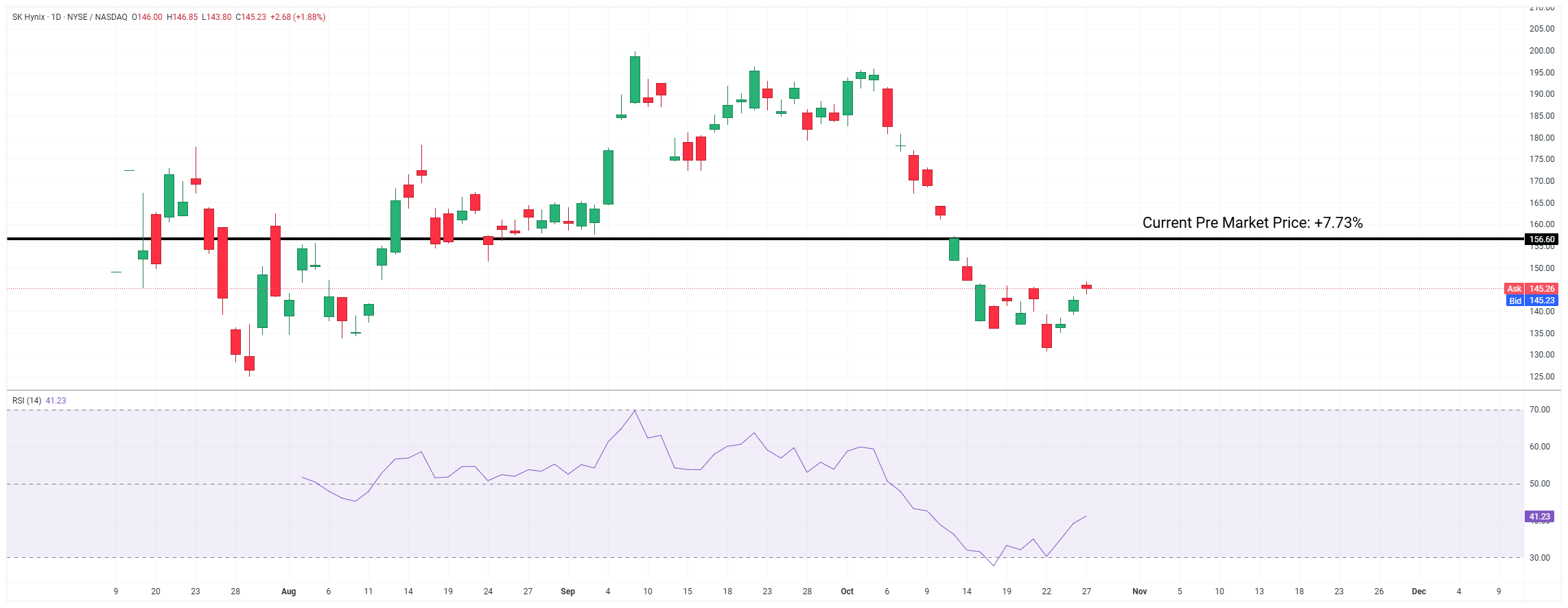
SK Hynix (SKHY.US) has delivered a quarter that can hardly be described as anything other than historic. The main memory supplier to Nvidia reported a more than seven-fold surge in profits, driven by an explosion in demand for memory for AI infrastructure, and immediately announced a return of around US$75 billion to shareholders this year. In pre-market trading, the company’s US ADRs rose by nearly 8 per cent to around US$156, driving the entire Asian and US semiconductor sector higher.
Here are the key figures from the report for the third quarter of 2026:
◆ Revenue: US$78.9 billion (expected: US$74.8 billion); +328% y/y ◆ Operating profit: US$62.8 billion (expected: US$58.5 billion); +632% y/y ◆ Operating margin: 80%; +3,300 basis points y/y; all-time high ◆ Gross margin: 85.7% (expected 85.2%) ◆ EPS: US$41.07; +205% y/y ◆ Net profit: USD 30.0 billion; +216% y/y (burdened by USD 24.6 billion in non-operating losses, including a USD 17.3 billion write-down on investment assets and a USD 8.8 billion foreign exchange loss following the strengthening of the won) ◆ Quarterly: revenue +32 per cent / operating profit +38 per cent ◆ Cash: US$86.3 billion; +311 per cent year-on-year, with net debt to equity at −32 per cent
Prices are at the heart of this profit surge. Average DRAM selling prices rose by a substantial 20 per cent quarter-on-quarter, whilst NAND prices rose by around 20 per cent; combined with rising volumes, this resulted in a record operating margin of 80 per cent. It is precisely the memory sector – long regarded as a cyclical, low-margin segment – that has now become one of the main beneficiaries of the artificial intelligence boom. However, the strongest message for the market was the comment on demand. SK Hynix announced that it has sold out its HBM and DRAM memory stock right through to 2029, that demand for HBM is twice the company’s production capacity, and that the chip shortage is likely to persist until 2030. These statements stand in stark contrast to investors’ concerns about the sustainability of AI spending.
Crucially, the company is securing this demand through long-term contracts signed with 14 key customers, including the world’s largest cloud providers, covering more than half of its production capacity for 2027 and 2028. Chief Financial Officer Kim Woo-hyun acknowledged that investors are scrutinising the profitability of AI projects more closely, but emphasised that spending will continue because clients’ investments translate into actual service roll-outs and tangible business results. The generosity towards shareholders is impressive. This year’s capital return programme is set to total around 100 trillion won, or US$75 billion, comprising over 30 trillion won in cash dividends and over 60 trillion won in share buy-backs and cancellations. In addition, the company will return most of the profit from its investment in Japan’s Kioxia in the form of a special dividend. Share buy-backs and cancellations are an effective way of increasing the value per share, which, combined with record results, explains the market’s enthusiasm.
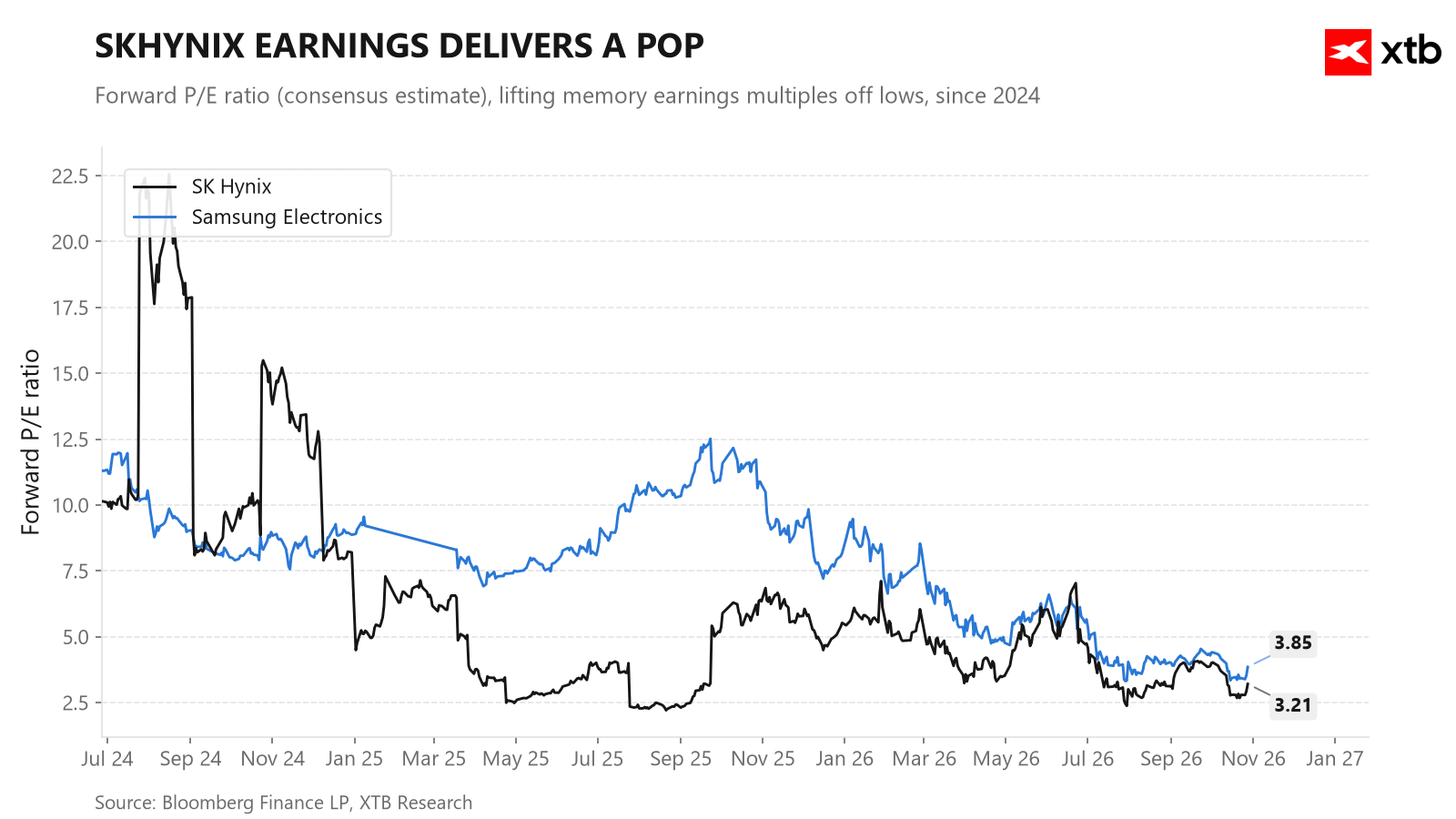
The XTB chart above shows the forecast price-to-earnings ratio (forward P/E) for SK Hynix and Samsung, calculated on the basis of analysts’ consensus forecasts from 2024 onwards. Despite SK Hynix’s share price having more than doubled this year, the company’s forward P/E ratio currently stands at just around 3.2, whilst Samsung’s is around 3.85. These are extremely low levels, well below the historical figures from 2024 and 2025, when multiples reached double figures and, at their peak, even 20.
The paradox is that earnings are growing faster than share prices, which means that, despite the rally, valuation multiples are sliding downwards. In other words, the market continues to value Memory as if it feared an imminent downturn in the cycle, whilst the company itself states that demand will outstrip supply for several more years. It is precisely this discrepancy between record results and exceptionally low price-to-earnings ratios that is currently the bulls’ main argument. Source: XTB Of course, the picture is not without its risks. Competitive pressure is mounting on the horizon from the Chinese manufacturer CXMT, which plans to start producing HBM3E chips in the coming months, although for the time being at a very low yield of around 20 per cent of usable chips.
The company has also announced a significant increase in capital expenditure next year, which is necessary to meet demand but will, at the same time, put a strain on cash flow. It is also worth bearing in mind that, despite today’s rebound, SK Hynix’s shares are still half their June record high, which illustrates just how sharp the earlier correction in the sector was. The macroeconomic context further underscores the significance of these results. SK Hynix’s record performance boosted Nasdaq shares and lifted sentiment surrounding AI trading, which had already rebounded following Anthropic’s filing for an IPO in the US. Micron rose by around 4 per cent in pre-market trading, whilst the entire semiconductor sector was in the green. All this, however, is taking place in the shadow of Wednesday’s Fed decision – where the market expects a pause following the previous rate rise – and the after-hours results from hyperscalers Microsoft and Alphabet, which will be another tough test for the narrative surrounding returns on AI investments.
Source: XTB