S&P 500 — US Large Cap Index
 FTSE 100 — UK Blue Chips
 Euro Stoxx 50 — Eurozone Leaders
 DAX 40 — German Equities
 CAC 40 — French Market Index
 Nikkei 225 — Japan Benchmark
 Hang Seng — Hong Kong Index
 Shanghai Composite — China Mainland
 ASX 200 — Australian Market
 TSX Composite — Canada Index
 Nifty 50 — India Large Cap
 STI Index — Singapore Market
 KOSPI — South Korea Index
 Bovespa — Brazil Equities
 JSE Top 40 — South Africa Index
 IPC Index — Mexico Market
The S&P500 is Bouncing Back. Let’s Explore The Fundamentals


The current S&P 500 is an index heavily weighted towards technology, with a marked reset in valuations relative to the rest of the world and accelerating earnings growth in the second quarter of 2026.
Record-high sector concentration
The technology sector currently accounts for around 36–39 per cent of the index’s weighting, which is higher than at the peak of the dot-com bubble in 2000. Together with the communications services and cyclical consumer goods sectors, these three ‘tech-adjacent’ sectors make up almost 59 per cent of the entire index. Within the technology sector itself, semiconductors have grown to account for around 42% of the sector’s weighting and nearly 20% of the entire S&P 500, meaning that passive investors are placing a heavily concentrated bet on AI-related companies.
Ten companies account for almost 40 per cent of the index
The top 10 companies — Nvidia, Apple, Alphabet, Microsoft, Amazon, Broadcom, Meta, Tesla, Micron and a few others that rotate on this list — account for 38–40 per cent of the index’s market capitalisation, compared with just around 22 per cent in 2010. Nvidia alone is currently the largest single holding, with a weighting of 7.3%, whilst the five largest companies together account for over 28% of the index. This structure means that the S&P 500 behaves more like a concentrated technology fund than a diversified broad-market index.
Prices have returned to more ‘reasonable’ levels
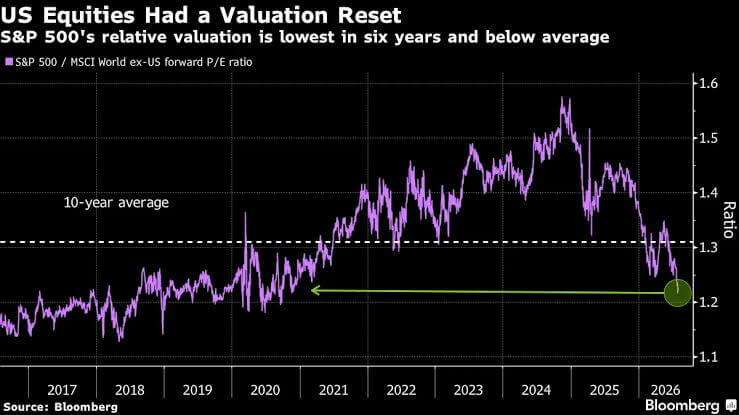
The valuation premium of US shares relative to the rest of the world (S&P 500 vs MSCI World ex-US forward P/E) has fallen to its lowest level in over six years and is now well below the ten-year average. The valuations of the Nasdaq 100, the S&P 500 and even the technology sector itself may be starting to look ‘more reasonable’ following the recent deleveraging of excessive leverage and leveraged positions. The forward P/E of the S&P 500 alone currently stands at around 21.2, with a trailing P/E of 28.3. Source: Bloomberg Financial Lp
Accelerating profit growth in Q2 2026
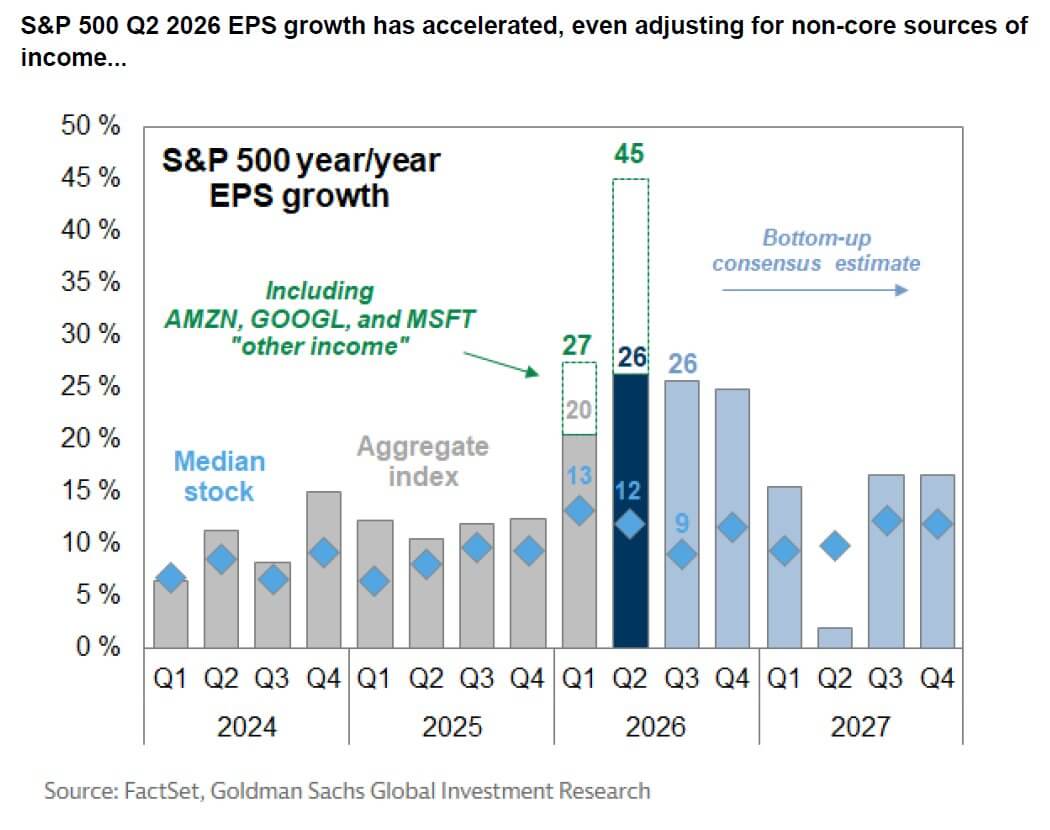
Year-on-year EPS growth for the S&P 500 is estimated at as much as 45% in the second quarter of 2026, well above the pre-earnings season consensus (22%). Excluding the one-off effect of US$151 billion in ‘other income’ from Alphabet and Amazon relating to capital investments, earnings growth still stands at a solid 26 per cent — the fastest pace since 2021 and an acceleration compared with the first quarter. This level of profit growth, driven mainly by hyperscalers investing in AI infrastructure, partly offsets the risk of rising bond yields. Source: Goldman Sachs