S&P 500 — US Large Cap Index
 FTSE 100 — UK Blue Chips
 Euro Stoxx 50 — Eurozone Leaders
 DAX 40 — German Equities
 CAC 40 — French Market Index
 Nikkei 225 — Japan Benchmark
 Hang Seng — Hong Kong Index
 Shanghai Composite — China Mainland
 ASX 200 — Australian Market
 TSX Composite — Canada Index
 Nifty 50 — India Large Cap
 STI Index — Singapore Market
 KOSPI — South Korea Index
 Bovespa — Brazil Equities
 JSE Top 40 — South Africa Index
 IPC Index — Mexico Market
The US100 confirms yesterday’s bearish scenarino. What’s next ?


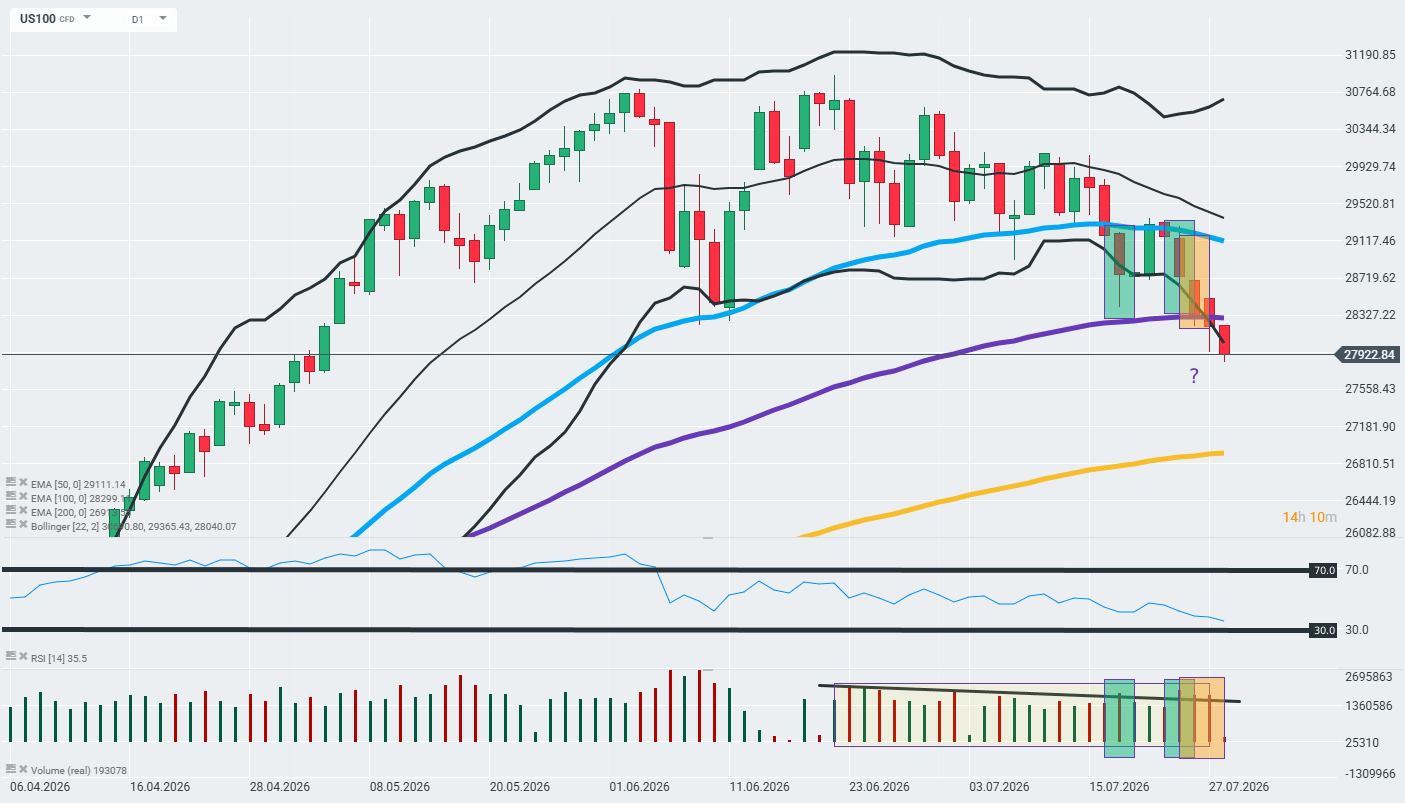
The US100 is confirming the bearish scenario that emerged the previous day – the index has broken down from its consolidation range, breaching the support at the 100-day EMA and falling below the 28,000-point level, which technically paves the way for a potentially deeper correction.
Source: xStation
Monday’s trading session and the chip sell-off
Monday’s trading session on Wall Street saw most stock market indices fall, despite a lull in the conflict in the Middle East. The US100 futures contract closed the day down 1 per cent, dragged down by a sharp sell-off in semiconductor stocks. Nvidia lost around 5 per cent, which served as the immediate trigger for a much more severe market shake-up in Asia the following day, i.e. today.
The crash on the Kospi and the reaction in the futures market
On Tuesday morning, South Korea’s Kospi index fell by as much as 10 per cent, triggering two ‘sidecar’ trading halts on both the main index and the technology-focused Kosdaq, with SK Hynix and Samsung Electronics losing around 10–12 per cent respectively. The panic stemmed from concerns about the sustainability of the artificial intelligence boom and growing competition from Chinese memory manufacturers, which had a direct impact on Nasdaq 100 futures, which at their lowest point fell by as much as around 1%. Japan’s Nikkei 225 closed 3.95 per cent lower, whilst China’s CSI 300 lost 2.83 per cent, confirming the regional – rather than isolated – nature of the sell-off in the technology sector.
Technical chart following a break below
The US100 daily chart shows a clear deterioration in the structure – following a series of unsuccessful attempts to retest the EMA50 (29,111) last week, the index broke through the EMA100 support level (28,299) and slumped to 27,922, which is well below the lower boundary of the previous consolidation zone. The latest red candle is long and lacks a significant lower shadow, confirming the continuation of the pattern already evident on Friday – supply is dominating with no signs of immediate buying at lower levels, whilst the volume accompanying the decline remains relatively high compared to previous consolidation sessions. The RSI has fallen to 35.5, approaching the oversold zone, although it is still not generating a clear reversal signal. If the downtrend persists, the 200-day EMA – which has not been tested since April – could be another interesting technical level to watch.
Key risk factors for this week
The market is entering the most important week of July with heightened nervousness, as, in addition to the crash in Korea, there are three other significant catalysts on the horizon.
- The Fed’s decision on Wednesday – the market is pricing in a hold on interest rates, but futures are already indicating a roughly 38 per cent chance of a rate rise in September, which, with the chip sector weakening, is further weighing on the valuations of growth stocks.
- Mega-cap results – Microsoft and Meta are due to report on Wednesday evening, whilst Amazon and Apple will report on Thursday; the key factor will be the scale of further growth in the hyperscalers’ capital expenditure on AI.
- The consumer confidence report and the results from Coca-Cola, UPS, Corning and Boeing, due to be published today before the US market opens, will provide further macroeconomic context.
- Geopolitical situation – Brent crude prices remain below US$90 per barrel thanks to a lull in the US-Iran conflict, whilst the yield on 10-year US government bonds has fallen back to around 4.65 per cent, which in theory should be supportive of the equity market, were it not for the sell-off in the chip sector.