S&P 500 — US Large Cap Index
 FTSE 100 — UK Blue Chips
 Euro Stoxx 50 — Eurozone Leaders
 DAX 40 — German Equities
 CAC 40 — French Market Index
 Nikkei 225 — Japan Benchmark
 Hang Seng — Hong Kong Index
 Shanghai Composite — China Mainland
 ASX 200 — Australian Market
 TSX Composite — Canada Index
 Nifty 50 — India Large Cap
 STI Index — Singapore Market
 KOSPI — South Korea Index
 Bovespa — Brazil Equities
 JSE Top 40 — South Africa Index
 IPC Index — Mexico Market

The start of the week was dominated by news regarding the suspension of hostilities between the US and Iran. 🌍 Geopolitics The night from Thursday to Friday was, for the moment, the last to see bombardment from the US. The suspension of airstrikes reportedly results from warnings by American advisors regarding dwindling targets and weapon stockpiles. On Sunday, this was confirmed by the US Ambassador to the UN, Mike Waltz. He emphasised that the pause was intended to “give diplomacy some space”. That same day, President Trump reported that talks were indeed underway:
- “We are talking to them right now. I think they are becoming more serious every day. We are ready for action, but we are talking to them.”
Tonight, he even mentioned that these are “good talks”. At the same time, as we have become accustomed to, he noted that if the negotiations fail, the US “will return to doing what it was doing”. The spokesperson for the Iranian Foreign Ministry, Esmail Baghaei, presents the situation slightly differently, claiming there is currently no direct dialogue between Iranian and US officials. Tehran has, however, confirmed that it is conducting talks with Oman, a key mediator in the conflict. Their goal is to establish “mechanisms for maritime traffic” in the Strait of Hormuz. For now, as Baghaei stated, “there is no change in the status of navigation through the Strait of Hormuz”. Tehran declared it would halt retaliation “as long as the US maintains the pause”.
🛢️ Energy commodities
The Strait of Hormuz remains effectively closed (according to Kpler data, vessel traffic is limited to a maximum of a dozen or so per day, compared to approximately 80-140 in standard conditions), and the parties remain far from an agreement regarding uranium enrichment.
- Brent crude is currently priced at approximately 88 dollars, and WTI at 82 dollars. This represents a decline of 15% and 12% respectively compared to Thursday’s peaks.
- Gas on the Dutch TTF exchange is also falling, with the September contract indicating a price of 58 dollars per MWh. For NATGAS, it is 2.75 dollars per MMBtu.
📈 Stocks
The significant decline in energy commodity prices has led to a marked improvement in market sentiment globally. Monday closed in the green primarily for European markets, led by the German DAX (+1%) and the Spanish Ibex 35 (+0.8%). The situation in the United States was less unambiguous. The Dow Jones ended the day 0.5% higher, the S&P 500 closed flat, and the Nasdaq 100 recorded a 0.2% decline. This disparity is primarily due to poor performance in semiconductor sector companies, which gave back some of their recent gains. Sandisk lost 11.3% yesterday, ASML 5.4%, Nvidia 5%, and Seagate 4%. Due to Nvidia’s continued declines, Apple has taken the position of the company with the highest market capitalization (4.95 trillion dollars). Figure 1: Winners and Losers of the Day in the Nasdaq 100 (27.07.2026)
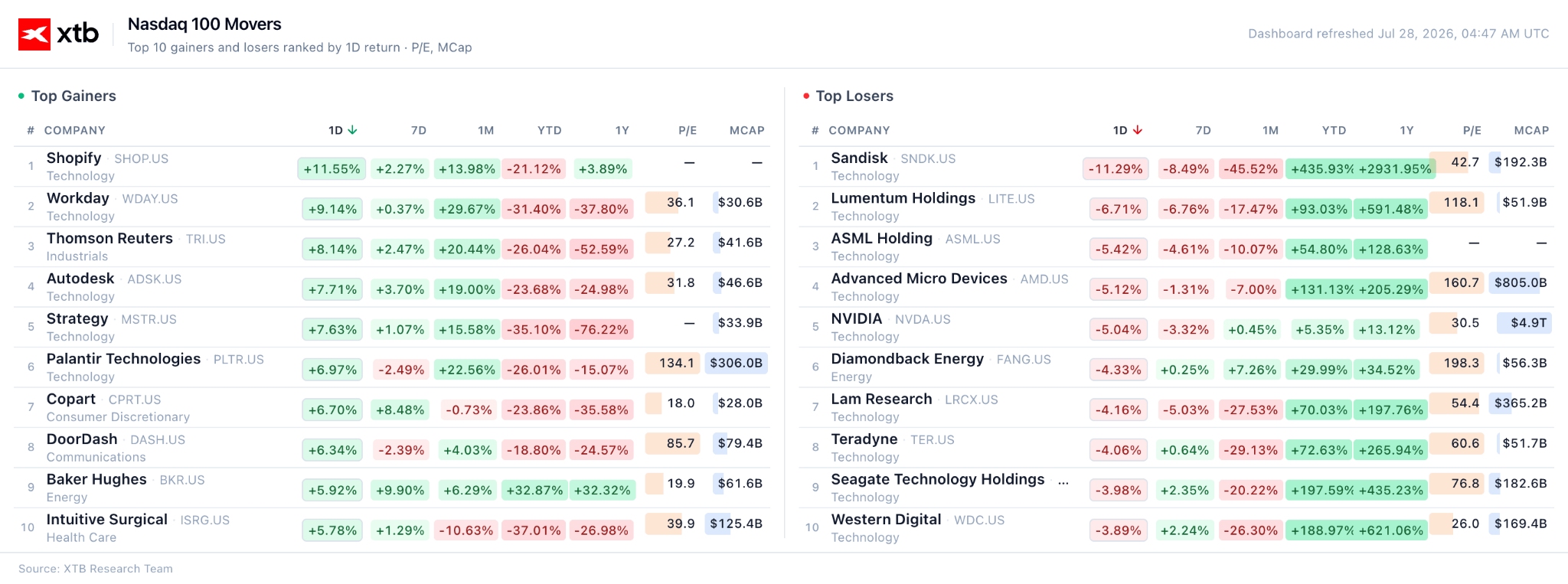
Source: XTB Research, 28.07.2026 The movement can partly be seen as profit-taking ahead of the publication of results by subsequent hyperscalers. However, information about progress in the construction of proprietary semiconductor production machinery by Chinese manufacturers may also have been significant in this context. Technology such as DUV (Deep Ultraviolet Lithography), fundamental to the production of advanced chips, is reportedly being developed.
🌏 Asia
The sell-off in the semiconductor sector did not bypass Asia. The Korean KOSPI index weakened by over 10%. Declines were led, naturally, by Samsung (-13.2%) and SK Hynix (-7.5%). The Japanese Nikkei 225 (-4.3%) and the Chinese Shanghai SE Composite (-1.3%) were also in the red. The Hang Seng was slightly above the line (+0.2%).
🧈 Precious metals
It is difficult to determine a clear direction for precious metal prices. Initially, after the market opened on Monday, both gold and silver posted gains. However, they gave these back in the latter part of the day (despite the decline in 10-year bond yields in major economies). Today, both metals are continuing their downward movement.
- Gold is at approximately $4045 per troy ounce (a decline of 0.8% since the start of the day), and silver at $57.2 (-2.1%).
📈 Macroeconomic data and monetary policy
Yesterday’s data publications were not numerous. Things will get more interesting in the second half of the week due to inflation data from European countries and the US (in this case, we are talking about PCE inflation, which is delayed by one month). However, the central focus this week will be the meetings of the largest central banks. On Tuesday, the Fed will make a decision on interest rates, on Thursday the BoE, and on the night from Thursday to Friday the BoJ. We do not expect any changes to interest rates from any of the banks. All, however, should present a hawkish rhetoric, guiding markets towards a hike at the next meeting (which, for each bank, is currently the base case scenario).
Germany
- The Ifo business climate index in Germany rose to 86.6, and business expectations also jumped (to 86.7). We did not see improvement in the current situation assessment. The data is largely consistent with recent PMI indicators, which suggest some improvement in the economic situation, especially in the industrial sector.
United States
- Durable goods orders increased in June by 0.3% month-on-month, significantly slower than expected (2.5%). Markets were hoping for a clearer rebound after the 4% decline in May. The poorer reading is mainly a matter of weaker demand in the transport sector. Orders for core capital goods proved solid, which somewhat calmed the mood. Moreover, growth in spending on AI-related issues was visible; the biggest drivers of the rebound in June were computers and electronic equipment (+3.1% m/m). The situation also looked decent regarding base metals (+1.1% m/m) and electrical equipment and appliances (+0.9% m/m).