S&P 500 — US Large Cap Index
 FTSE 100 — UK Blue Chips
 Euro Stoxx 50 — Eurozone Leaders
 DAX 40 — German Equities
 CAC 40 — French Market Index
 Nikkei 225 — Japan Benchmark
 Hang Seng — Hong Kong Index
 Shanghai Composite — China Mainland
 ASX 200 — Australian Market
 TSX Composite — Canada Index
 Nifty 50 — India Large Cap
 STI Index — Singapore Market
 KOSPI — South Korea Index
 Bovespa — Brazil Equities
 JSE Top 40 — South Africa Index
 IPC Index — Mexico Market

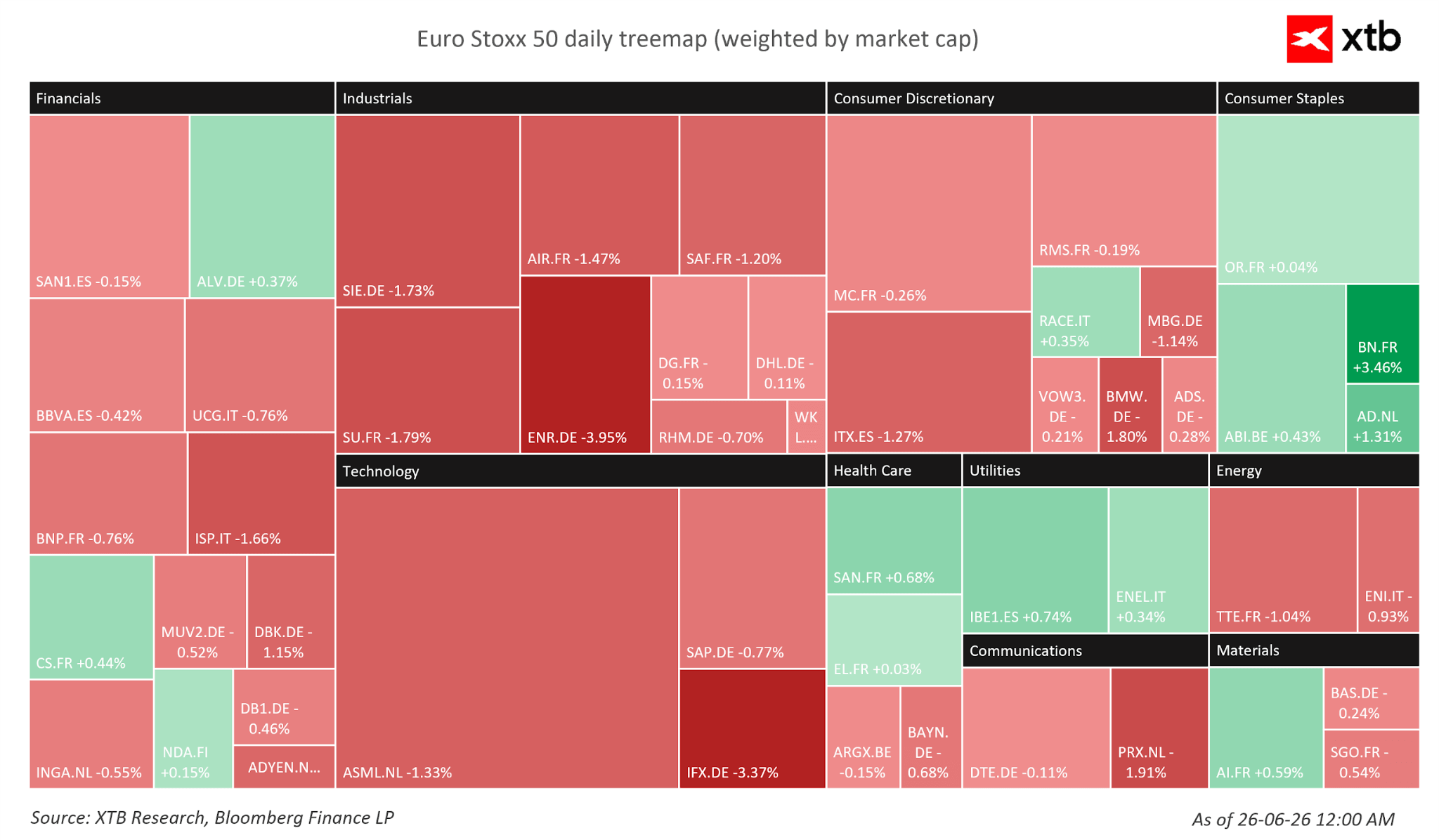
Chip and advanced technology manufacturers are recording declines on trading floors in Frankfurt, Paris, and Amsterdam. European sector leaders such as ASML and Infineon are following in the footsteps of American giants. Negative sentiment is also enveloping companies in the automotive and heavy industry sectors. Figure 1: Sector Heatmap in Euro Stoxx 50 (26.06.2026)
Source: XTB Research, 26.05.2026
With the cooling of the USA-Iran conflict, speculative enthusiasm surrounding companies in the broadly defined AI ecosystem is fading. Increasingly, it takes more to meet the very high expectations of investors, and billion-dollar outlays on infrastructure and data centres are being verified with greater scrutiny. Furthermore, the second quarter, which was exceptionally successful for the tech sector, is coming to an end. Due to rebalancing, especially in institutional and balanced funds, the final days of June may be demanding for the companies that have performed best in recent months. Fund managers are often compelled to restore the appropriate portfolio structure (e.g., 60% equities, 40% bonds), which partly explains the recently recorded price increases for government bonds of the world’s largest economies.
Companies
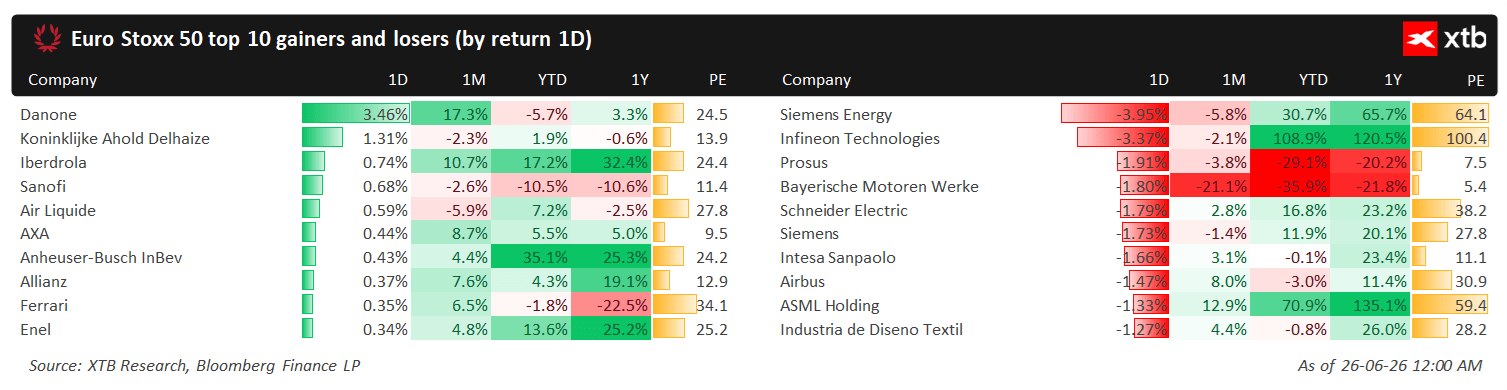
While as recently as yesterday, following the publication of results far better than expected by Micron, we wrote about the significant strengthening of Infineon Technologies and ASML, today both companies are among the biggest losers, recording declines of 3.4% and 1.3%, respectively. Figure 2: Winners and losers in Euro Stoxx 50 (26.06.2026)
Source: XTB Research, 26.06.2026
German giants are also losing ground – Siemens (-4%) and BMW (-1.8%), the latter of which has weakened by over 20% on a monthly scale. The sharp decline in the share price of the Bavarian automotive manufacturer is largely due to a slump in sales in China (down as much as 18% year-on-year). Chinese consumers are mass-migrating to domestic, local electric vehicle brands such as BYD, Xiaomi, and Li Auto.
Indices
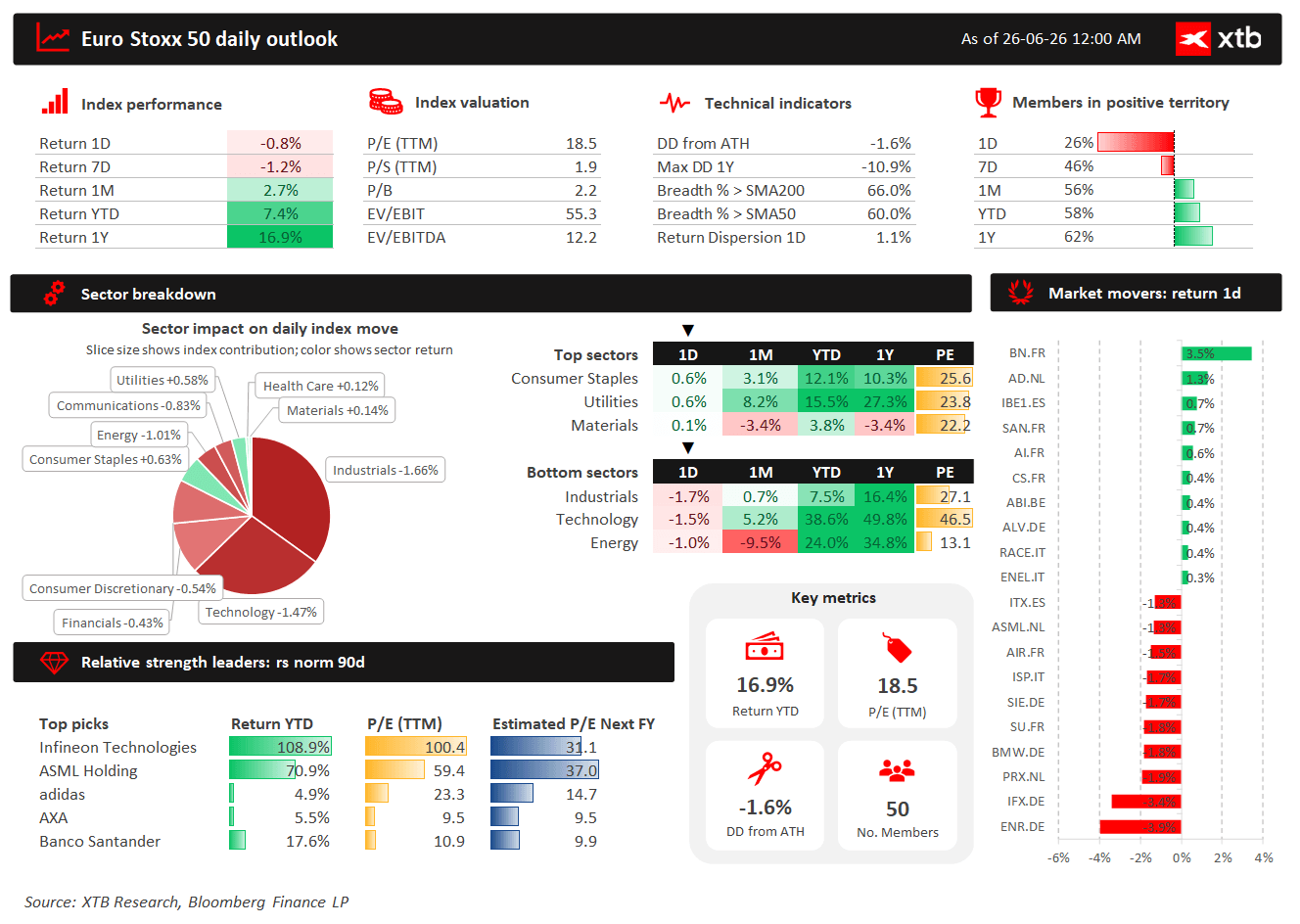
It is not only the pan-European Euro Stoxx 50 that is falling (-0.8%). The German DAX (-1.2%), French CAC40 (-0.8%), Italian FTSE MIB (-1.3%), and Polish WIG20 (-1.6%) are also flashing red. Figure 3: Dashboard for Euro Stoxx 50 (26.06.2026)
Source: XTB Research, 26.06.2026 Futures contracts also suggest that the US stock market should open in the red.
Energy Commodities
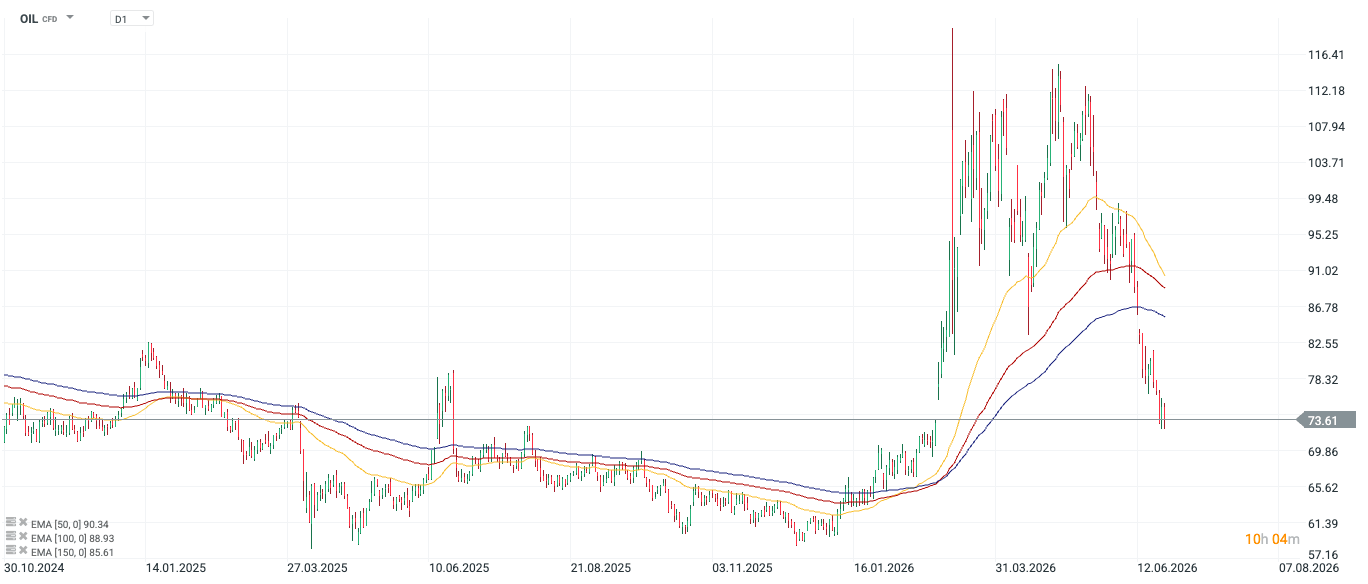
According to the words of the US Secretary of Energy, Chris Wright, an average of approximately 72 vessels have passed through the Strait of Hormuz over the past few days, transporting nearly 20 million barrels of crude oil per day. Kpler, a company specialising in analytics regarding the global commodities and maritime transport market, also reports that 70 vessels passed through the strait on 24 June. This is still about half as much as before the outbreak of the war, yet the trend is clearly upward, which may explain further price declines.
- We currently pay just over $73 for a barrel of Brent crude oil.
- The cost of a WTI barrel is approximately $70.
Figure 4: OIL [D1] (30.10 – 26.06)
Source: xStation, 26.05.2026