S&P 500 — US Large Cap Index
 FTSE 100 — UK Blue Chips
 Euro Stoxx 50 — Eurozone Leaders
 DAX 40 — German Equities
 CAC 40 — French Market Index
 Nikkei 225 — Japan Benchmark
 Hang Seng — Hong Kong Index
 Shanghai Composite — China Mainland
 ASX 200 — Australian Market
 TSX Composite — Canada Index
 Nifty 50 — India Large Cap
 STI Index — Singapore Market
 KOSPI — South Korea Index
 Bovespa — Brazil Equities
 JSE Top 40 — South Africa Index
 IPC Index — Mexico Market
Intraday USD correction, but UBS sees the greenback regaining a new trend — what’s next for EUR/USD?


hursday’s and Friday’s trading sessions saw a sharp rebound in the EUR/USD pair, which is now attempting to consolidate above 1.14 after a series of strong bullish daily candles in recent weeks pushed the dollar to levels not seen since May 2025. Meanwhile, UBS analysts take the opposite view—arguing that the current weakness of the USD is a temporary phenomenon, not a structural one.
UBS vs. the Market — A Discrepancy in Narratives
UBS lowered its forecast for the EUR/USD exchange rate at the end of 2026 to 1.12 from the previous 1.14 , signaling that the bank expects the current trend to reverse. This view is based on a reassessment of U.S. interest rate expectations—the market is beginning to price in the possibility that the Fed may maintain a restrictive monetary policy for longer than previously anticipated. UBS notes that the DXY index has the potential to test the 102 level, which was last seen in May 2025. Although long positions in the dollar have increased, the bank assesses that they are far from the extreme levels seen in 2024—which means there is still room for further USD buying.
Fed vs. ECB — The Divergence Persists
The key driver for the EUR/USD pair remains the divergence in monetary policy on both sides of the Atlantic.
The Fed —despite some market expectations of rate cuts—maintains a hawkish stance, emphasizing the resilience of the U.S. economy and labor market.
The ECB , in turn, is continuing its easing cycle, and further rate cuts are almost fully priced in by the market for the second half of the year. This asymmetry naturally favors the dollar over the euro in the medium term. Today’s rebound in EUR/USD can therefore be interpreted as a technical correction following an extremely rapid move, rather than a change in the pair’s fundamental outlook.
Technical Context and Carry Trade
It is worth noting that, in the same analysis, UBS points to the Swiss franc as a currency that may weaken in the short term due to its growing role as a carry trade funding currency—which indirectly supports risk appetite and may temporarily curb the dollar’s strength. The Australian dollar’s target was lowered to 0.68 from 0.74 , reflecting the global context: weaker macroeconomic data outside the U.S. and narrowing interest rate differentials are boosting the greenback against commodity and emerging-market currencies.
Technical Analysis: EURUSD D1
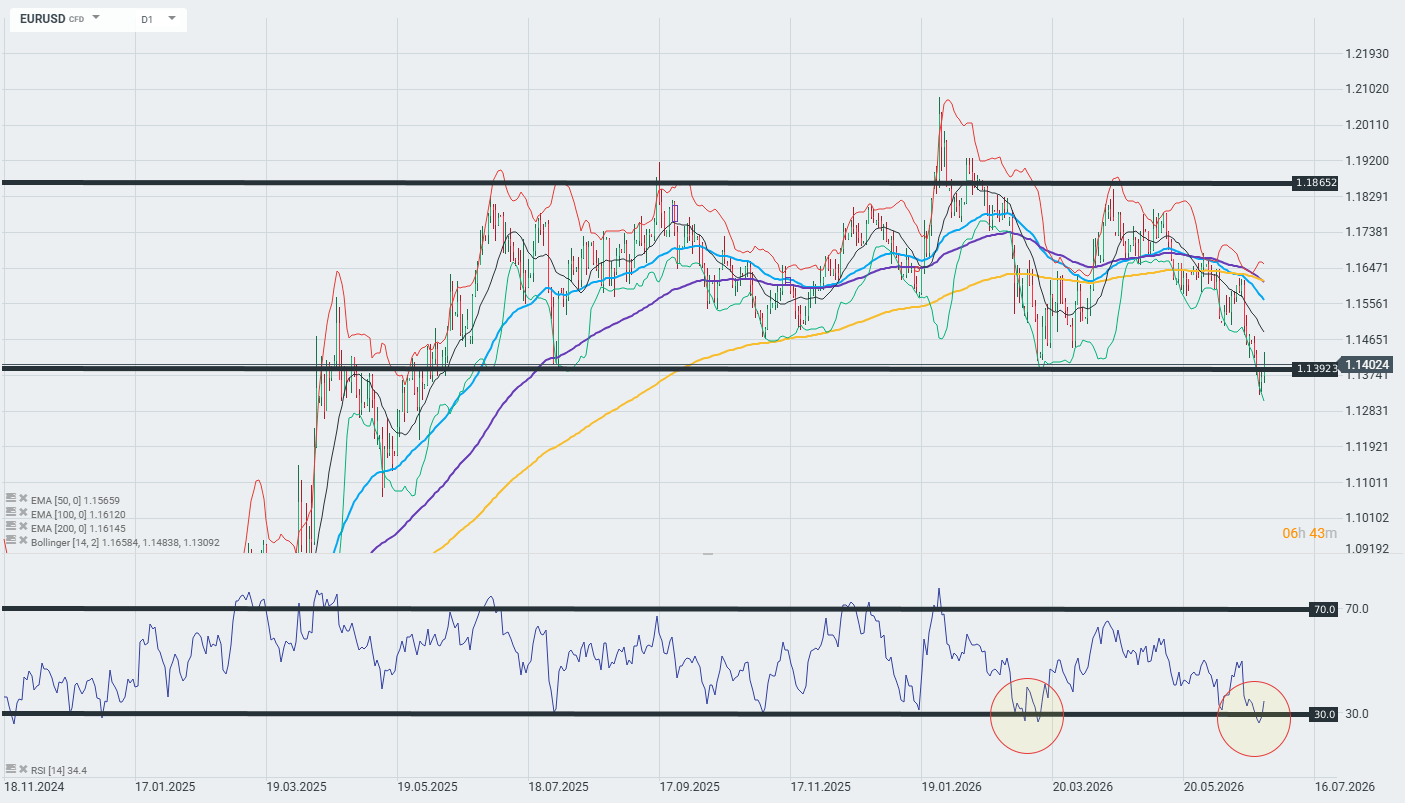
The pair is currently testing a key level at 1.1392—a break below or above this level could determine the pair’s trajectory for the coming sessions. On the upside, resistance comes from the 50/100/200 EMAs clustered around 1.1560–1.1615. The RSI, at 34.4, is approaching the oversold zone (30)—similar to February 2026—which could trigger a short-term technical rebound. Nevertheless, as long as the pair does not close the day clearly above 1.1392, technical analysis favors a continuation of the downtrend. It is worth noting, however, that the pair has been highly volatile in recent days, so price movements may remain chaotic in the near term.