S&P 500 — US Large Cap Index
 FTSE 100 — UK Blue Chips
 Euro Stoxx 50 — Eurozone Leaders
 DAX 40 — German Equities
 CAC 40 — French Market Index
 Nikkei 225 — Japan Benchmark
 Hang Seng — Hong Kong Index
 Shanghai Composite — China Mainland
 ASX 200 — Australian Market
 TSX Composite — Canada Index
 Nifty 50 — India Large Cap
 STI Index — Singapore Market
 KOSPI — South Korea Index
 Bovespa — Brazil Equities
 JSE Top 40 — South Africa Index
 IPC Index — Mexico Market
Lululemon Under Fire: Burry Bets on the Fallen Giant, but the Market Says “No”


Key takeaways
- Lululemon shares have fallen by 20 per cent following the worst results in the company’s history.
- Michael Burry, the legendary investor from *The Big Short*, has announced aggressive buying.
- Who is right?
Lululemon Athletica (LULU) shares fell nearly 20% on Friday, hitting their lowest level in eight years, after the Canadian athletic apparel maker cut its annual forecast for the second time this year and reported its first-ever simultaneous decline in comparable sales across all key markets. The company, which just two years ago was a Wall Street darling, is now trading around $100 per share — 81% below its all-time high.
Results That Spooked the Market
In the second fiscal quarter of 2026, Lululemon’s revenue fell 4.3% year-over-year to $2.42 billion, disappointing analysts who had expected $2.46 billion. Comparable sales (comp sales) contracted by 9% — significantly worse than the consensus estimate of a 6.2% decline. Adjusted earnings per share came in at $2.06 after tariff refund adjustments, beating expectations ($1.79), but the market ignored the positive margin surprise, focusing instead on what really hurts: customers are turning away from the brand. North America, the company’s largest market, saw revenue decline 8%, with comparable sales plunging 12%. Mainland China — until recently the growth engine with +24% momentum a year earlier — shocked with an 8% decline on a constant currency basis, versus market expectations of nearly 8% growth. That’s a sequential collapse of 2,100 basis points in just one quarter.
Leggings No Longer Sell Themselves
Interim CEO Meghan Frank acknowledged on the earnings call that global sales of women’s leggings — accounting for over 20% of the company’s revenue — fell 20% in the quarter. New collections are meeting with an “inconsistent” response from customers, and key product categories are losing their appeal. It’s worth noting that women’s leggings, the company’s flagship product, account for over 20% of total revenue (it used to be even more when the company focused exclusively on this category). “The overall response to our product launches remains inconsistent, and we’ve continued to see pressure on the brand in both of our largest markets,” Frank said. Management pointed to several factors weakening the brand: negative social media buzz surrounding the proxy battle with founder Chip Wilson, the Texas Attorney General’s investigation into PFAS substances in the company’s products, and in China — a controversial marketing campaign on the Great Wall featuring a Japanese taiko drum, which triggered a wave of criticism among Chinese consumers.
Guidance Slashed to the Bone
Lululemon drastically lowered its expectations for the full fiscal year 2026:
- Revenue: $10.35–$10.50 billion (a 5–7% decline), down from previous guidance of $11.0–$11.15 billion
- Earnings per share: $9.48–$9.73, down from previous guidance of $10.95–$11.15
- Q3: revenue expected to decline 10–11%, with EPS of just $0.93–$0.98 — 60% below the market consensus of $2.37
At least 12 brokerages cut their price targets on Friday.
Burry Goes Against the Grain
Standing in stark contrast to the market panic is Michael Burry — the investor famous for betting against subprime mortgages in 2008, immortalized in the film “The Big Short.” Burry announced that Lululemon is his largest portfolio position and pledged to buy aggressively below $100. “Lululemon is the trickster in my portfolio. This time the trickster is my largest position, and it does seem determined to take me where mermaids fear to tread,” Burry wrote on his blog, drawing a comparison to his earlier investment in Tailored Brands, which ended in the company’s bankruptcy. Burry also suggested that a potential long-term scenario for Lululemon could be a private equity takeover — which, for a company with a strong brand but weak operational management, would not be unprecedented in the industry.
New CEO Walks Into a Fire
New CEO Heidi O’Neill will officially take the reins next week, stepping into the role at one of the most challenging moments in the company’s history. Analysts expect her to quickly present a turnaround plan, but warn that rebuilding a premium brand is a process measured in quarters, not weeks. “Lulu is a powerful brand but an overstretched one,” said Simeon Siegel of Guggenheim. “It needs to return to what made it special, but that’s hard — because appealing to everyone means moving past what made it so specialized.” Morningstar analyst David Swartz expects a slowdown in store expansion, cost cuts, and a possible “operational realignment.” The company also needs to win back customers who have defected to competitors — brands like Alo Yoga and Skims.
Valuation Is Tempting, but Risk Remains
At its current price, Lululemon trades at a price-to-earnings ratio of approximately 11.5x — well below Nike (20.8x) and Adidas (13.4x). For value investors like Burry, that’s a signal of opportunity. For the market — it’s a signal that something is fundamentally wrong. The key question is: is the decline in comparable sales a temporary problem fixable by new management, or the beginning of a permanent erosion of premium brand value? When a premium brand starts posting negative comps, the market begins pricing in a permanent decline in brand value. That’s a much harder narrative to reverse. The stock has virtually never faced a selloff wave of this momentum in its history. The $100 per share price was last seen in 2018.
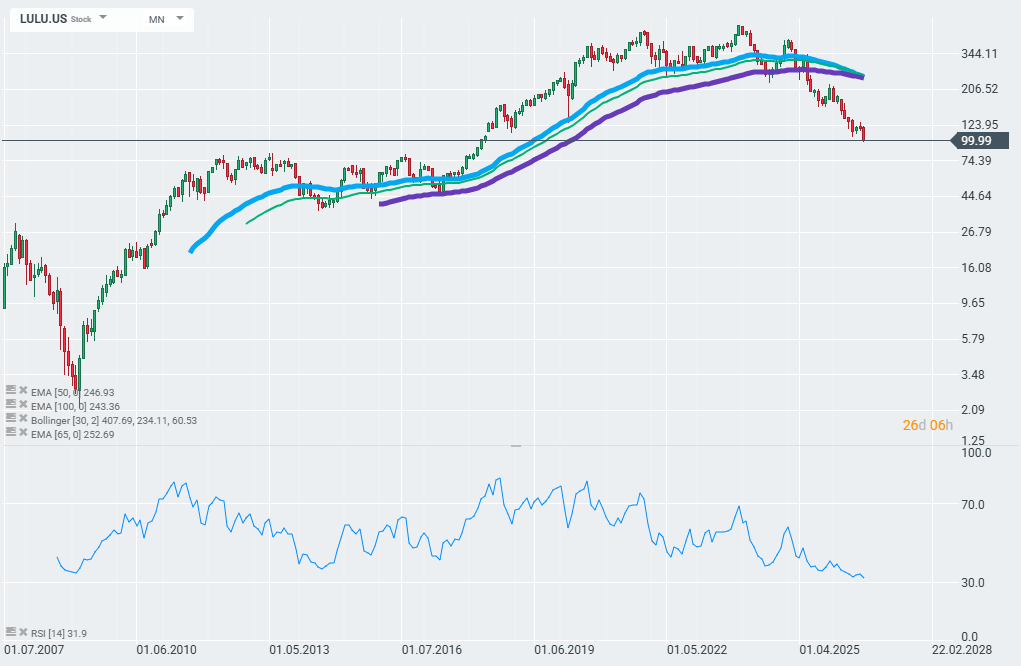
Source: xStation