S&P 500 — US Large Cap Index
 FTSE 100 — UK Blue Chips
 Euro Stoxx 50 — Eurozone Leaders
 DAX 40 — German Equities
 CAC 40 — French Market Index
 Nikkei 225 — Japan Benchmark
 Hang Seng — Hong Kong Index
 Shanghai Composite — China Mainland
 ASX 200 — Australian Market
 TSX Composite — Canada Index
 Nifty 50 — India Large Cap
 STI Index — Singapore Market
 KOSPI — South Korea Index
 Bovespa — Brazil Equities
 JSE Top 40 — South Africa Index
 IPC Index — Mexico Market

Key takeaways
- Continued hostilities in the Middle East leads to another day of gains for oil
- Stocks in Europe are under pressure
- OECD cuts global growth outlook, and calls out the biggest threat to the AI trade
- AI rally meets economic reality
- Dollar gets a boost from rising Middle East tensions
- US labour market data in focus
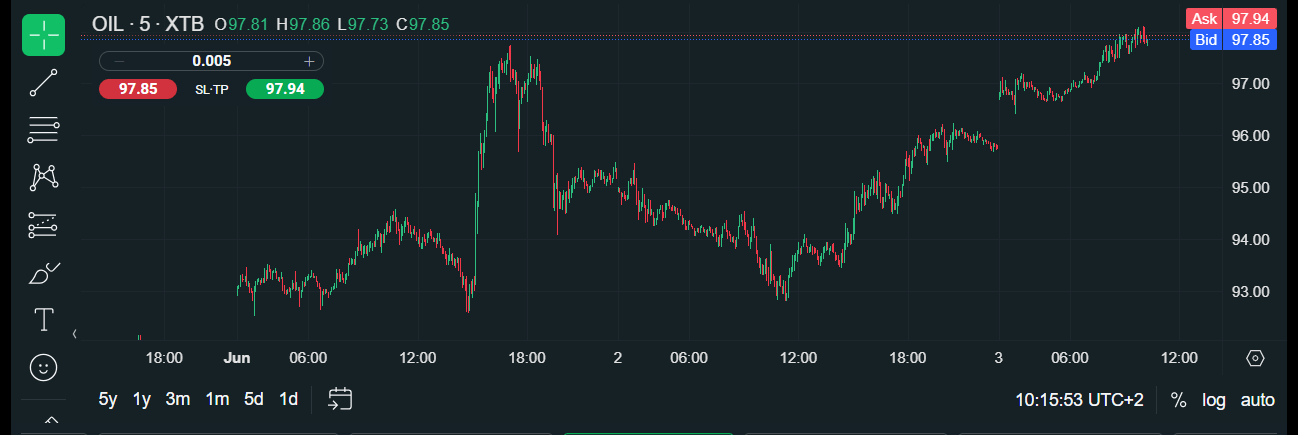
Stock indices in Europe are buckling under the news that fresh Iranian strikes have hit parts of the Gulf, as hostilities flare in the region once more. The oil price is higher by 2% and Brent crude is back above $97 per barrel, as diplomatic efforts to end the war look like they are on pause. It is unclear if talks to end the war and reopen the Strait are ongoing, but the latest developments suggest that investors may have been too quick to price in the impact from last week’s promised Memorandum of Understanding between Iran and the US. As we enter the start of the fourth month of the conflict, there are clear signs that the energy price spike is becoming embedded in the global economy.
This week’s PMI surveys for May suggest that elevated levels of inflation are passing through the manufacturing sector, all eyes will be on the service sector data to see if there are second round effects from the energy price spike, which could impact the future direction of central bank policy. Tuesday’s Eurozone CPI report for last month showed headline inflation rising to 3.2% and core inflation rising to 2.5%.
While this is roughly in line with ECB expectations from March, a rate hike from the ECB is now almost a certainty. The interest rate futures market is currently pricing in a 96% chance of a hike from the ECB on 11th June. The OECD has also cut its global growth outlook for this year, which is weighing on sentiment. It expects global growth to slow to 2.8%this year, down from 3.4% last year, but it also warned that a prolonged closure of the Strait of Hormuz, that lasts beyond this month and into 2027, could trigger a much worse outcome for the global economy, with growth of 2.1% this year and a mere 1.8% next year.
This could tip some countries into recession, and cause unemployment rates to rise. The OECD also said that investment, including in energy-intensive AI, could weaken significantly, which would inevitably lead to stock price losses for highly valued tech names. This is a timely warning: the AI trade has been extremely resilient to geopolitical risks this year, but the OECD is reminding us that this may not last. Although the OECD has laid out its worst-case scenario, the failure of diplomacy to reach a deal and reopen the Strait of Hormuz could, unsurprisingly, lead investors to price in this worst-case scenario in the coming days.
The OECD also reiterated what central bankers have been talking about in recent weeks: even with a deal, it will take some time to restore energy markets and for growth and inflation levels to return to their pre-war trends. European markets are lower this morning, the Dax, which is highly correlated to global growth expectations, is down 0.7%, while the FTSE 100 is only moderately lower as it benefits from a recovery at Howden’s, which fell on Monday.
The joinery group announced a £390mn takeover of online kitchen maker DIY Kitchens, which has pushed up the stock price by more than 2% on Wednesday and it is the top performer on the FTSE 100. The UK’s index is also benefitting from a higher oil price and both BP and Shell are higher today. The market is digesting a 6% rise in the price of Brent this week. The ongoing crisis in the Middle East is also pushing up the USD. USD/JPY was close to 160.00 earlier on Wednesday, before backing away from this level.
This pair has dropped 30 points so far this morning, as official Japanese intervention looms around 160.00. US stocks have been some of the top global performers this week, behind the Japanese Nikkei and the Korean Kospi index. However, futures suggest that they may pull back slightly today. Investors may heed the warning about AI investment from the OECD, especially after Marvell rose 32% on Tuesday, on the back of Nvidia CEO, Jensen Huang, saying that it will be the next trillion dollar company. It currently has a market cap of $254bn, so it is some way off a trillion-dollar valuation, but after Micron surged to this level, it is not beyond the realm of possibilities, especially if the Strait of Hormuz is reopened this month and the price of energy comes down. Ahead today, it won’t just be Jensen Huang whose predictions can move markets, the focus will also be on the latest jobs data. ADP private sector employment will be the highlight.
This is expected to rise to 117k, however, any upside surprise could trigger concerns that the Fed will formally shift away from their easing bias at this month’s meeting. So far this week, strong Jolts job openings data has added to upside pressure on Treasury yields, which is also boosting the dollar. If we see another strong month of payrolls on Friday, then rising yields could pose a big problem for the continuation of stock market gains.
Chart 1: Brent crude oil price
Source: XTB